13
5. Photomicrographic Procedure
• To ensure vibration free operation, set the microscope on a
sturdy vibration free table or a bench with a vibration proof
device.
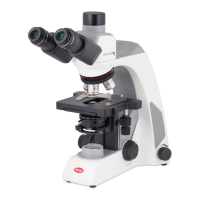
• Pull the optical path selection lever of the trinocular eyepiece
tube all of the way out to the limit, the ratio of light entering
the observation tube and phototube will be 20:80.
• For the same total magnification, select a combination of the
highest possible objective magnification and lowest possible
projection lens magnification to achieve the utmost image
definition and contrast.
• To ensure optimal illumination, check the position and cen-
tring of the lamp and position of the condenser.
• Select a blue filter for routine application. An additional
colour-compensating filter can also be used depending on the
colour rendition.
• Adjusting the field diaphragm is important for the purpose
of limiting extraneous light that may cause flare and lower the
contrast. Stop down the diaphragm to achieve an illuminated
area slightly larger than that of the field of view.
• A change of depth of focus, contrast and resolution of image
is attainable with an aperture setting that is 2/3 of the objec-
tive N.A.
6. Using Oil Immersion Objectives
• Oil immersion objectives are labelled with the additional
engraving “Oil” and are to be immersed in oil between the
specimen and the front of the objective.
• The immersion oil supplied by Motic is synthetic, non-fluo-
rescing and non-resining oil, with a refractive index of 1.515
• Normally, cover glass must be used with oil immersion objec-
tives with a few exceptions.
Deviations from thickness are not important as a layer of im-
mersion oil acts as compensation above the cover glass.
• The small bottle of oil supplied with every immersion objec-
tive facilitates application of the oil to the cover slip.
• Remove any air bubbles in the nozzle of the oil container
before use.
• Immersion oil must be used sparingly. After the examination,
the oil should be wiped off the objective with a lens cleaning
tissue and the residual film removed with soft cloth moistened
with petroleum benzine or absolute alcohol.
• Locate the field of interest, with a lower magnification objec-
tive, swing the objective out of the light path, and add one drop
of immersion oil over the site of the specimen. Swing in the oil
immersion objective. Use the fine focus to make the image sharp.
• Freedom from air bubbles must be ensured. To check for air
bubbles, remove an eyepiece, fully open the field and aperture
diaphragms, and look at the exit pupil of the objective within the
eyepiece tube. Air bubbles are recognized by presence of a sur-
rounding black ring. Bubbles may often be dislodged by moving
the slide to and fro or by slightly rocking the revolving nosepiece
back and forth. If not successful in clearing the bubbles then
the oil must be wiped off and replaced with a fresh drop.


 To Next Page