INFINITY OPTICAL SYSTEM
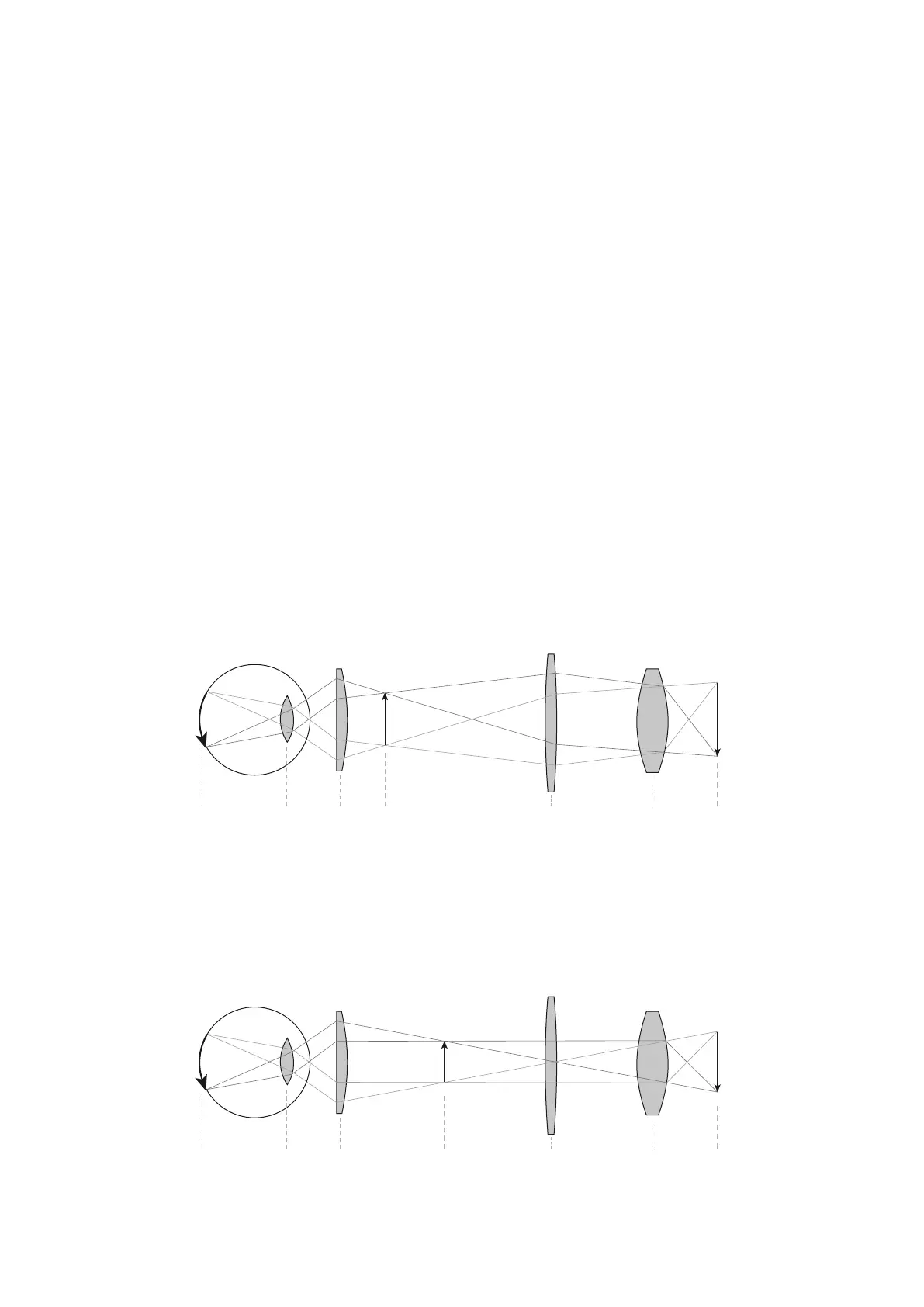
An optical configuration (in which the specimen is located at
the front focal plane of the objective) gathers light transmitted
through or reflected from the central portion of the specimen
and produces a parallel bundle of rays projected along the opti-
cal axis of the microscope toward the tube lens.
A portion of the light reaching the objective originates from the
periphery of the specimen, and enters the optical system at
oblique angles, moving forward diagonally but still in parallel
bundles toward the tube lens. All of the light gathered by the
tube lens is then focused at the intermediate image plane, and
subsequently enlarged by the eyepiece.
The real merit of the infinity based system lies in its ability
to accommodate modular accessories in the optical path and
produce a flexible design.
SpecimenObjectiveTube lensIntermediate
image
EyepieceLens of eyeRetina
Optical System Using Infinity Corrected Objectives
Optical System Of A Conventional Microscope
SpecimenObjectiveTube lensIntermediate imageEyepieceLens of eyeRetina
The conventional microscope has a two-stage magnification
system. There are two lens systems, the objective and the
eyepiece, mounted at opposite end of a body tube. The objec-
tive forms an enlarged real image of the object being examined
and is called intermediate image. The intermediate is further
enlarged by the eyepiece and is seen as a virtual image of the
intermediate image. The eye can examine this final image,
situated at infinity. The total magnification of the microscope is
determined by the focal lengths of the objective and eyepiece.
CONVENTIONAL MICROSCOPE


 To Next Page