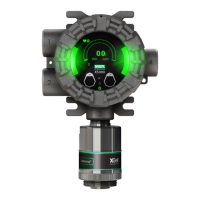
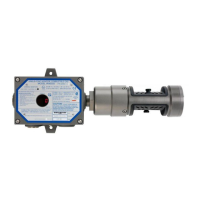
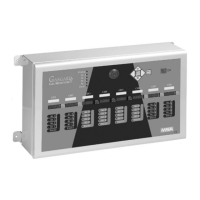
Some toxic gases are provided in a fritless sensor housing. The fritless sensor housing is labeled as Div 2 or Zone 2 and is
approved for Div 2 or Zone 2 installations only. The protection method is Nonincendive or Type n respectively. Ensure all
components are approved for the wiring method being used and in accordance with the National Electrical Code of the country
of use, any applicable local regulations, and this manual.
Failure to follow this warning can result in serious personal injury or death.
3.4.1 Sensor Mounting Location
The best location for the transmitter and the sensor may not be the same location. Sensors should be placed in a location
where a gas leak is most likely to be detected. When the best sensor placement would not allow the transmitter display to be
easily viewed or accessed, a remote junction box can be used to mount the sensor remotely from the transmitter, allowing both
to be installed in the optimum location.
Two main factors should be considered when choosing a sensor location. The first is the density of the target gas relative to
the air. Gases, such as propane, that are heavier than air should be placed near ground level while gases that are lighter than
air should be placed above potential leak sources.
Optimum sensor placement will depend on the surrounding processing equipment, such as pipes, valves, or turbines. MSA
offers a gas and flame mapping service that systematically evaluates potential sources of leaks and recommends detector
quantity and placement to create the most effective detection system.
3.4.2 Transmitter Mounting Location
The transmitter display should be mounted so that the screen is visible and easily accessed after installation. The electronics
assembly inside the enclosure have one orientation inside the cylindrical housing. Take care to position the conduit entries and
display so that the display is read in the correct orientation.
3.4.3 Sensor Orientation
WARNING!
Mount the IR Sensor with the sensor inlet fitting extended horizontally from the main enclosure (see Figure 10 Correct and
Incorrect Mounting Orientations for IR Sensor) to prevent the build-up of particulate or liquid matter on the monitor's optical
surfaces.
Mount the digital sensor with the sensor inlet fitting (see Figure 11 Correct and Incorrect Mounting Orientation for Digital
Sensors) pointed downward; otherwise, the inlet may become clogged with particulate matter or liquids.
Failure to follow this warning can result in serious personal injury or death.
Sensor orientation will depend on the sensor type. If mounting an IRSensor, whether locally on the transmitter or via remote
junction box, the sensor should be mounted horizontally. If the IRSensor is not mounted horizontally, the sensor will be prone
to more frequent beam blocking issues due to accumulated dust and condensation on the surface of the IRSensor. Figure 10
Correct and Incorrect Mounting Orientations for IR Sensor shows the correct and incorrect mounting orientations for the
IRSensor.
16
3 Installation US



 To Next Page