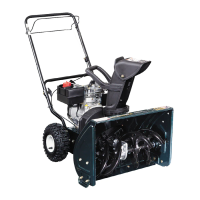
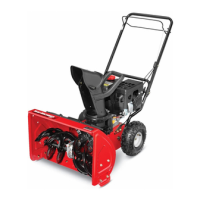
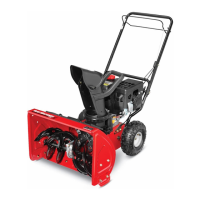
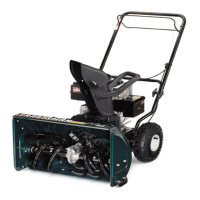
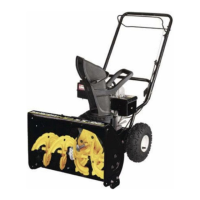
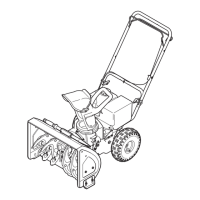
This document is an operator's manual for a single-stage snow thrower, covering models 240, 250, 260, S250, and S260. It provides comprehensive instructions for assembly, safe operation, maintenance, and off-season storage. The manual emphasizes safety throughout, with warnings about potential hazards and proper handling of the equipment.
Function Description
The single-stage snow thrower is designed to clear snow from various surfaces. Its primary function involves an auger/impeller system that draws snow into a housing and expels it through a discharge chute. The rubber paddles on the auger not only collect snow but also aid in propelling the snow thrower forward by making contact with the pavement. This design allows for efficient snow removal, particularly for snow close to the pavement's surface, which is facilitated by a shave plate that maintains constant contact.
The snow thrower is powered by an internal combustion engine, which requires a specific mixture of gasoline and oil. The engine's operation is controlled by several key components, including a choke lever for starting in cold weather, a primer button to inject fuel into the carburetor, and an ignition key to activate the engine. For models equipped with electric start, a button engages the electric starter when connected to a 120V power source via an outdoor extension cord.
Snow is discharged through a chute, which can be rotated left or right using a chute handle to direct the snow stream. The pitch of the discharge chute can also be adjusted upward or downward by loosening a wing knob, allowing the operator to control the angle and distance of snow projection.
Usage Features
Before operation, the manual stresses the importance of thorough preparation. This includes inspecting the area for foreign objects that could be thrown by the auger, wearing appropriate safety gear such as safety glasses and adequate winter clothing, and ensuring proper footwear for slippery conditions. For electric start models, a grounded extension cord and receptacle are required. The collector housing height should be adjusted to clear gravel or crushed rock surfaces, and the control handle must be disengaged before starting the engine. It is also recommended to allow the engine and machine to adjust to outdoor temperatures before clearing snow.
Fuel handling requires extreme caution due to gasoline's flammability and explosive vapors. Operators are warned to use an approved container, extinguish all ignition sources, never fuel indoors or while the engine is hot, and allow the engine to cool before refueling. Overfilling the fuel tank is to be avoided, and any spills must be wiped up, with the machine moved to another area and allowed to sit for five minutes before starting.
During operation, safety is paramount. Operators must never place hands or feet near rotating parts, the auger housing, or the discharge chute. The auger control handle acts as a safety device, engaging the auger when squeezed against the upper handle and disengaging when released. This mechanism should never be bypassed. The machine should not be operated with a missing or damaged discharge chute, and all safety devices must be in place and working. Engine operation indoors or in poorly ventilated areas is prohibited due to carbon monoxide hazards.
When clearing snow, the manual advises planning the snow throwing pattern to avoid discharging material toward roads, bystanders, or windows. Bystanders, helpers, pets, and children should be kept at least 75 feet away. The machine should not be overloaded by attempting to clear snow too quickly. Good visibility and light are essential, and operators must maintain firm footing and a strong grip on the handles, walking rather than running. Caution is advised when operating on or crossing gravel surfaces and when changing direction or operating on slopes.
To engage the auger, the control handle is squeezed against the upper handle. Lifting the handle slightly allows the rubber paddles to contact the pavement and propel the snow thrower forward. Excessive upward pressure on the handle is warned against, as it can lead to premature wear of the rubber auger paddles or damage to the pavement. Once the snow thrower begins to move, a firm hold on the handle should be maintained, guiding the machine along the path to be cleared. To stop the snow throwing action and forward motion, the auger control handle is simply released.
To stop the engine, the ignition key is turned counterclockwise to the OFF position and then removed. After clearing snow, the engine should be allowed to run for a few minutes to dry any moisture, preventing freeze-up of the auger/impeller.
Maintenance Features
Regular maintenance is crucial for the snow thrower's safe and efficient operation. Safety devices should be checked regularly for proper function. Before any cleaning, repairing, or inspecting, the control handle must be disengaged, the engine stopped, and the spark plug wire disconnected and grounded against the engine to prevent unintended starting.
Bolts and screws should be checked frequently for proper tightness, and the machine visually inspected for any damage. Engine governor settings should not be altered, as the governor controls the maximum safe operating speed. Shave plates and skid shoes are wear items and should be checked frequently and replaced with original equipment manufacturer (OEM) parts to ensure proper performance and safety. Controls should also be periodically checked and adjusted as necessary. Safety and instruction labels must be maintained or replaced if damaged.
Lubrication is recommended once every season and before storage. Pivot points on the control handle and the extension spring at the end of the clutch cable should be lubricated with a light oil.
The shave plate, which has two wearing edges, can be reversed or replaced when worn. To adjust or replace it, the snow thrower is tipped back onto its handle, and the lock nuts securing the shave plate to the housing are loosened. The shave plate is then moved to the desired position and retightened, ensuring all four nuts are securely fastened.
The auger's rubber paddles are also subject to wear and should be replaced if signs of excessive wear are present. This involves unthreading the self-tapping screws that secure them to the auger and then securing the replacement paddles with the same hardware.
Replacing the drive belt is necessary if signs of cracking, shredding, or rotting are present. This procedure involves removing the belt cover by unthreading five hex screws, gently grasping and pivoting the idler bracket upward to ease tension on the drive belt, slipping the belt off the engine pulley, releasing the idler bracket, and then slipping the belt off the auger pulley. Installation of a new belt follows these steps in reverse.
For engine-related maintenance, operators are directed to consult the separate engine manufacturer's Owner's/Operator's Manual provided with the unit.
Off-Season Storage
Proper off-season storage is essential to prolong the life of the snow thrower. A critical warning is issued against storing the engine with fuel in the tank indoors or in poorly ventilated areas where fuel fumes could reach an open flame, spark, or pilot light from appliances like water heaters, furnaces, or clothes dryers.
Before storage, the snow thrower should be thoroughly cleaned and lubricated as instructed in the maintenance section. Blocks should be placed under the front of the auger housing to prevent the snow thrower from resting on the rubber auger paddles, as this can cause the rubber to become misshapen over several months. For storage in poorly ventilated or metal sheds, rustproofing the equipment, especially springs, cables, and all moving parts, is recommended. The engine manual should be consulted for specific off-season storage instructions.


 To Next Page
 General