Need help?
Do you have a question about the MTD 31A-3CAD729 and is the answer not in the manual?
Explanation of warning symbols (Danger, Warning) and Proposition 65 notice.
Guidelines for operator training and preparing the work area before operation.
Detailed instructions for safe handling, storage, and refueling of gasoline.
Key safety rules and procedures for operating the snow thrower.
Detailed steps for starting, running, and stopping the snow thrower engine.
How to engage and disengage the drive wheels and the auger system.
Steps for safely clearing snow, including chute rotation and auger engagement.
Step-by-step guide to assembling and positioning the upper handle of the snow thrower.
Diagnosing and fixing problems related to engine start, erratic running, overheating, and power loss.
Troubleshooting issues like vibration, self-propel failure, auger rotation, and snow discharge.
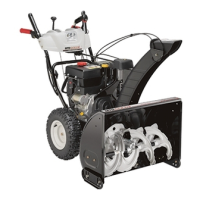
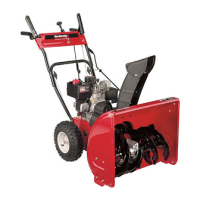
This document is an operator's manual for a two-stage snow thrower, specifically a 300 Series model, manufactured by MTD LLC. It provides comprehensive instructions for safe operation, assembly, setup, maintenance, troubleshooting, and warranty information. The manual emphasizes safety throughout, with warnings and cautions highlighted to prevent personal injury and property damage.
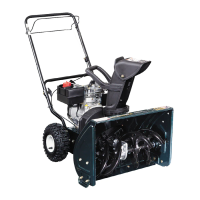
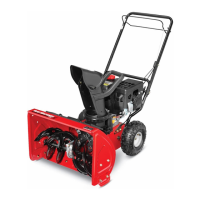
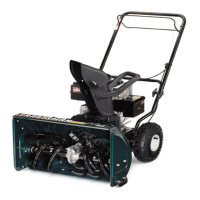
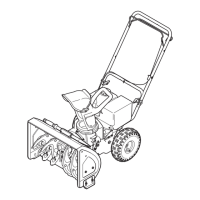
The two-stage snow thrower is designed to clear snow by drawing it into an auger housing and then discharging it through a chute assembly. The "two-stage" designation implies that it uses both an auger to collect snow and an impeller to throw it, making it effective for various snow conditions. The machine is powered by an internal combustion engine, which drives both the augers and the wheels for self-propulsion. Key controls allow the operator to engage/disengage the augers and drive, adjust the discharge chute direction and distance, and manage engine speed. The inclusion of a primer and choke aids in starting the engine, especially in cold weather.
The snow thrower is designed for ease of use with several operational features. The Drive Control, located on the underside of the upper handle, engages and disengages the wheels, allowing the operator to control forward motion. The Auger Control, adjacent to the upper handle, engages the augers to collect and throw snow. Both controls are designed to return automatically to the disengaged position when released, enhancing safety.
The Chute Assembly directs the discharged snow. The Chute Handle allows the operator to turn the chute assembly to the desired direction, while the Chute Knob enables adjustment of the upper chute's pivot to control the distance snow is thrown. This flexibility helps in avoiding discharge towards bystanders, roads, or property.
For starting, the machine includes a Starter Rope for recoil starting and an Ignition Key as a safety device, which must be fully inserted for the engine to start. The Throttle Control, located on the rear of the engine, regulates engine speed and can shut off the engine when moved to the STOP position. A Choke control aids in cold-weather starting by closing the carburetor's choke plate, and a Primer forces fuel into the carburetor for easier ignition in cold conditions.
The snow thrower is equipped with Skid Shoes and a Shave Plate. The shave plate maintains contact with the pavement for close snow removal, while the skid shoes can be adjusted based on surface conditions (upward for hard-packed snow, downward for gravel or crushed rock) to maintain proper clearance and prevent damage.
A Chute Clean-Out Tool is conveniently fastened to the rear of the auger housing. This tool is crucial for safely dislodging snow and ice that may accumulate in the chute assembly, preventing operators from using their hands.
The manual provides detailed instructions for starting the engine, engaging the drive, and engaging the augers. It emphasizes operating the engine at full throttle (FAST) when throwing snow for optimal performance. Operating tips include removing snow immediately after it falls, discharging snow downwind, and slightly overlapping cleared paths. The importance of maintaining good visibility and footing, especially on slippery surfaces, is also stressed.
The manual outlines a comprehensive maintenance schedule to ensure the snow thrower's longevity and safe operation. General recommendations include regularly checking fasteners for tightness, inspecting for damage, and maintaining the machine according to the manual's instructions to preserve the warranty.
Tire Pressure: The proper inflation pressure is 20 psi, and operators are advised to check and maintain equal pressure in both tires periodically, with a strong warning against over-inflation using an air compressor.
V-Belts: The manual details how to check the condition of the drive belts every 50 hours of operation, including removing the plastic belt cover for inspection. Instructions for replacing both the auger belt and drive belt are provided, noting that both should ideally be replaced at the same time.
Shave Plate and Skid Shoes: These wear parts should be checked periodically and replaced when necessary. The manual includes steps for removing and reassembling them, emphasizing correct adjustment for optimal performance and to avoid uneven wear.
Auger Shaft Lubrication: At least once a season, operators are instructed to remove the shear pins, spray lubricant inside the shaft, and around the spacers and flange bearings.
Lubrication: Pivot points on the auger and drive controls should be lubricated with light engine oil once a season. The auger idler bracket also requires seasonal lubrication.
Shear Pins: The augers are secured by shear pins designed to break if a foreign object or ice jam is struck, protecting the gearbox. The manual provides instructions for checking and replacing sheared pins, stressing the use of OEM replacement parts to maintain warranty coverage and safety.
Cleaning: The manual advises cleaning the snow thrower thoroughly after each use and before storage. The chute clean-out tool is specifically designed for safely clearing snow and ice from the chute assembly.
Off-Season Storage: Detailed instructions are given for proper storage if the snow thrower will not be used for 30 days or longer, or at the end of the snow season. This includes storing the equipment in a clean, dry area, rustproofing it with light oil or silicone if stored in an unventilated area, and cleaning the exterior.
Troubleshooting: A dedicated section provides a table of common problems, their causes, and corresponding remedies, helping operators diagnose and fix issues such as the engine failing to start, running erratically, overheating, loss of power, excessive vibration, or problems with self-propulsion or snow discharge.
 General
| Type | Two-Stage |
|---|---|
| Engine Type | 4-Cycle |
| Chute Control | Manual |
| Auger Material | Steel |
| Intake Height | 21 inches |
| Throw Distance | 40 feet |
| Starter Type | Recoil |
| Engine | MTD |

 To Next Page