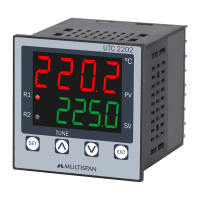
This document describes the AMULTISPAN UTC 2202 Temperature Controller, a device designed for precise temperature regulation in various industrial and commercial applications. The controller features a clear digital display for both process value (PV) and set value (SV), along with intuitive key operations for parameter setting and control.
Function Description
The UTC 2202 is a versatile temperature controller capable of managing heating and cooling processes. It offers multiple control methods to suit different application requirements:
- PID Control with Auto-Tuning: This is the most advanced control method, allowing the controller to automatically compute and set optimal Proportional Band (Pb), Integral Time (It), Derivative Time (dt), and Cycle Time (Ct) parameters based on the process characteristics. This ensures precise and stable temperature control. The auto-tuning function is initiated by pressing a specific key combination for 6 seconds, and a dedicated LED indicates when auto-tuning is active. If power is interrupted during auto-tuning, the process will restart upon power restoration.
- Time Proportional (TP) Control: This method provides a simpler form of control by varying the ON/OFF time of the output based on the deviation from the setpoint.
- ON-OFF Control: This is the most basic control method, where the output is simply switched ON when the temperature is below the setpoint (for heating) or above the setpoint (for cooling), and OFF when the temperature reaches or exceeds the setpoint (for heating) or falls below the setpoint (for cooling). Hysteresis can be configured to prevent rapid cycling of the output.
- Blower Time Proportional (BL.TP) Control: Specifically designed for cooling applications, this method uses time proportional control for blower operation.
The controller supports various input types, including J, K, and PT-100 thermocouples, and PT.1 RTDs, allowing it to be integrated with a wide range of temperature sensors. It provides two relay outputs and an SSR drive output, offering flexibility in controlling external heating or cooling elements.
Usage Features
The UTC 2202 is designed for ease of use with a straightforward interface:
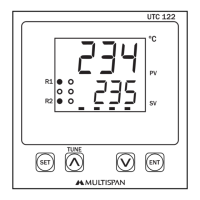
- Display: The device features a dual 4-digit, 7-segment LED display. The upper display (0.70" Red) shows the Process Value (PV), while the lower display (0.50" Green) shows the Set Value (SV).
- Key Operation: Three primary keys – SET, INC (increment), and DEC (decrement) – facilitate navigation and parameter adjustment.
- SET Key: Used to enter parameter setting mode, move to the next parameter, and save/exit settings.
- INC Key: Used to increment parameter values.
- DEC Key: Used to decrement parameter values.
- Combined Key Presses: Specific combinations, such as pressing SET for 6 seconds, are used to start/stop PID auto-tuning. Pressing INC + DEC for 3 seconds allows access to factory setting mode.
- Status LEDs: Several LEDs provide visual feedback on the controller's status:
- Soak Time Counting Indication: Indicates when the soak time function is active.
- Relay 1 Control O/P: Shows the status of Relay 1 output.
- Relay 2 Control O/P: Shows the status of Relay 2 output.
- Auto Tuning On Indication: Illuminates when the auto-tuning process is active.
- Soak Time Function: This feature allows the process to be held at a preset temperature for a specified duration (up to 999 hours). The display indicates when soak time is completed. The controller also includes a soak time memory function, which, if enabled, allows the remaining soak time to continue counting after a power supply failure. If disabled, the soak time counting will restart from the beginning.
- Alarm Functions: The controller supports various alarm types, including High, Absolute Low, Inband, and Outband alarms, providing critical alerts for process deviations.
- Parameter Setting: The manual details a comprehensive parameter setting structure, including setpoint settings, control parameters (PB, IT, DT, Cycle Time), and basic configuration settings (input type, control action, alarm types, limits, and password protection).
- Error Display: The controller provides clear error codes on the display (e.g., "OPEN" for sensor not connected or over-range, "SrE" for reversed sensor connection) to assist in troubleshooting.
Maintenance Features
The UTC 2202 is designed for reliable operation with simple maintenance guidelines:
- Cleaning: The equipment should be cleaned regularly to prevent blockage of ventilating parts. A clean, soft cloth should be used, and isopropyl alcohol or other cleaning agents are not recommended.
- Fuse Replacement: The fusible resistor should not be replaced by the operator.
- Installation Guidelines: Proper installation is crucial for long-term reliability. This includes:
- Ensuring power supply is OFF during wiring to prevent electric shock.
- Using adequately rated and twisted wires for connections to minimize electromagnetic interference.
- Using power supply cables with a cross-section of at least 1mm and insulation capacity of 1.5kV.
- Installing a circuit breaker or mains switch between the power source and the supply terminal in an easily accessible location.
- Preventing metal pieces or filings from entering the product during installation.
- Mounting the unit away from heat sources, caustic vapors, oils, or steam.
- Using specified crimp terminals (M3.5 screws) and tightening them to a torque of 1.2 N.m.
- Avoiding connections to unused terminals.
- Environmental Conditions: The instrument should be used and stored within the specified ambient temperature (0°C to 55°C) and relative humidity (up to 95% RH, non-condensing) ranges to ensure optimal performance and longevity.

 Need help?
 General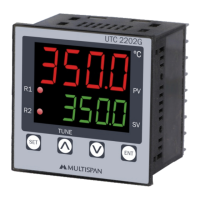


 To Next Page