EasyManua.ls Logo

MULTISPAN PTC-1202A - User Manual

MULTISPAN PTC-1202A
7 pages
Print Icon
To Next Page IconTo Next Page
Loading...
PTC- 1202A
OUTPUT SPECIFICATION
AUXILIARY SUPPLY
PROCESS & TEMPERATURE CONTROLLER
Relay
Supply voltage
Relay Type
Power consumption
(VA RATING)
Rating
2 nos.
1 C/O (NO-C-NC)
Approx 7 VA @ 230V AC MAX
5A, 230V AC/30 V DC
4 to 20mA DC
24V DC
ENVIRONMENT CONDITION
Relative Humidity
Protection Level
Operating Temp.
0°C to 55°C
UP to 95% RH
(non-condensing)
IP-65 (Front side) As per IS/IEC
60529 : 2001
100 to 270V AC, 50-60Hz
Input Types
Resolution
Indication
Accuracy
Input Range
0 to 600°C
0 to 1200°C
-99 to 400°C
-99.9 to 400.0°C
-999 to 9999
-999 to 9999
-999 to 9999
J
K
PT-100
PT.1
0-10V DC
0-20mA DC
4-20mA DC
J,K,PT-100 = 1°C
±1% of FSD ± 1 Count
PT.1 = 0.1°C
Display
Heating
Size
Keys
Cooling
Alarm
Panel Cutout
1) PID control with Auto-Tuning
2) ON-OFF control
High/Low/Inband/Outband/
Absolute Low/Absolute Outband
1) BL.TP (Blower Time Proportion)
2) ON-OFF control
96 (H) x 96 (W) x 54 (D) mm
SET, INC, DEC, ENT
92 (H) x 92 (W) mm
TECHNICAL SPECIFICATION
(FSD : full scale deflection)
INPUT SPECIFICATION:
DISPLAY AND KEYS:
DIMENSION:
CONTROL METHOD:
0-10V DC,0-20mA DC,4-20mA DC
= 0.1,0.01,0.001,0001
Relay Output
Analog Output
Transmitter supply
TERMINAL CONNECTION
PV = Process value
SV = Set Value
Upper : 4 digit,7 seg 0.8” RED LED
Lower : 4 digit,7 seg 0.56” White LED
MECHANICAL INSTALLATION
96
54
92
92
3
96
Outline Dimension (mm) Panel Cutout
Dimension (mm)
ENT
SET
PTC 1202A
Tune
AO
Out 1
Out 2
ºC
PV
SV
10 20 30 40 50 60 70 80 90 100
% O/P
0456
1
7 8 9
12
1314
10
11
1617181920
15
2
3
4
5
6
NO
C
NC
T/C
+
+
-
RELAY-1
100
270V AC
~
50/60 Hz
7VA
!
L
N
0/4-20
mA DC
0-10
V DC
NO
C
NC
RELAY-2
PT-100
3W
O/P
24V DC
+
-
Made in India
www.multispanindia.com
+
-
O/P
4-20mA DC
Question and Answer IconNeed help?

Do you have a question about the MULTISPAN PTC-1202A and is the answer not in the manual?

Summary

Technical Specifications Overview

Input Signal Types and Ranges

Details supported sensor inputs like J, K, PT-100 and their respective measurement ranges.

Accuracy and Resolution Details

Specifies the instrument's indication accuracy and display resolution.

Output and Supply Configuration

Relay and Analog Output Specs

Information on relay type, rating, and analog output specifications.

Auxiliary Supply and Environment

Covers supply voltage, power consumption, and operating conditions.

User Interface and Physical Design

Display, Keys, and Dimensions

Describes the unit's display, control buttons, and physical size.

Control Methods and Terminals

Lists control options (Heating, Cooling, Alarm) and terminal connections.

Key Operation and Controls

Operator Mode Functions

Instructions for accessing parameter setting, auto-tuning, and factory reset.

Parameter Setting Mode Operations

Details on modifying parameter values using the control keys.

Installation and Safety Guidelines

Mechanical Installation Procedures

Guidelines for panel cutout, unit fitting, and terminal wiring.

General Safety Precautions

Emphasizes adherence to safety codes and warnings for safe operation.

Electrical Safety Warnings

Specific warnings regarding the risk of electric shock during wiring.

Maintenance and Warning Guidelines

Equipment Maintenance

Instructions for cleaning the unit and maintaining ventilation.

General Warning Guidelines

Advice on reducing electromagnetic interference and using proper wiring.

Factory Setting and Parameter Description

Factory Setting Mode

Procedure for accessing and applying factory default settings.

Parameter Message Descriptions

Explanation of various parameter codes and their meanings.

Parameter Control Ranges

Control Parameter Ranges

Defines the valid input ranges for control parameters.

Parameter Message Descriptions

Further explanation of parameter codes like LOPC, HI PC, Frud, etc.

Parameter Setting Procedures

Analog Output and Controlling Setup

Steps for configuring analog output and controlling modes.

Password and Basic Configuration

Explanation of password entry and basic configuration parameter.

Relay and Control Functionality

Relay 1 and Relay 2 Modes

Configuration details for Relay 1 and Relay 2 in Heat, Cool, and Alarm modes.

Input Selectable Parameters

Details on parameters related to input selection and basic configuration.

Control Function Explanations

Analog Output Configuration

Steps for setting up analog output parameters like PU/SU/CON.

Soak Timer Functionality

Configuration options for the soak timer function.

Alarm Control Functions

Graphical explanations of High, Low, Outband, and Inband alarm behaviors.

Summary

Technical Specifications Overview

Input Signal Types and Ranges

Details supported sensor inputs like J, K, PT-100 and their respective measurement ranges.

Accuracy and Resolution Details

Specifies the instrument's indication accuracy and display resolution.

Output and Supply Configuration

Relay and Analog Output Specs

Information on relay type, rating, and analog output specifications.

Auxiliary Supply and Environment

Covers supply voltage, power consumption, and operating conditions.

User Interface and Physical Design

Display, Keys, and Dimensions

Describes the unit's display, control buttons, and physical size.

Control Methods and Terminals

Lists control options (Heating, Cooling, Alarm) and terminal connections.

Key Operation and Controls

Operator Mode Functions

Instructions for accessing parameter setting, auto-tuning, and factory reset.

Parameter Setting Mode Operations

Details on modifying parameter values using the control keys.

Installation and Safety Guidelines

Mechanical Installation Procedures

Guidelines for panel cutout, unit fitting, and terminal wiring.

General Safety Precautions

Emphasizes adherence to safety codes and warnings for safe operation.

Electrical Safety Warnings

Specific warnings regarding the risk of electric shock during wiring.

Maintenance and Warning Guidelines

Equipment Maintenance

Instructions for cleaning the unit and maintaining ventilation.

General Warning Guidelines

Advice on reducing electromagnetic interference and using proper wiring.

Factory Setting and Parameter Description

Factory Setting Mode

Procedure for accessing and applying factory default settings.

Parameter Message Descriptions

Explanation of various parameter codes and their meanings.

Parameter Control Ranges

Control Parameter Ranges

Defines the valid input ranges for control parameters.

Parameter Message Descriptions

Further explanation of parameter codes like LOPC, HI PC, Frud, etc.

Parameter Setting Procedures

Analog Output and Controlling Setup

Steps for configuring analog output and controlling modes.

Password and Basic Configuration

Explanation of password entry and basic configuration parameter.

Relay and Control Functionality

Relay 1 and Relay 2 Modes

Configuration details for Relay 1 and Relay 2 in Heat, Cool, and Alarm modes.

Input Selectable Parameters

Details on parameters related to input selection and basic configuration.

Control Function Explanations

Analog Output Configuration

Steps for setting up analog output parameters like PU/SU/CON.

Soak Timer Functionality

Configuration options for the soak timer function.

Alarm Control Functions

Graphical explanations of High, Low, Outband, and Inband alarm behaviors.

Overview

The Multispan PTC-1202A is a process and temperature controller designed for industrial applications, offering precise control and monitoring capabilities.

Function Description

The device functions as a PID (Proportional-Integral-Derivative) controller, capable of both PID control with auto-tuning and ON-OFF control for heating and cooling applications. It also supports blower time proportion (BL.TP) for cooling. The controller features two relay outputs for control actions and an analog output (4-20mA DC) for retransmission of process value (PV) or set value (SV), or for manual selection. It includes alarm functions such as High, Low, Inband, Outband, Absolute Low, and Absolute Outband alarms. A soak timer function is also available, allowing for programmed temperature profiles.

Important Technical Specifications

  • Input Types:
    • Thermocouples: J (0 to 600°C), K (0 to 1200°C)
    • RTD: PT-100 (-99 to 400°C), PT.1 (-99.9 to 400.0°C)
    • Analog: 0-10V DC, 0-20mA DC, 4-20mA DC (all -999 to 9999 range)
  • Resolution: 1°C for J, K, PT-100; 0.1°C for PT.1; 0.1, 0.01, 0.001, 0001 for analog inputs.
  • Indication Accuracy: ±1% of FSD + 1 Count (FSD: full scale deflection).
  • Output Specifications:
    • Relay Outputs: 2 nos., 1 C/O (NO-C-NC) type, rated 5A, 230V AC/30V DC.
    • Analog Output: 4 to 20mA DC.
    • Transmitter Supply: 24V DC.
  • Auxiliary Supply: 100 to 270V AC, 50-60Hz.
  • Power Consumption: Approximately 7 VA @ 230V AC MAX.
  • Environmental Conditions:
    • Operating Temperature: 0°C to 55°C.
    • Relative Humidity: Up to 95% RH (non-condensing).
    • Protection Level: IP-65 (Front side) as per IS/IEC 60529:2001.
  • Dimensions: 96 (H) x 96 (W) x 54 (D) mm.
  • Panel Cutout: 92 (H) x 92 (W) mm.
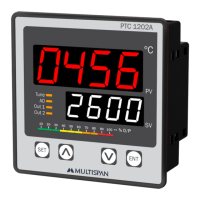
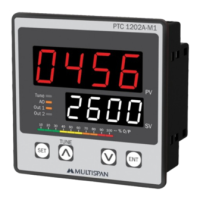
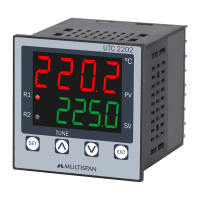
  • Display: Upper 4-digit, 7-segment 0.8" RED LED for Process Value (PV); Lower 4-digit, 7-segment 0.56" White LED for Set Value (SV).

Usage Features

The controller is designed for ease of use with a clear display and intuitive key operations.

  • Display Indication: The upper display shows the Process Value (PV) and the lower display shows the Set Value (SV). An output percentage indication is also provided.
  • Key Operation:
    • SET key: Used to enter parameter setting mode (press for 5 seconds), set parameter values, and save/exit parameter settings.
    • V key: Used to increment parameter values.
    • ^ key: Used to decrement parameter values.
    • ENT key: Used to enter parameter setting mode, start/stop PID auto-tuning (press for 6 seconds), go to factory setting mode (press for 3 seconds), and reset soak process (long press).
  • Control Methods: Supports PID control with auto-tuning and ON-OFF control for both heating and cooling. Cooling can also utilize Blower Time Proportion (BL.TP).
  • Alarm Functions: Configurable for High, Low, Inband, Outband, Absolute Low, and Absolute Outband alarms.
  • Parameter Setting: A comprehensive menu structure allows users to configure various parameters including proportional band (PB), integral time (IT), derivative time (DT), cycle time (CT), manual reset (MR), offset, hysteresis, cooling proportional band (C-PB), cooling ON/OFF times, relay delay times, and alarm time.
  • Factory Setting: A dedicated factory setting menu allows for resetting the device to default values.
  • Analog Output Configuration: The analog output can be configured for retransmission of PV or SV, or for manual percentage-wise selection.
  • Soak Timer: Allows for programming a soak time with selectable units (hour, minute, second) and memory function.

Maintenance Features

The device is designed for minimal maintenance, with clear guidelines for installation and cleaning.

  • Cleaning: The equipment should be cleaned regularly to prevent blockage of ventilating parts. Use a clean soft cloth; avoid isopropyl alcohol or other cleaning agents.
  • Fuse: The fusible resistor should not be replaced by the operator.
  • Installation Guidelines:
    • Proper panel cutout and secure mounting with clamps.
    • Avoid proximity to heating sources, caustic vapors, oils, or other unwanted process byproducts.
    • Use specified crimp terminals (M3.5 screws) for wiring, tightening screws with a torque of 1.2 N.m.
    • Do not connect anything to unused terminals.
    • Ensure the device is installed in an environment within the specified temperature and humidity ranges.
    • A circuit breaker or mains switch must be installed between the power source and the supply terminal for power ON/OFF.
  • Safety Precautions:
    • Always turn off power supply before wiring to prevent electric shock.
    • Do not touch terminals while power is supplied.
    • Use appropriate wire ratings and twists to reduce electromagnetic interference.
    • Cables for power connection must have a cross-section of 1mm or greater with insulation capacity of at least 1.5kV.
    • For thermocouple extension, use compensation wires. For RTD, use wiring material with small lead resistance (50Ω max per line) and no resistance differentials among the three wires.
    • Using a standard power supply cable can improve anti-noise effect.

MULTISPAN PTC-1202A Specifications

General IconGeneral
BrandMULTISPAN
ModelPTC-1202A
CategoryTemperature Controller
LanguageEnglish

Related product manuals