Instruction manual – MU-C/S 51
10 Malfunctions, causes and remedies
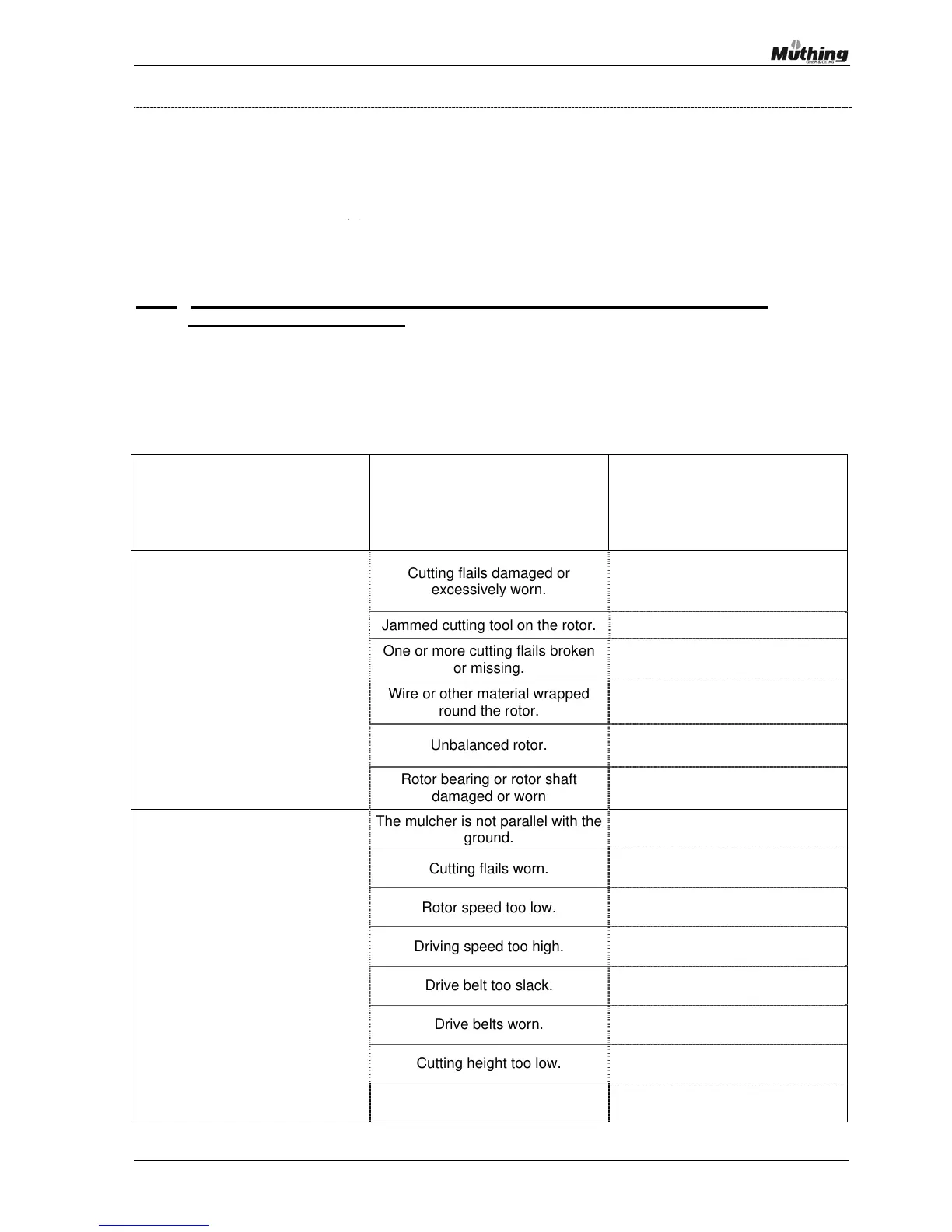
The table below contains a list of faults that we have collected in the course of our experience with
mulchers, the possible causes of these faults and the action that you should normally take to
resolve the problem.
If our recommended action fails to cure the fault or further problems arise please contact your
supplier. This will help us to get to the root of the problem and find a suitable solution. We shall use
the experience gained from this information to make further improvements to the mulcher.
Note: Please note the safety instructions, details of risks and accident prevention
regulations on pages 16 -26!
Fault Cause
Solution
Cutting flails damaged or
excessively worn.
Change the worn cutting flails
including mounting nut and bolt in
pairs or as a complete set
.
Jammed cutting tool on the rotor. Clean cutting tool mounting.
One or more cutting flails broken
or missing.
Replace cutting flails.
Wire or other material wrapped
round the rotor.
Remove debris.
Unbalanced rotor.
Check the weighting and
rebalance as necessary.
The mulcher emits excessive
vibration and noise
Rotor bearing or rotor shaft
damaged or worn
Replace the bearing or shaft.
The mulcher is not parallel with the
ground.
Adjust the toplinkage until the
mulcher is sitting correctly.
Cutting flails worn.
Change the worn cutting flails
including mounting nut and bolt.
Rotor speed too low. Increase rotor speed.
Driving speed too high. Drive more slowly
Drive belt too slack.
Check drive belt tension and if
necessary retighten.
Drive belts worn.
Replace complete set of drive
belts.
Cutting height too low.
Lower the support roller/wheels
and /or adjust the toplinkage.
Mulcher operation
and/or
cut unsatisfactory
Cutting height too high.
Raise the support roller/wheels
and /or adjust the toplinkage.



 To Next Page