Need help?
Do you have a question about the Nachi RMU20-20 and is the answer not in the manual?
Provides an overview of the robot monitoring unit (RMU) functions.
Details the key characteristics and capabilities of the RMU.
Explains the specific safety functions performed by the RMU.
Lists the technical specifications and parameters of the RMU.
Outlines the process for identifying and mitigating potential dangers.
Details requirements and procedures for connecting the RMU.
States compliance with relevant EC machinery directives.
Illustrates how the RMU connects to the robot and external systems.
Details the physical layout and components of the RMU unit.
Explains the various signals connected to the RMU.
Describes the redundant safety input signals for the RMU.
Details the general safety output signals from the RMU.
Provides safety and compliance guidelines for RMU installation.
Overview of the RMU's monitoring capabilities for robot operation.
Describes the sequence for controlling robot motor power.
Explains how to set logical operations for safety output signals.
Details assigning RMU errors to specific output signals.
Provides steps for enabling the RMU setting.
Introduces the Virtual Safety Fence (VSF) system.
Details the steps for configuring the Virtual Safety Fence.
Defines the robot's positional and angular relationship for VSF.
Configuration for defining safety fence areas and part ranges.
Sets spherical or rectangular limits for tools.
Defines movement limits based on the robot arm's geometry.
Provides a list of error codes specific to the VSF function.
Specific configuration settings for robots mounted on sliders.
Outlines the steps for the initial RMU setup and configuration.
Details the process for configuring RMU parameters.
Configures robot mechanism-specific parameters.
Sets parameters for each individual robot axis.
Configures the assignment of input and output signals.
Defines logical operations for the safety output signals.
Configures EtherNet/IP safety network parameters for RMU20-30.
Verifies that the RMU parameters have been set correctly.
Finalizes RMU settings by confirming parameters and enabling functions.
Configures settings for axis disconnection utility.
Provides an overview of the RMU settings menus.
Introduces the EtherNet/IP safety network capabilities.
Details the configuration steps for the RMU within EtherNet/IP.
Explains how to configure the safety PLC for RMU integration.
Provides guidance for diagnosing issues in the EtherNet/IP safety network.
Introduces the PROFINET safety network capabilities.
Details the configuration of the PROFINET module.
Configures the safety network parameters for PROFINET.
Provides guidance for diagnosing issues in the PROFINET safety network.
Details routine and periodic checks for the RMU.
Outlines the recommended schedule for RMU inspections.
Lists specific items and methods for periodic RMU inspections.
Provides the procedure for replacing the RMU unit.
Guides users through diagnosing and resolving RMU errors.
Steps to follow after replacing or resetting the encoder.
Example troubleshooting for input signal inconsistency.
 General
| Manufacturer | Nachi |
|---|---|
| Category | Robotics |
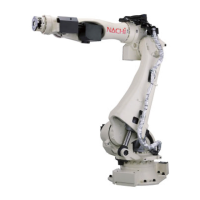
| Model | RMU20-20 |
| Payload | 20 kg |
| Number of Axes | 6 |
| Type | Articulated Robot |
| Degrees of Freedom | 6 |
| Protection Class | IP67 |
| Installation | Floor, Ceiling |


 To Next Page