38
Some people start chimney res fairly frequently, as a means of chimney cleaning. This deters very intense
chimney res and the small ones which do happen are always under a watchful eye. Under some circumstances,
this practice may be reasonable, but generally it is a risky method to keep a chimney clean. There is always some
danger of a house re, but in addition, any chimney re is wearing on a chimney; the high temperatures increase
the corrosion rate of metals and the thermal expansion of masonry materials encourage crack formation and
growth.
Chemical chimney cleaners are available. Opinions on their effectiveness vary, but apparently when used
regularly, and as directed, they work, and do not damage chimneys. The usual chimney cleaning method is the
oldest human energy and some kind of mechanical tool. A stiff wire brush, a heavy chain (perhaps in a bag)
hung with a rope and worked up and down from the top of the chimney, and very small brushes have all been
used. Professional chimney sweeps are also reappearing.
Some people clean yearly, other after every few cords of wood burned, but there are so many factors inuencing
creosote build up that such generalizations are not appropriate in most particular cases. In new installations, or
when changes occur (such as a different stove) the chimney should be checked frequently (after 2 weeks, then
after a month, then after another 2 months, etc.) until it is clear how frequently cleaning is usually needed.
The preceding is an excerpt from “THE WOOD-BURNERS ENCYCLOPEDIA” published
by Vermont Crossroads Press, Inc. – Dec., 1976.
WOOD IS A SAFE CLEAN AND ECONOMICAL FUEL
Species
Approx. Wt.
Per Cord
BTU Per Air
Dried Cord
Equivalent
Value #2
Heating Oil Litre
Cost at 70.0
cents
Cost at 75.0
cents
Cost at 80.0
cents
Hickory 3595 30,600,000 827.4 $579.18 $620.55 $661.92
Hard Maple 3075 29,000,000 784.6 $549.22 $588.45 $627.68
Beech 3240 27,800,000 752.4 $526.68 $564.30 $601.92
Red Oak 3240 27,300,000 738.7 $517.09 $554.03 $590.96
Yellow Birch 3000 26,200,000 709.2 $496.44 $531.90 $567.36
Elm 2750 24,500,000 662.8 $463.96 $497.10 $530.24
Soft Maple 2500 24,000,000 649.2 $454.44 $486.90 $519.36
Tamarack 2500 24,000,000 649.2 $454.44 $486.90 $519.36
Cherry 2550 23,500,000 635.5 $444.85 $476.63 $508.40
Ash 2950 22,600,000 611.4 $427.98 $458.55 $489.12
Spruce 2100 18,100,000 490.1 $343.07 $367.58 $392.08
Hemlock 2100 17,900,000 484.1 $338.87 $363.08 $387.28
Aspen 1900 17,700,000 483.2 $338.24 $362.40 $386.56
White Pine 1800 17,700,000 462.8 $323.96 $347.10 $370.24
Basswood 1900 17,000,000 459.6 $321.72 $344.70 $367.68
Note: To change litres to US gal. multiply by 0.264
For the least amount of wood handling, the wood with the highest heat content is most desirable.
An open replace can actually refrigerate a house because it sucks in so much cold air, which is only partially
used for combustion. A carefully designed replace makes use of perhaps 10 – 15 % of the heat available; most
still going up the ue. The well-constructed potbellies get perhaps 20 – 25 % and the automatic, draft regulated,
tightly sealed wood heaters get perhaps 50 %.
Notice that the percentage efciency goes up as the combustion process becomes more and more controlled.
The roaring re is a complete waste of fuel. The best situation is one where the combustion chamber is gas-tight.
This allows a controlled re that toasts the wood and puts the right quantity of wood gas in the right place and at
the right temperature for optimal combustion and heat transfer.
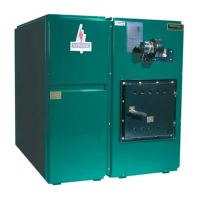
The NEWMAC COMBINATION OIL AND WOOD FURNACE toasts the wood to charcoal and the charcoal and the
charcoal burns to dust leaving a minute amount of residue. From the above heat values, it can be seen that a
cord or Hickory wood is equivalent to $ 248.22 (@ 30.0 cents litre) worth of oil, over twice as much as you would
pay for a cord of wood.
Without taking into account all the free wood that is available, EFFICIENT WOOD HEATING cuts your heating costs
in half.


 To Next Page