28 29
4
QUICK GUIDE
4
QUICK GUIDE
4
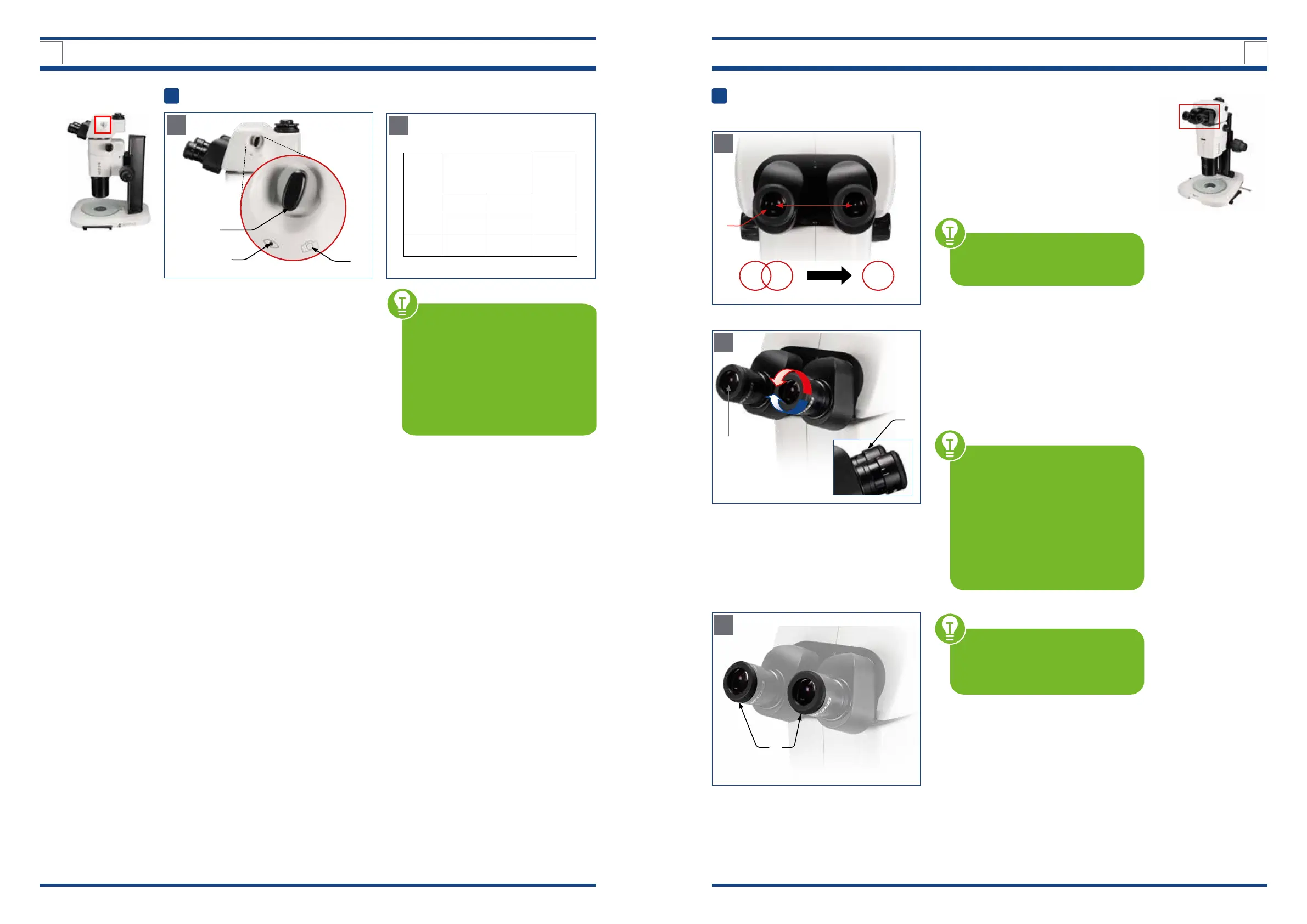
Direct light to the eyepieces or to the camera
A
Illustration xx A/B: Light path of the trinocular viewing head.
2
1
3
You have the option of directing the light
either to the eyepieces of the binocu-
lar part (1) or to the camera (2) via the
switching lever for visual observation/
photo (3). To microscope the specimen
set the lever to 100 % to the eyepieces of
the binocular part.
B
Icon Proportion on the
light for the binocular
part
Propor-
tion of
the light
for the
camera
left right
¡
100% 100% 0%
,
100% 0% 100%
CONSIDER: The light amount
of the left eyepiece is always 100 %.
The light amount of the right
eyepiece is diverged to the photo
adapter. Only the images of the
right eyepiece optical path are
recorded by camera. To do this,
ip the switching lever for visual
observation/photo to the symbol.
5
Settings on the trinocular viewing head
Trinocular viewing head with 20° xed inclined eyepieces.
A
Illustration xx: Adjusting the interpupillary distance.
two elds of view merge
Adjusting the interpupillary distance
(Distance between the eyepieces)
Look through the eyepieces (1) and ad-
just the interpupillary distance (2) so that
the left and right elds of view are com-
pletely aligned.
NOTE: Proper interpupillary dis-
tance is crucial to the comfort of the
user.
B
Illustration xx: Diopter adjustment.
1
3
Diopter adjustment
Look through one of the eyepiece (1) and
focus the image (eyepiece freely selecta-
ble). Then look through the other eye-
piece with the other eye and turn only
the diopter adjustment ring (3) on this
eyepiece to focus the sample.
THE DIOPTER COMPENSATION
is an adjustment possibility on both
eyepieces and serves to compen-
sate for near - or farsightedness
(max. +/-8 dpt. difference between
both eyes can be compensated). If
the difference is higher, or if you
suffer from astigmatism etc. we
recommend observing with your
prescribed glasses on.
C
Illustration xx: Eyepieces with rubber cups.
4
DIOPTER COMPENSATION is
possible on both eyepieces but is
only performed on one eye if the
difference is +/- 4 dpt. or lower.
ADDITIONAL FEATURE:
Protection through rubber cups
Both eyepieces are suitable for spectacle
wearers. They are protected with rubber
cups (4) so that the user's eyeglasses are
not damaged when accidentally coming
in contact with the eyepiece.
1
2



 To Next Page