10.4.3 User Manual Contents April 17, 2020
Firmware: 5.2.1 Page 49 of 142
CAUTION: Snippets Is Data Intensive
To ensure smooth data collection, make sure that the acquisition PC is not
near its maximum CPU load. If CPU load is too great, artefacts may appear
in the snippets record.
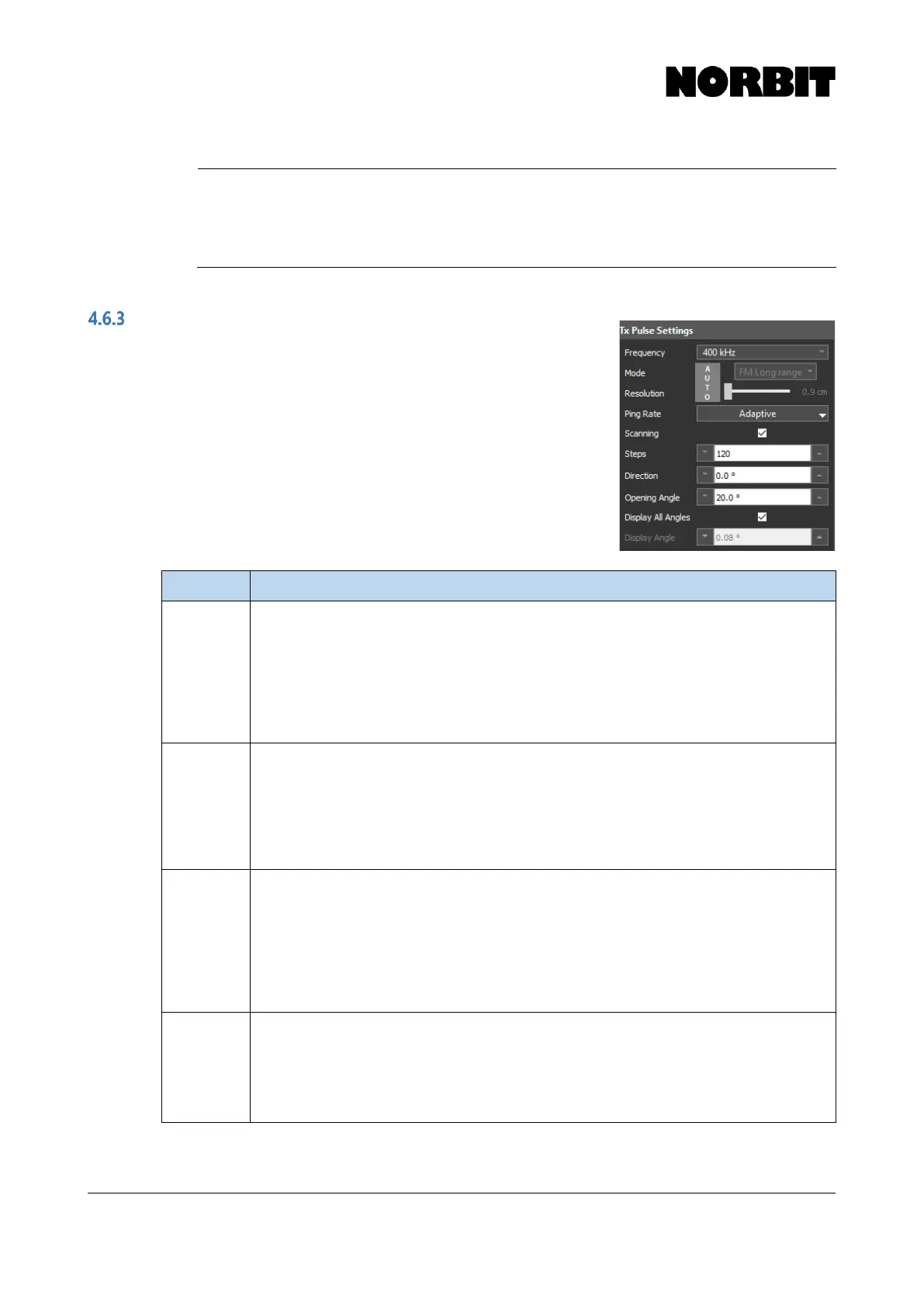
Tx Pulse Settings
The Tx Pulse Settings control the acoustic transmission (Tx)
signals. Typically, with default settings, these values are
automatically determined based on sonar range. For most survey
applications, these settings need not be changed.
If the GUI detects a WBMS STX model, this menu activates
additional options to allow transmit pulse steering. These controls
are not visible if a standard WBMS is detected. All functions are
explained in the table below.
For additional information on STX operation, refer to section 5.3.
Sets center frequency of transmitted pulse. The WBMS is optimized for a center frequency of
400kHz for standard systems and 200kHz for deep/long range systems. For a given depth,
higher frequencies theoretically have higher bottom detection resolution, but also higher
signal attenuation, especially in the presence of sediments. For most applications, however,
NORBIT recommends maintaining a frequency close to the center frequency of that system
(200 or 400kHz).
Standard Systems: 200kHz – 700kHz (optimized for 400kHz)
Long Range Systems: 160kHz – 400kHz (optimized for 200kHz)
Sets sweep time of the signal transmission. The available selections are FM Long Range
(recommended setting for most applications), FM Short Range (applicable for surveys in very
shallow water, less than 5m), or CW (legacy option). With FM Long Range, a long sweep
time of 500µs is used. The FM Short Range option reduces this value to 200µs. Decreasing
sweep time increases effective ping rate. For CW mode, the duration of the signal
transmission increases range performance at the expense of detection quality. NORBIT
systems are optimized for FM operation.
Sets the acoustic range resolution by controlling pulse bandwidth. The resolution is calculated
as c/2*BW, where c is the speed of sound and BW is the bandwidth. When maximum
resolution (0.9cm) is set in FM Long Range or FM Short Range modes, 80kHz bandwidth is
used. Therefore, with a center frequency of 400kHz, transmission sweeps from 360-440kHz.
Decreasing resolution enhances range performance in deep water by reducing bandwidth. In
CW mode, frequency transmission is constant, i.e. 0 kHz bandwidth. However, the system is
designed from conception as an FM system and performs optimally in this mode, yielding
highest resolution regardless of depth. Auto selection is recommended.
Automatic
Mode and
Resolution
(Auto)
Adjusts Mode and Resolution for best performance in nearly all survey conditions, as
determined by the software. For backscatter, unless very high ping rate is desired in shallow
water, disable Auto and set Mode to FM Long Range and Resolution to 0.9cm to ensure
full processing of the backscatter signal. The system will otherwise switch between 200 and
500µs and some software cannot process out the signal change.



 To Next Page