11. TROUBLESHOOTING
The first step in identifying an operational problem is to determine whether
the fault is in the furnace or in the thermostat and/or its connecting wiring.
To help make this determination, the furnace is equipped with a “Thermostat
ON” diagnostic light. If the light is “ON”, it indicates the thermostat has
closed and is calling for heat; the blower should be operating. If the light is
“OFF”, the furnace should not be operating.
1. If the furnace will not start:
Turn the thermostat to its highest setting. If the light goes on, the thermostat
has closed, so the fault is in the furnace. If the light does not go on, the
thermostat or its connecting wiring is the problem.
2. If the furnace will not turn off:
Turn the thermostat to its lowest setting. If the light goes off and the
furnace continues to run, the thermostat has opened properly and the
problem resides in the furnace. If the light stays on, the fault is in the
thermostat or its connecting wiring.
After the fault area is isolated by use of the diagnostic light, a check of
the following components can be made more efficiently.
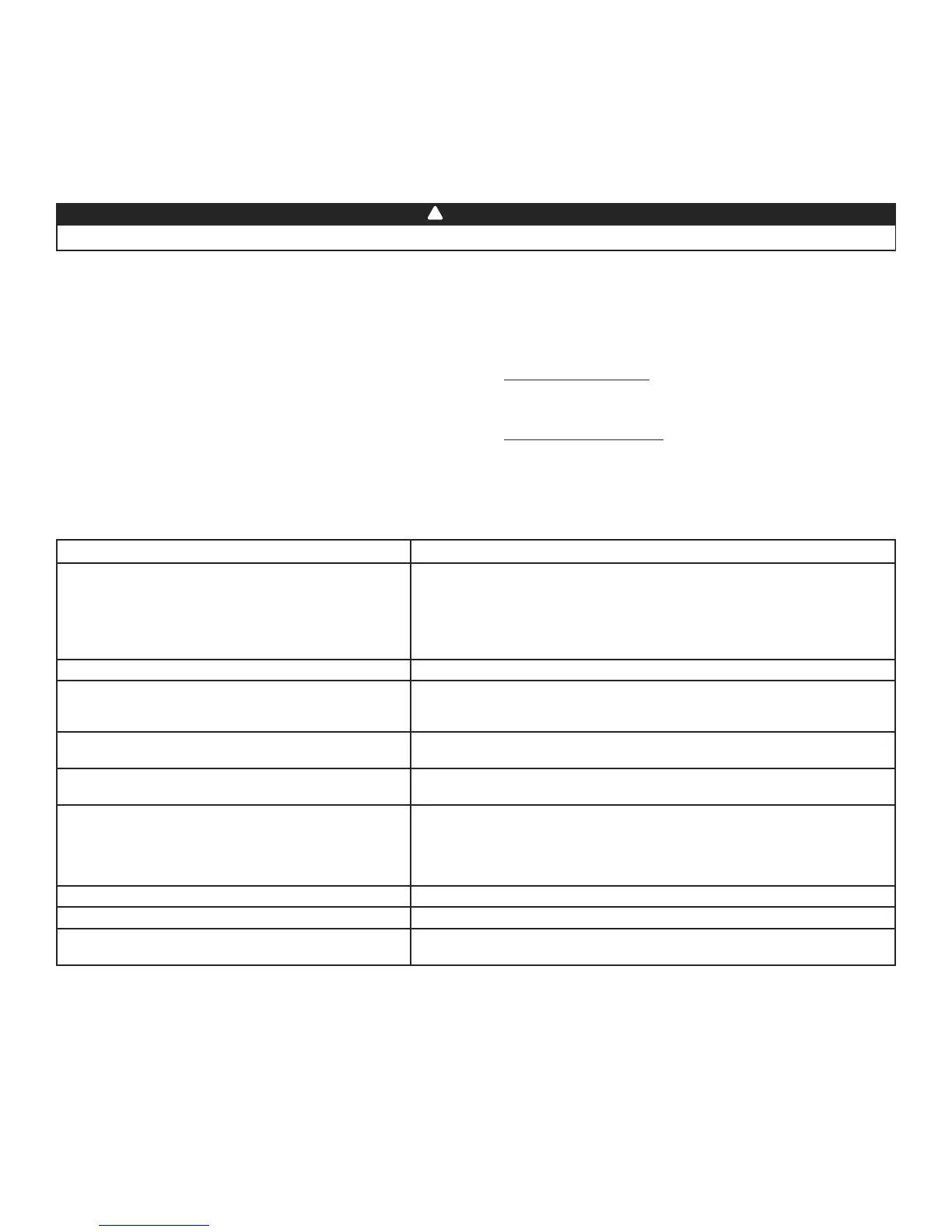
PROBLEM POSSIBLE DEFECTIVE PARTS OR COMPONENTS
1. The furnace will not turn on. • Thermostat
• Circuit breaker or fuse is open
• Motor or capacitor
• SPEED SELECTOR switch (open contact)
• Electronic control
• Transformer
2. Motor runs continuously. • Thermostat wires incorrectly attached to the furnace
3. Elements on, but motor does not run. • Motor or capacitor
• SPEED SELECTOR switch (open contact)
• Electronic control
4. Motor going on and off in short cycles
(or in too long cycles)
• Heat anticipator in thermostat incorrectly set or may be defective
5. The thermostat must be set much higher (or lower)
than the desired house temperature
• The thermostat is not leveled or out of calibration
6. Not enough heat • One or more defective elements or relays
• HEAT ACTIVATION switch set in L
OW position
• Safety limits opening because duct obstruction or dirty filters are restricting air flow
• Defective or incorrect wired two-stage or outdoor thermostat
• Lack of enough cold air returns in house
7. Two-stage or outdoor thermostat not operating properly • HEAT ACTIVATION switch not set in L
OW position
8. Thermal cut-out opens • Airflow is reduced because of blocked ductwork or very dirty filters
9. Breaker on front panel trips • Overcurrent on heating element. Reset the breaker.
If problem persists, call an electrician
10. MAINTENANCE
MOTOR: The motor is lubricated for life and needs no oiling.
FILTERS: Size is 20” x 20” x 1” (508 mm x 508 mm x 25 mm). Should be inspected and replaced when dirty.
Ordinarily replacement is required twice per heating season and, perhaps, a third time if continuous blower operation is used.
NOTE: Each element has an automatic reset thermal cut-out which is set to open at 160°F (71°C). If it opens, the element will be de-energized until the
cut-out resets itself. In addition to that, there are 2 manual reset thermal cut-outs that open at 200°F (93°C). If any of them open, a front panel
needs to be removed so the cut-out can be manually reset.
- 13 -
!
WARNING
Cut 240 V power supply before removing the front panel!



 To Previous Page