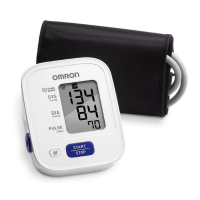
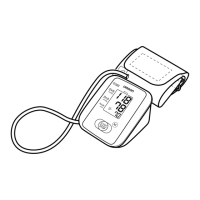
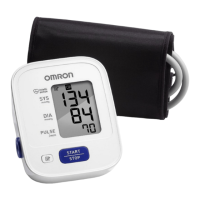
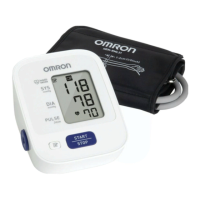
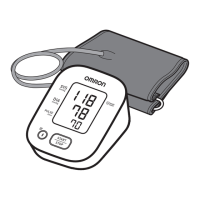
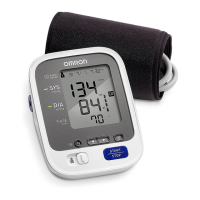
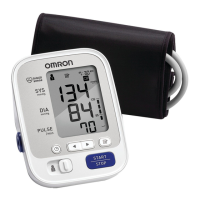
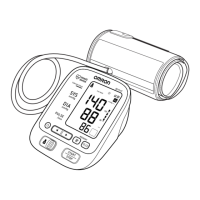
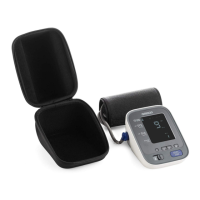
This document is an instruction manual for the OMRON BP710NVA Blood Pressure Monitor.
Function Description
The OMRON BP710NVA Blood Pressure Monitor is a digital device designed for measuring blood pressure and pulse rate in adult patients. It utilizes the oscillometric method, detecting blood movement through the brachial artery and converting it into a digital reading. The monitor also detects and provides a warning signal for irregular heartbeats during measurement. It does not require a stethoscope, making it simple to use.
General Usage Warnings:
- DO NOT adjust medication based on measurement results. Consult a physician for diagnosis and treatment of High Blood Pressure.
- The monitor is not intended as a diagnostic device.
- Consult a physician before using the device if you have common arrhythmias (atrial or ventricular premature beats, atrial fibrillation), arterial sclerosis, poor perfusion, diabetes, age, pregnancy, pre-eclampsia, or renal diseases. Patient motion, trembling, or shivering may affect readings.
- Do not use on an injured arm or an arm under medical treatment.
- Do not apply the arm cuff on an arm with an intravenous drip or blood transfusion.
- Consult a physician before using on an arm with an arterio-venous (A-V) shunt.
- Do not use simultaneously with other medical electrical (ME) equipment.
- Do not use in areas with HF surgical equipment, MRI, CT scanners, or oxygen-rich environments.
- The air tube may cause accidental strangulation in children, toddlers, or infants.
- Contains small parts that may cause a choking hazard if swallowed by children, toddlers, or infants.
Battery Usage Warnings:
- Do not insert batteries with incorrect polarities.
- Use only 4 "AA" alkaline or manganese batteries. Do not mix new and used batteries or different battery types.
- Remove batteries if the device will not be used for three months or more.
- Keep batteries out of reach of children, toddlers, or infants.
General Usage Cautions:
- Always consult your physician. Self-diagnosis and self-treatment are dangerous.
- Consult your physician before use if you have had a mastectomy.
- Consult your physician before use if you have severe blood flow problems or blood disorders, as cuff inflation can cause bruising.
- Do not take measurements more often than necessary to avoid bruising from blood flow interference.
- Remove the arm cuff if it does not start deflating during measurement.
- Do not use on infants or persons who cannot express their intentions.
- Do not use for any purpose other than measuring blood pressure.
- Use only the approved arm cuff for this device to ensure accurate results.
- Avoid using near mobile phones or other devices that emit electromagnetic fields, as this may cause incorrect operation.
- Do not disassemble the monitor or arm cuff, as this may cause inaccurate readings.
- Do not use in moist locations or where water may splash on the device, as this may damage it.
- Do not use in a moving vehicle (car, airplane).
- If your systolic pressure is known to be more than 210 mmHg, refer to the manual's specific instructions for inflating the cuff. Inflating to a higher pressure than necessary may result in bruising.
Important Technical Specifications
- Model: BP710NVA (REF HEM-7121-ZVA)
- Display: LCD digital display
- Measurement Range:
- Pressure: 0 to 299 mmHg
- Pulse: 40 to 180 beats / min.
- Accuracy:
- Pressure: ±3 mmHg or 2% of reading
- Pulse: ± 5% of display reading
- Inflation: Fuzzy-logic controlled by electric pump
- Deflation: Automatic pressure release valve
- Measurement Method: Oscillometric method
- IP Classification: IP 20
- Power Source: 4 "AA" batteries 1.5V
- Battery Life: Approximately 1000 measurements (using new alkaline batteries)
- Operating Temperature / Humidity / Air Pressure: 50°F to 104°F (10°C to 40°C) / 15 to 90% RH / 700 to 1060 hPa
- Storage Temperature / Humidity / Air Pressure: -4°F to 140°F (-20°C to 60°C) / 10 to 95% RH / 700 to 1060 hPa
- Weight:
- Monitor: Approximately 8 7/8 oz. (250 g) not including batteries
- Arm cuff: Approximately 6 oz. (170 g)
- Dimensions:
- Monitor: Approximately 4" (w) x 3 1/8" (h) x 5 1/8" (l) (103 mm x 80 mm × 129 mm)
- Arm cuff: Approximately 5 3/4" × 23 1/2" (air tube: 29 1/2") (145 mm × 594 mm (air tube: 750 mm))
- Cuff Circumference: 9" to 17" (22 to 42 cm)
- Memory: Up to 14 sets
- Applied Part: Type BF
- Protection against electric shock: Internally powered ME equipment
- Clinical Validation: The 5th phase was used on 85 subjects for determination of diastolic blood pressure. Not validated for use on pregnant patients.
Usage Features
Display Symbols:
- Memory symbol: Indicates stored readings.
- Systolic blood pressure: Top reading.
- Diastolic blood pressure: Middle reading.
- Low battery symbol: Indicates batteries need replacement.
- Heartbeat symbol: Flashes during measurement.
- Irregular heartbeat symbol: Appears if an irregular rhythm is detected two or more times (rhythm 25% less or 25% more than average). Consult a physician if this symbol appears.
- Movement error symbol: Appears if body movement occurs during measurement. Remove cuff, wait 2-3 minutes, and re-measure.
- Pulse display / Memory number: Shows pulse rate or memory slot number.
- Deflation symbol: Indicates cuff deflation.
Preparation:
- Battery Installation: Remove the battery cover, insert 4 "AA" batteries as indicated (ensure correct polarity), and replace the cover. Replace all batteries when the low battery symbol appears. Measurement values are retained in memory even after battery replacement.
Applying the Arm Cuff:
- Remove tight-fitting clothing or rolled-up sleeves from the left upper arm. Do not place the cuff over thick clothes.
- Insert the air plug securely into the air jack.
- Wrap the arm cuff firmly around the left upper arm. The bottom edge of the cuff should be 1/2 inch (1 to 2 cm) above the elbow. The air tube should be on the inside of the arm, aligned with the middle finger.
- Secure the cuff with the fabric fastener.
- Note: If measuring on the right arm, the air tube will be at the side of the elbow. Avoid resting the arm on the air tube.
- Note: Blood pressure can differ between arms. OMRON recommends using the same arm for consistency. Consult a physician if values differ substantially.
How to Sit Correctly:
- Be relaxed and comfortably seated in a comfortable room temperature.
- Avoid bathing, drinking alcohol or caffeine, smoking, exercising, or eating for 30 minutes before measurement.
- Sit on a chair with feet flat on the floor, back straight, and back and arm supported.
- The arm cuff should be at the same level as your heart.
Taking a Measurement:
- Press the START/STOP button. The arm cuff will inflate automatically.
- If systolic pressure is more than 210 mmHg: After inflation starts, press and hold the START/STOP button until the monitor inflates 30 to 40 mmHg higher than your expected systolic pressure. The monitor will not inflate above 299 mmHg.
- Note: Inflating to a higher pressure than necessary may cause bruising.
- The monitor will display systolic blood pressure, diastolic blood pressure, and pulse rate.
- Remove the arm cuff.
- Press the START/STOP button to turn the monitor off. The measurement result is automatically stored in memory. The monitor will automatically turn off after 2 minutes.
- Note: Wait 2-3 minutes between measurements to allow arteries to return to their prior condition.
Using the Memory Function:
- The monitor stores up to 14 sets of measurement results. The oldest value is deleted when memory is full.
- To View Stored Values: Press the memory button. The memory number appears briefly before the pulse rate. The newest set is "1". Press the memory button repeatedly to view other stored values.
- To Delete All Stored Values: While the memory symbol appears, press and hold the memory button, then press the START/STOP button for more than 3 seconds. Partial deletion is not possible.
Maintenance Features
General Maintenance:
- Store the device and components in a clean, safe location.
- Do not use abrasive or volatile cleaners (e.g., gasoline, thinners).
- Do not wash the device or components, or immerse them in water.
- Use a soft, dry cloth or a soft, moistened cloth with neutral soap to clean the monitor and arm cuff.
- Do not disassemble or attempt to repair the device or components; this voids the warranty. Consult Customer Service for issues.
Storage:
- Unplug the air plug from the air jack.
- Gently fold the air tube into the arm cuff. Do not bend or crease the air tube excessively.
- Avoid storing in situations where:
- The device is wet.
- Exposed to extreme temperatures, humidity, direct sunlight, dust, or corrosive vapors (e.g., bleach).
- Exposed to vibrations, shocks, or at an angle.
Optional Medical Accessories:
- Arm Cuff (7" - 9" / 17 - 22 cm): CD-CS9 (Model: HEM-CS24)
- Arm Cuff (9" - 17" / 22 - 42 cm): CD-WR17 (Model: HEM-RML31)
Error Messages and Troubleshooting
The manual provides a table of error displays, their causes, and solutions, including:
- Irregular heartbeats detected.
- Movement during measurement.
- Low or exhausted batteries.
- Air plug disconnected.
- Arm cuff applied too loosely.
- Air leaking from the arm cuff.
- Arm cuff not inflated sufficiently (E2 error).
- Arm cuff inflated exceeding maximum allowable pressure (E3 error).
- Clothing interfering with the arm cuff (E5 error).
- Device error (Er error).
Troubleshooting also covers:
- No power/display: Replace batteries, check polarity.
- Measurement values too high or too low: Review measurement procedures (Section 1.2 and 3.3) as blood pressure varies due to stress, time of day, and cuff application.
Electromagnetic Compatibility (EMC)
The OMRON BPM conforms to IEC60601-1-2:2007 for immunity and emissions.
- Precautions: Use only OMRON-specified accessories and cables. Avoid using adjacent to or stacked with other equipment. Refer to guidance for the appropriate electromagnetic environment.
- Emissions: The device uses low RF energy and is unlikely to cause interference. It is suitable for domestic and public low-voltage power supply environments.
- Immunity: The device is designed to withstand electrostatic discharge, electrical fast transients, surges, voltage dips, and power frequency magnetic fields within specified levels.
- Separation Distance: Recommended separation distances from portable and mobile RF communications equipment are provided based on the transmitter's output power and frequency to prevent interference.

 Need help?
 General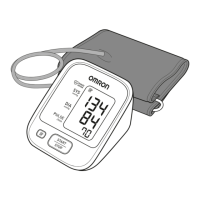

 To Next Page