6.
7.
8.
9.
10.
11.
12.
13.
On some engines,
it
is possible that
a
groove
from
the old head gasket fire ring may be impressed
into the head and/or block. If this
is
the case, it is
essential that the part be replaced or milled
to
remove the imperfection.
If all of the top six studs accepted 30 ft-lb of
torque without pulling out, the new head gasket
may be put on without replacement of the studs. If
this is the case, skip steps 6 through 12.
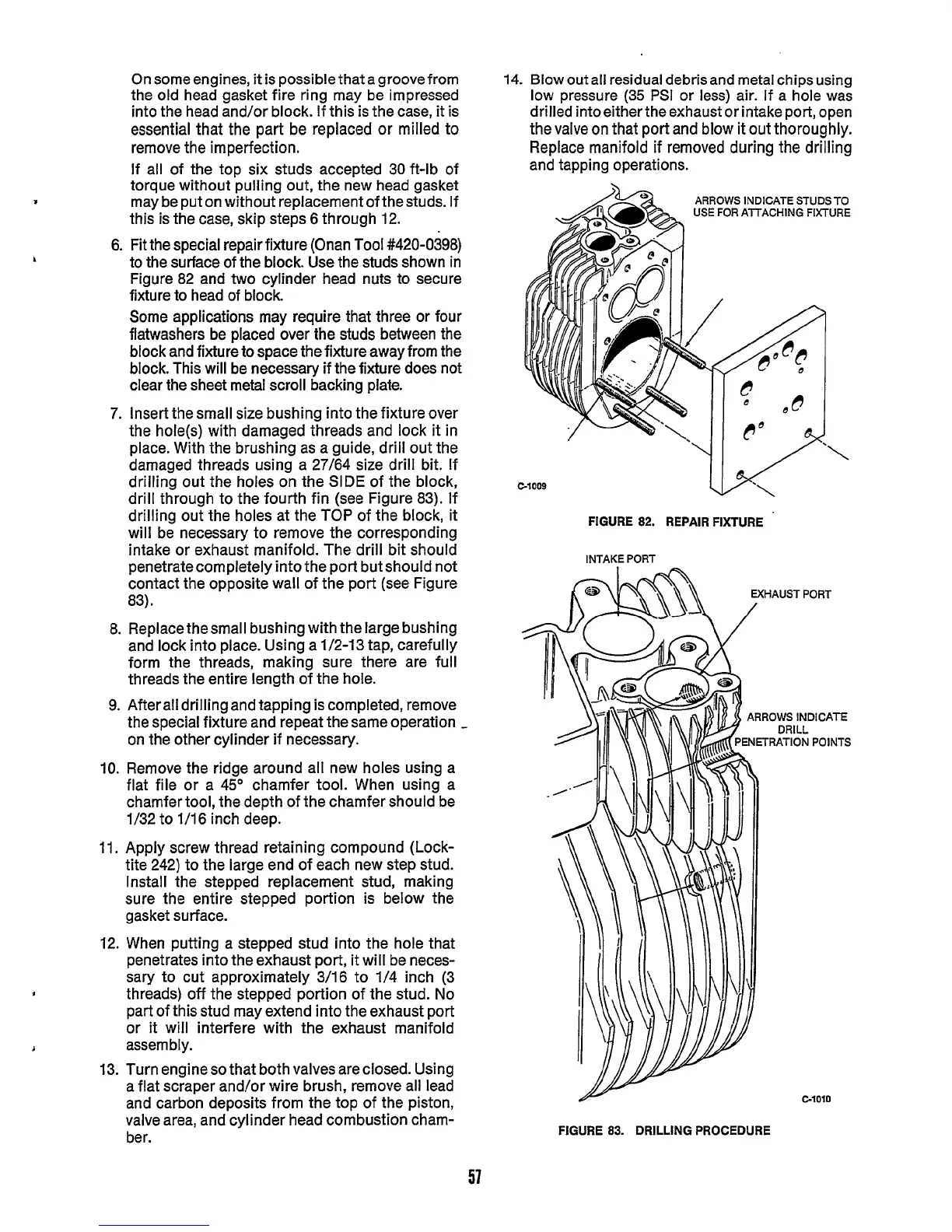
Fit the special repair fixture (Onan
Tool
#420-0398)
to the surface of the block. Use the studs shown in
Figure
82
and
two
cylinder head nuts to secure
fixture to head of block.
Some applications may require that three or four
flatwashers be placed over the studs between the
block and fixture
to
space the fixture away from the
block. This will be necessary if the fixture does not
clear the sheet metal scroll backing plate.
Insert the small size bushing into the fixture over
the hole(s) with damaged threads and lock
it
in
place. With the brushing as a guide, drill out the
damaged threads using a 27/64 size drill bit. If
drilling out the holes on the
SIDE
of the block,
drill through to the fourth fin (see Figure 83). If
drilling out the holes at the TOP of the block,
it
will be necessary to remove the corresponding
intake or exhaust manifold. The drill bit should
penetrate completely into the port but should not
contact the opposite wall of the port (see Figure
83).
Replace the small bushing with the large bushing
and lock into place. Using a 1/2-13 tap, carefully
form the threads, making sure there are full
threads the entire length of the hole.
After all drilling and tapping is completed, remove
the special fixture and repeat the same operation
-
on the other cylinder if necessary.
Remove the ridge around all new holes using a
flat file or a 45" chamfer tool. When using a
chamfertool, the depth of the chamfer should be
1/32 to 1/16 inch deep.
Apply screw thread retaining compound (Lock-
tite 242) to the large end of each new step stud.
Install the stepped replacement stud, making
sure the entire stepped portion is below the
gasket surface.
When putting a stepped stud into the hole that
penetrates into the exhaust port, it will be neces-
sary to cut approximately 3/16 to 1/4 inch (3
threads)
off
the stepped portion of
the
stud.
No
part of this stud may extend into the exhaust port
or it will interfere with the exhaust manifold
assembly.
Turn engine
so
that both valves areclosed. Using
a flat scraper and/or wire brush, remove all lead
and carbon deposits from the top of the piston,
valve area, and cylinder head combustion cham-
ber.
1
4.
Blow
out
all
residual
debris
and
metal
chips using
low
pressure
(35
PSI
or less) air.
If
a hole was
drilled into either the exhaust or intake port, open
the valve on that port and blow it out thoroughly.
Replace manifold if removed during the drilling
and tapping operations.
FIGURE
83.
DRILLING
PROCEDURE
57



 To Next Page