This document is an Operator Manual for the ONYX X-Series Propane Floor Machines, which include JX, SX, TX, and ZX models. These machines are designed for floor care, utilizing propane as fuel. The manual provides essential instructions for operation, maintenance, and safety.
Function Description:
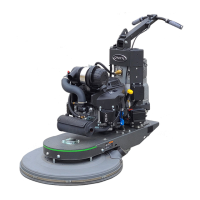
The ONYX X-Series Propane Floor Machines are designed for professional floor care, specifically for buffing and polishing. They are powered by propane engines, which are calibrated to operate with a "lean" air/fuel ratio to minimize carbon monoxide (CO) production. Each machine is equipped with a catalytic muffler to further reduce CO, hydrocarbons (HC), and nitrous oxides (NOx) from the engine exhaust, making them suitable for indoor operation. The machines feature a rotating pad system for floor treatment, with adjustable handle and wheel positions to accommodate different operators and floor conditions. Some models may include optional features such as clutch handles, headlight switch, water switch, dust bag, and dust chute.
Important Technical Specifications (JX Model as an example):
- Engine Size: 603 CC
- Pad Diameter: Available in 21 in., 24 in., or 27 in. (varies by model)
- Net Weight: 272 lb
- Gross Weight: 330 lb
- Packaged Dimension (L x W x H): 52 in. x 30 in. x 44 in.
- Front Wheels: 6 x 1.5 in. (x2)
- Pulley Ratio: 4:8
- Belt: BX51
- Engine Idle RPM: 2000
- Engine MAX RPM: 2900 to 3500 (varies by model)
- PAD RPM: 1000 to 1800
- Propane Cylinder: 20 LB Vertical Vapor
- Oil Capacity: Approximately 2.0 Liter
- Spark Plug: F7TRC (NHSP) or equivalent, with a gap of 0.6-0.8mm
- Battery Specs:
- Model: HJTZ5S-30-GFP
- Voltage (V): 12.8
- Capacity (Ah): 3
- Weight: 0.7 kg / 1.5 lb
- Charging Current: 0.5A to 15A
- Charging Voltage: 14.4 ± 0.5 V
- Cold Cranking Amps: 180
- Cycle Life: ≥1000
Usage Features:
- Operation: The manual details preparation steps, including checking engine oil, propane cylinder fill level, fuel system integrity, and machine part security. It provides instructions for starting the engine (slowly opening the propane service valve, setting throttle to idle, rocking the machine back, and turning the ignition switch to "Start") and stopping it (setting throttle to idle, closing the service valve, allowing remaining propane to be consumed, and turning the key off).
- Handle Adjustment: The handle can be adjusted to various heights by loosening a knob, positioning the handle, and then tightening the knob.
- Wheel Position Adjustment: The front wheels' position significantly impacts machine performance (pad pressure, forward propulsion, machine torque). Adjustments involve stopping the engine, rocking the machine back, removing the cotter pin/hair pin and wheel axle, repositioning the wheel and spacer in the desired hole, and reinserting the axle and pin. This allows operators to customize performance based on floor type, finish, pad type, and personal preference.
- Propane Fuel: The machines use HD-5 grade vapor propane. Cylinders must be correctly oriented (horizontal or vertical, depending on machine design) and properly filled to 80% capacity to prevent liquid propane withdrawal, which can damage the regulator.
- CO Safety: Emphasizes the importance of proper ventilation, limiting the number of engines running, and maintaining the engine to avoid high CO content in exhaust. It also discusses "Effective Operating Zones" and how different work types (e.g., stripping vs. burnishing) affect CO diffusion and operator exposure. Fans are recommended for forced air mixing in small or concentrated operating zones.
Maintenance Features:
- Maintenance Schedule: A comprehensive schedule outlines daily, 25-hour, 50-hour, 100-hour, 200-hour, and 500-hour checks and tasks.
- Daily/Every 5 hours: Check engine oil level, loose hardware, fuel/oil leakage, intake air filter, bonnet filter, dust bag, pad, and shroud/seal.
- Every 25 hours (or more frequently under heavy load/hot weather): Change oil.
- Every 50 hours/Every season: Clean silencer and engine, check engine mounts, check belt for wear/slippage, check pulleys, drive shaft, and bearings, check wheels & bearings.
- Every 100 hours: Replace spark plug, check fuel filter.
- Every 200 hours: Replace air cleaner primary element.
- Every 500 hours: Replace air cleaner secondary element, overall checkup at authorized service center.
- Oil Change: Instructions for draining warm oil, cleaning around the filler cap, refitting the drain plug, filling with fresh oil (approx. 2.0 Liter), and checking the oil level.
- Air Filter Maintenance: Cleaning debris from the air filter cap and rain cover, opening clips, gently shaking and tapping the element to remove dust, and cleaning the filter housing. Water, petrol, or detergents should not be used to clean the cartridge.
- Spark Plug Service: Removing, cleaning electrodes, checking the gap (0.6-0.8mm), and installing the spark plug. Replacement is necessary if electrodes are burnt or porcelain is damaged.
- Dust Collection Maintenance: For models with dust collection, instructions include removing the bag, unzipping and emptying its contents (preferably outside), shaking out debris, and reinstalling. The bag is functional for 20-30 cycles before replacement.
- Pad Change: Instructions for stopping the engine, rocking the machine back, removing the pad holder (counterclockwise), peeling off the old pad, installing a new pad centered on the gripper surface, and reinstalling the pad holder (clockwise).
- Battery Maintenance: The machine uses an onboard charging system. For offline charging, the manual provides steps to disconnect the battery, connect charger clamps (red to positive, black to negative), set voltage/amperage, plug in the charger, charge for at least 8 hours, disconnect, and reinstall.
- Storage: Steps for long-term storage include turning off the ignition, removing and storing the propane tank outside, disconnecting battery cables to prevent drain, and storing the machine indoors in a climate-controlled, low-humidity environment.
- Troubleshooting Guide: Extensive tables for diagnosing and resolving common issues related to engine starting, inconsistent operation, loss of power, and propane system problems.


 To Next Page
 General