1
1 General
1.1 For your information...
Please read this manual carefully before using your appliance. It contains important safety advice; it explains how to use
and look after your appliance so that it will provide you with many years of reliable service.
Should a fault arise, please first consult the section on “Troubleshooting”. You can often rectify minor problems yourself,
thus saving unnecessary service co
sts.
Please keep this manual in a safe place and pass it on to new owners for their information and safety.
Assembly and installation may only be carried out by trained specialists and taking into account the applicable laws,
regulations and standards. All safety and warning information as well as the handling instructions in the enclosed
documents must be observed.
1.2 Intended use
The appliance is to be used solely for preparing food in the home or in other environments. Similar environments:
Use in shops, offices and other similar working environments.
Use in agricultural enterprises.
Use by customers in hotels, motels and other typical living environments.
Use in breakfast buffets.
It may not be used for any other purpose and may only be used under supervision.
GENERAL
EN
1.3 Explanation for symbols and indications
The following appliance was produced according to state of the art technology. Machines nevertheless give rise to risks
which cannot be constructively avoided.
In order to guarantee sufficient safety for the use, safety instructions are also given. These instructions are marked by way
of the highlighted texts which follow.
Sufficient safety in operation will only be guaranteed whene these instructions are observed.
The designated text passages have different meanings:
DANGER
Note indicating an imminent threat which may result
in death or very serious injury.
CAUTION
Note indicating a potentially dangerous situation
which may result in death or very serious injury.
IMPORTANT
Note indicating a dangerous situation which may
result in minor injury or damage to the appliance.
NOTE
Note to be observed in order to make handling the
appliance easier.
WARNING OF ELECTRICAL ENERGY!
RISK OF FATAL INJURY!
Live components have been installed near this
symbol. Covers bearing this sign may only be
removed by a certified skilled electrician.
This symbol has been applied to surfaces which get
hot. There is a risk of serious burning or scalding.
The surfaces may also be hot after the appliance has
been switched off.
OBSERVE REGULATIONS FOR HANDLING
ELECTROSTATICALLY SENSITIVE
COMPONENTS AND MODULES (ESDS)
Electrostatically endangered components and
modules are located behind covers bearing the
adjacent symbol. Never touch plug connections, strip
conductors or component pins. Only qualified staff
members who are familiar with ESDs are authorised
to carry out any technical intervention work.
3.3 How the cooktop extractor works
Depending on the model you purchased, the cooktop extractor can be operated as an exhaust air or a
recirculating air version.
Exhaust air mode
The air suctioned away is purified by the grease filter and expelled into the open air via a duct system.
The exhaust air must not be expelled into:
• a smoke or exhaust gas flue that is in operation
• a shaft used for the aeration of rooms where fireplaces are installed.
If the exhaust air is to be directed into a smoke or exhaust gas flue that is not in use, the installation must
be checked and approved by the responsible heating engineer.
Recirculation mode (only in C-version)
The air suctioned away is purified by the grease filter and an activated charcoal filter and fed back into the
room in which the appliance is installed. To prevent odours in recirculation mode, an odour filter must be
used. For hygiene and health reasons, the activated charcoal filter must be replaced at the recommended
intervals (see the Cleaning and maintenance chapter).
How the induction cooktop works
3.4.1 Slide control
The glass ceramic hob is operated with touch control sensor keys. The sensor keys are operated as
follows: lightly touch a symbol on the surface of the ceramic glass plate. A buzzer will indicate when the
controls have been operated correctly.
The touch control sensor key will then be indicated as “key”.
What must be observed when operating sensor fields?
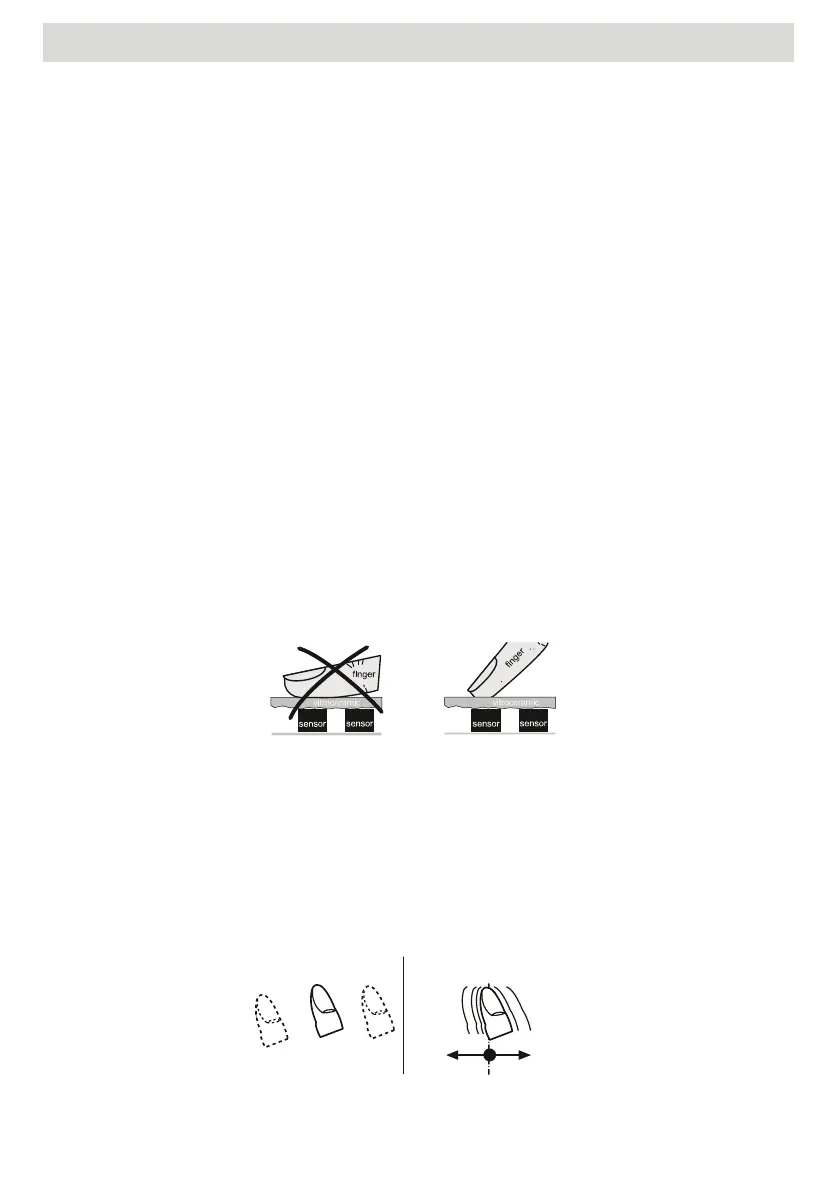
Your finger should not be placed flat onto the glass ceramic surface in order to avoid adjacent keys/sensor
fields from reacting by mistake.
Press the sensor field lightly or move your finger around
You can press the sensor field very lightly with your finger; when this is done the setting on the display
(power level) will gradually change.
When you put your finger on the sensor field and then move it to the left or right, the display setting will
change progressively.
The faster the movement, the faster the change in the display
touch move
3.3 How the cooktop extractor works
Depending on the model you purchased, the cooktop extractor can be operated as an exhaust air or a recirculating
air version.
Exhaust air mode
The air suctioned away is purified by the grease filter and expelled into the open air via a duct system. The exhaust
air must not be expelled into:
a smoke or exhaust gas flue that is in operation
a shaft used for the aeration of
rooms where fireplaces are installed.
If the exhaust air is to be directed into a smoke or exhaust gas flue that is not in use, the installation must be
checked and approved by the responsible heating engineer.
Recirculation mode (only in C-version)
The air suctioned away is purified by the grease filter and an activated charcoal filter and fed back into the room in
which the appliance is installed. To prevent odours in recirculation mode, an
odour filter must be used. For hygiene
and health reasons, the activated charcoal filter must be replaced at the recommended intervals (see the Cleaning
and maintenance chapter).
3.4 How the induction cooktop works
3.4.1 Slide control
The glass ceramic hob is operated with touch control sensor keys. The sensor keys are operated as follows: lightly
touch a symbol on the surface of the ceramic glass plate. A buzzer will indicate
when the controls have been
operated correctly.
The touch control sensor key will then be indicated as “key”.
What must be observed when operating sensor fields?
Your finger should not be placed flat onto the glass ceramic surface in order to avoid adjacent keys/sensor fields
from reacting by mistake.
unsuitable
right
Press the sensor field lightly or move your finger around
You can press the sensor field very lightly wi
th your finger; when this is done the setting on the display (power
level) will gradually change.
When you put your finger on the sensor field and then move it to the left or right, the display setting will change
progressively.
The faster the movement, the faster the change in the display.
APPLIANCE DESCRIPTION EN
1
2 3 4 5 6 7 8 9 P
2 3 4 5 6 7 8 9 P
1
touch move
3.3 How the cooktop extractor works
Depending on the model you purchased, the cooktop extractor can be operated as an exhaust air or a recirculating
air version.
Exhaust air mode
The air suctioned away is purified by the grease filter and expelled into the open air via a duct system. The exhaust
air must not be expelled into:
a smoke or exhaust gas flue that is in operation
a shaft used for the aeration of
rooms wher
e fireplaces are installed.
If the exhaust air is to be directed into a smoke or exhaust gas flue that is not in use, the installation must be
checked and approved by the responsible heating engineer.
Recirculation mode (only in C-version)
The air suctioned away is purified by the grease filter and an activated charcoal filter and fed back into the room in
which the appliance is installed. To prevent odours in recirculation mode, an odour filte
r must be used. For hygiene
and health reasons, the activated charcoal filter must be replaced at the recommended intervals (see the Cleaning
and maintenance chapter).
3.4 How the induction cooktop works
3.4.1 Slide control
The glass ceramic hob is operated with touch control sensor keys. The sensor keys are operated as follows: lightly
touch a symbol on the surface of the ceramic glass plate. A buzzer will indicate
when the
controls have been
operated correctly.
The touch control sensor key will then be indicated as “key”.
What must be observed when operating sensor fields?
Your finger should not be placed flat onto the glass ceramic surface in order to avoid adjacent keys/sensor fields
from reacting by mistake.
unsuitable
right
Press the sensor field lightly or move your finger around
You can press the sensor field very lightly wi
th your fin
ger; when this is done the setting on the display (power
level) will gradually change.
When you put your finger on the sensor field and then move it to the left or right, the display setting will change
progressively.
The faster the movement, the faster the change in the display.
APPLIANCE DESCRIPTION EN
5 Cleaning and care
x Switch the hob off and let it cool down before you clean it.
x Never clean the glass ceramic hob with a steam cleaner or similar appliance!
x When cleaning make sure that you only wipe lightly over the ON/OFF key. The hob may otherwise be
accidentally switched on.
x Observe all safety and warning information.
x Regular cleaning and maintenance ensures long service life of the appliance and opt
imal function.
Component Cleaning cycle
Operating panel Immediately after every soiling
Glass ceramic hob
Clean with conventional glass ceramic detergents immediately
after soiling and on a weekly basis
Air inlet glass
After cooking very greasy dishes; at least once a week. Clean
by hand (Do not put this part in the dishwasher!)
Grease filters
Clean when the fan power level indicator shows F. (Do not put
this part in the dishwasher!)
Condensation filter Every time you clean the grease filters (do not put this part in
the dishwasher!).
Water collector When some water overflows and flows in the air inlet opening.
Carbon filters (only in C - version)
Regenerate if odours have built up, extraction power is
dwindling or the fan power level indicator shows C. Every 2
years the carbon filters must be replaced.
5.1 Glass ceramic hob
Important! Never use aggressive cleaning agents such as rough scouring agent, abrasive saucepan cleaners, rust
and stain removers etc.
Cleaning after use
x Always clean the entire hob when it has become soiled. It is recommended that you do so every time the hob
is used. Use a damp cloth and a little washing up liquid for cleaning. Then dry the hob with a clean dry cloth
to ensure that there is no de
tergent left on the surface of the hob.
Weekly cleaning
x Clean the entire hob thoroughly once a week with commercial glass cerami
c cleaning agents. Please follow
the manufacturer's instructions carefully. When applied, the cleaning agent will coat the hob in a protective
film which is resistant to water and dirt. All the dirt will remain on the film and can then easily be removed.
Then rub the hob dry with a clean cloth. Make sure th
at no cleaning agent remains on the surface of the hob
since this will react aggressively when the hob is heated up and will change the surf
ace.
5.2 Specific soiling
Heavy soiling and stains (lime scaling and shiny, mother-of-pearl-type stains) can best be
removed when the hob is still slightly warm. Use commercial cleaning agents to clean the hob.
Proceed as outlined under Item 2.
First soak food which has boiled over with a wet cloth and then remove remaining soiling with
a special glass scraper for glass ceramic hobs. Then clean the hob again as described under chapter
5.1.
17
CLEANING AND CARE
EN
48
APPLIANCE DESCRIPTIONEN


 To Next Page
 Loading...
