Need help?
Do you have a question about the Opex Sure Sort and is the answer not in the manual?
Explains the manual's content, intended audience, and structure.
Details how to navigate the manual using links, bookmarks, and software.
Explains the meaning of safety hazard symbols and conventions used.
Introduces the safety information relevant to operating and maintaining the OPEX equipment.
Provides essential safety guidelines to be observed when working with the equipment.
Identifies safety labels located on the machine and their purpose.
Details safe use notice labels on the induct conveyor module.
Warns about arc flash and electrical hazards, requiring adherence to standards.
Warns about electrical hazards inside and the need to disconnect power before opening.
Warns about electrical hazards on the return conveyor and need to disconnect power.
Warns about pinch hazards at gaps near the conveyor belt.
Warns about electrical hazards on base/stacker modules and need to disconnect power.
Cautions against climbing machine structure due to falling hazard.
Cautions to keep hands away from moving parts due to crush hazard.
Warns about electrical hazards in expansion modules and need to disconnect power.
Cautions to keep hands away from moving parts in expansion modules.
Cautions personnel about stored electrical charge inside the iBOT module.
Cautions personnel about hazardous substance contained inside the iBOT module.
Describes emergency stop buttons and door interlocks for machine safety.
Explains the function and location of emergency stop buttons.
Procedure for safely restarting the machine after an emergency stop.
Explains the safety door interlock system that stops the machine when doors open.
Details the safety procedure for shutting down and locking out the machine.
Procedure for shutting down and locking out the Sure Sort for maintenance.
Procedure for de-energizing plug-in machines using lockout devices.
Procedure for de-energizing hard-wired machines by locking out main disconnect.
Procedure for clearing jams and removing iBOTs safely with lockout.
Procedure to return the machine to normal operation after maintenance or jam clearing.
Recommends specific PPE for operator safety based on Arc Flash Category 1.
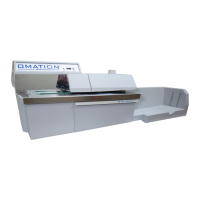
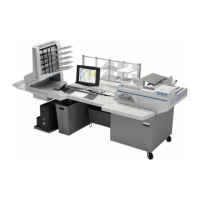
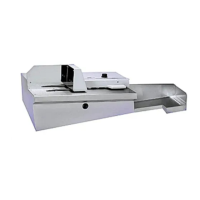
Provides a general overview of the Sure Sort system and its main components.
Details the available options and configurations for the Sure Sort system.
Lists the components included in the standard Sure Sort base system.
Lists optional enhancements such as barcode tunnels and return conveyors.
Explains the operational workflow of the Sure Sort system.
Describes the operator's main interface for system control and job management.
Explains the ELC application's role in interfacing with WMS and host software.
Details the functionality of the optional barcode scanning tunnel.
Provides technical specifications for the Sure Sort system.
Lists dimensions and electrical requirements for the base system configuration.
Provides detailed dimensions and weights for various machine modules.
Details agency approvals, noise levels, operating temperatures, and humidity.
Shows the system footprint and required space with dimensions.
Specifies the electrical power requirements for North American installations.
Specifies the electrical power requirements for European (EU) installations.
Specifies the electrical power requirements for Japanese installations.
Provides FCC compliance information and operating conditions for the wireless transceiver.
Lists the standards used for evaluating the Sure Sort equipment.
Shows where to find machine and iBOT serial numbers for support.
Provides an overview of the operator station and system accessibility.
Details the step-by-step process for inducting and sorting items.
Instructions for powering the machine on and off, including UPS and computer startup.
Steps to launch and log into the Sure Sort Host software.
Explains how to navigate the Host software interface using menus and tabs.
Details the main components and functions of the Run screen for job management.
Provides information on machine performance during a run via various tabs.
Displays general job statistics like run time, idle time, and item counts.
Lists jams that have occurred during the current run, including time and count.
Provides information on active iBOT status, power level, and destination.
Shows the status of the ELC interface, indicating connectivity and function.
Explains how to identify and clear common jams and issues.
Describes jams caused by items not arriving on iBOTs correctly or on time.
Describes jams caused by missed or blocked sensors preventing item processing.
Describes jams when an iBOT cannot deliver an item to a bin due to bin issues.
Describes jams when an iBOT fails to unload an item into the bin due to obstruction.
Lists other possible causes of jams related to product handling or packaging.
Explains how to switch between the Host and InductELC software applications.
Provides an overview of the statistics available for system job runs.
Explains how to generate and export statistics reports.
Allows selection of a time range for generating statistics reports.
Defines various reject and jam codes and their meanings.
Lists and defines reject messages originating from ELC and Host systems.
Defines ELC-specific reject messages and their causes.
Defines Host-specific reject messages and their causes.
Lists and defines various jam messages and their causes.
Lists and defines jams that impact system safety.
Alphabetical list of acronyms used throughout the documentation.
Alphabetical list of terms and concepts used in the documentation.
 General
| Throughput | 45, 000 pieces per hour |
|---|---|
| Dimensions | Varies by model |
| Weight | Varies by model |
| Power Supply | Varies depending on configuration |
| Item Size | Varies by model |
| Item Weight | Varies by model |
| Sort Destinations | Up to 100 |
| Weight Capacity | Varies by model |
| Power Requirements | Standard electrical outlet |
| Output Bins | Varies by model |


 To Next Page