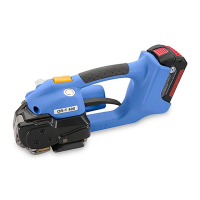
The OR-T 55 is a battery-operated strapping tool designed for plastic strapping, specifically polypropylene (PP) and polyester (PET) straps. It is intended for securing packaged items such as packages and pallet loads. The tool is manufactured by Orgapack, c/o Signode Switzerland GmbH.
Function Description:
The OR-T 55 operates by tensioning and friction welding plastic straps. The process begins by pressing the tensioning lever against the handle to open the tensioning device. The start of the strap is then inserted below the tension shoe (2) and under the cutting device (1). After releasing the tensioning lever, the strap coming from the dispenser is inserted between the tension wheel (3) and the tension shoe (2), and then through the slot in the cutting device (1). The tensioning lever is moved back and forth until the desired tensioning force is achieved. Finally, the welding button is pressed against the tensioning lever, and the lever is moved all the way forward. This action welds the straps together and cuts off the upper strap in the cutting device (1).
The tool features adjustable strap tension, welding time, and strap width. The strap tension is adjusted via a friction clutch, which can be increased by turning a nut clockwise and decreased by turning it counterclockwise. The welding time is set using '+' and '-' keys on the foil keyboard, with the current setting displayed by filled dots. The strap width can be adjusted by removing the strap stop and refitting it with washers of varying thickness, depending on the desired strap width.
Important Technical Specifications:
- Weight: 3.8 kg (8.4 lb) (including battery).
- Dimensions: Length: 380 mm (15"), Width: 130 mm (5.1"), Height: 200 mm (7.9").
- Strap Tension: Fully variable up to 2300 N (510 lbs.), depending on strap quality, controlled by a friction clutch.
- Sealing Method: Friction welded.
- Strap Types: Polypropylene (PP) and Polyester (PET).
- Adjustable Strap Widths: 9-10 mm (3/8"), 12-13 mm (1/2"), 15-16 mm (5/8"), 19 mm (3/4").
- Strap Thickness: 0.50-1.00 mm (.019"-.039").
- Battery: Bosch Li-Ion 12 V/6.0 Ah (Part no 2187.020 for OR-T 55, Part no 2187.021 for USA version).
- Charger: Bosch AL60 DV1419 (Part no 2188.025 for 230 V, Part no 2188.026 for 115 V USA version, Part no 2188.027 for 100 V Japan version).
- Charging Time: Approximately 60 minutes for 80% capacity, 80 minutes for 100% capacity (US-Version: approx. 120 min for 80%, 160 min for 100%).
- Strappings per Battery Charge: Approximately 500, depending on strap.
- Operating Temperature: -10 °C to +40 °C (14–104 °F).
- Relative Humidity: Up to 90%.
- Sound Pressure Level (LPA): 79 dB (A) (Deviation 3.0 dB).
- Sound Power Level (LWA): 90 dB (A) (Deviation 3.0 dB).
- Vibrations at Handle (ah): 4.3 m/s² (Deviation 1.5 m/s²).
Usage Features:
The OR-T 55 is designed for ease of use and safety. It features a Tri-Color LED (10) that indicates the tool's status: green for ready, yellow during welding and cooling, flashing red if the tensioning lever is moved too early (tool blocked), and off if the battery charge is too low. A battery charging indicator (Section 4.1.3) on the foil keyboard (9) shows the battery's charge status with four LED segments. The tool automatically enters sleep mode after approximately two minutes of inactivity to conserve battery life.
Safety precautions include wearing eye, ear, and hand protection (cut-proof gloves) and safety shoes during operation. Users are warned against placing hands or other body parts between the strap and packaged goods during strapping to prevent jamming and crushing. In case of emergency, the strap tension can be released by actuating the rocker lever before welding, or the strap can be cut with a suitable tool after welding. The tool should not be used in explosive atmospheres or to lift packaged goods by the strapping.
Maintenance Features:
Regular maintenance is crucial for the OR-T 55's longevity and performance.
- Cleaning: The tool should be cleaned regularly, especially the tension wheel (1) and the toothed plate (2). This involves blowing them out sideways with compressed air or using the supplied steel brush. Daily cleaning is recommended for heavy use (>300 strappings/day), or weekly for lighter use (<300 strappings/day).
- Tool Inspection: A specialist unit should service the tool every 2 years or 50,000 strappings.
- Battery Care: Only Bosch batteries and chargers specified in the manual should be used. Batteries should be charged within a temperature range of 15-40 °C (59–104 °F) and stored in the charger if the tool is not used for long periods.
- Replacing Wear Parts:
- Tension Wheel: The tension wheel (1) is a wear part and can be replaced. This involves removing the battery, blocking the tension shaft (7) with an SW 11 wrench, removing the nut (3) with an SW 17 wrench, removing saucer springs (2) and carrier (1), pressing the tensioning lever to remove pin (8), and finally removing the tension wheel (5) with its clutch disks (4) and (6). Reassembly is in reverse order. It is important not to oil the coupling discs and to set maximum belt tension after installation.
- Tension Shoe: The tension shoe (1) is also a wear part. Replacement involves removing the battery, pushing the tensioning lever forward, removing set screw (3) with compression spring (4) and bolt (5), releasing set screw (7), pushing out spiral pin (6), raising the rocker unit (8) to remove the tension shoe (1), and cleaning the tooth plates and tension wheel. Reassembly is in reverse order, ensuring the switch link of the rocker lies below the stroke lever and the tension wheel is turned until the rocker moves down.
- Seal Check: After each strapping, a visual inspection of the weld seal is required. Poorly welded seals (weld not over entire area or excess material forced out) indicate issues with welding time settings or strap type, and require re-strapping or tool inspection by an authorized service center.
- Original Spare Parts: Only original spare parts should be used to maintain warranty and liability.

 Need help?

 To Next Page
 General