19
HYDROFIT™ Owner’s Information Manual
WARNING: The use and ownership of this work is defined in the legend upon the front page hereof.
The ERU not only improves passenger safety, but it also installs quickly with little
disruption to building tenants.
Your elevator has a supplemental emergency supply of power provided by a 12-volt DC
battery unit. It is located within a top-of-car integration box mounted to the top of the
elevator car. In the event main power is lost, power is switched automatically to the
emergency supply and lights two lamps located in the elevator car’s ceiling. The supply is
rated so that the lamps remain lit a minimum of four hours.
The Alarm button and Emergency Stop switch located in the car operating panel are
wired into the emergency power circuitry. When operated, an alarm bell, located on the
car top, sounds continuously. Communication begins between those in the elevator car
and either building personnel, an outside emergency authority, or OTISLINE®. The
choice depends on the equipment and the emergency services selected for your
particular elevator.
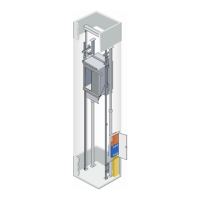
Low-Rise Lifting Equipment
The equipment that lifts the elevator car is housed in the machine room or in the machine
roomless elevator, in the hoistway of your building. The principle components that make
up both systems lifting equipment are the plunger and cylinder assembly (also known as
the “jack”), an AC motor directly attached to a pump, and a control valve.
The plunger and cylinder assembly receives hydraulic oil at a measured rate. The device
controlling the rate of oil flow is called the control valve. The control valve is connected by
piping to the motor/pump assembly, which is used to force hydraulic oil through the pipe
to the plunger and cylinder.
The motor/pump assembly is submersed in the hydraulic oil of the oil tank. The elevator
controller is mounted on the outside wall of the oil tank. All of this equipment is located
adjacent to the bottom of the elevator hoistway, commonly referred to as “the pit.”
To lift the elevator, electrical energy from your building is converted to mechanical
energy. Electricity is fed to the submersed motor. When the motor is operating, oil flows
from the tank, through the valve, and then toward the plunger and cylinder assembly. The
increase in oil volume in the cylinder forces the plunger to lift, and consequently, the
attached elevator car to rise.
Certain physical properties of fluid make it an effective means of producing mechanical
power. Fluid can change shape, it can be divided to do work at different locations, and it
can transmit a force in all directions. Since fluid is practically incompressible, mechanical
forces may be transmitted, multiplied, or controlled by means of hydraulic fluids under
pressure.


 To Next Page