4
HYDROFIT™ Owner’s Information Manual
WARNING: The use and ownership of this work is defined in the legend upon the front page hereof.
Modern day Otis came into being during the late 1800s
and the early 1900s, a time when “big business”
flourished. Otis Brothers & Co. merged in 1898 with
several U.S. elevator companies in Boston, Chicago,
and Philadelphia to become the Otis Elevator
Company. Forty more, small, independent elevator
companies were acquired during the period prior to
World War I.
The company expanded its product line by acquiring
the patents for modern escalator technology from
Charles D. Seenberger and Jesse W. Reno. The
world’s leading elevator manufacturer unveiled its new
“escalator” (a term trademarked and owned by Otis for
50 years) at the Paris World’s Fair of 1900.
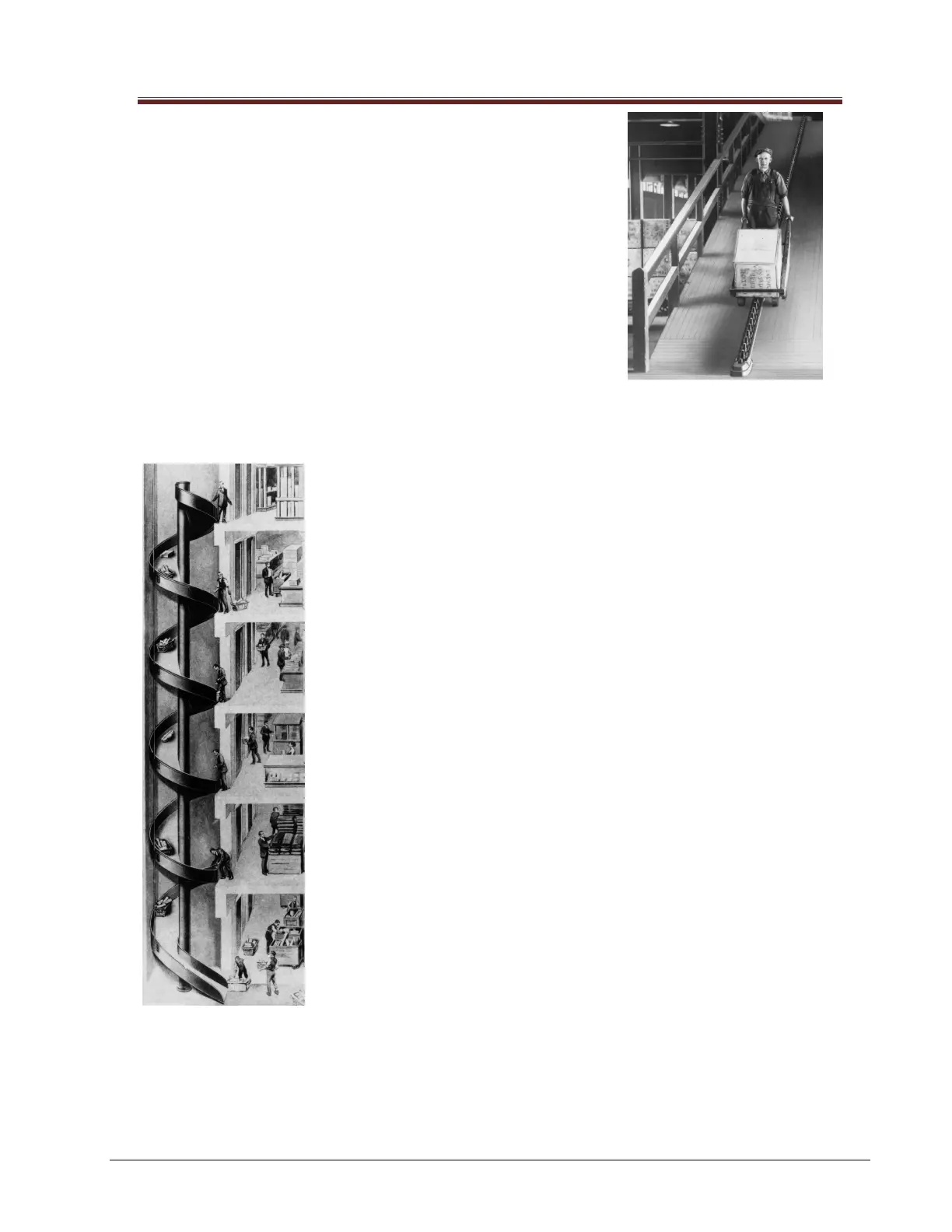
1920: Freight Incline
1900: Gravity Conveyers
In 1903, Otis introduced what would become the
“backbone” of the elevator industry, the gearless traction
electric elevator. It could be used in buildings of any height
and operated at greater speeds than steam elevators.
As skyscrapers got taller and taller, more Otis elevators
were installed, particularly in New York City. For example,
the 20-story Flatiron building was built in 1902 and had six
Otis elevators. In 1912, the Woolworth building rose to 60
floors and was equipped with 26 elevators.
Skyscrapers reached a new pinnacle in 1931 when the
world’s tallest building—the Empire State Building—
opened, serviced by 67 Otis elevators.
More tall buildings meant more elevators and a greater
need to keep them in good running condition. Otis
recognized this and in 1921 introduced the first preventive
maintenance service. Today, maintenance represents 50
percent of Otis’ overall business.
From its early days under Elisha Otis until late 1960s, Otis
Elevator explored many different product lines outside its
core business of elevators and escalators: the rotary oven
for bakeries in the 1850s, a haymaker in the 1870s, gravity
conveyors around 1900, the Sultan automobile from
1909–1912, and passenger and freight inclines in the
1920–1930s.


 To Next Page