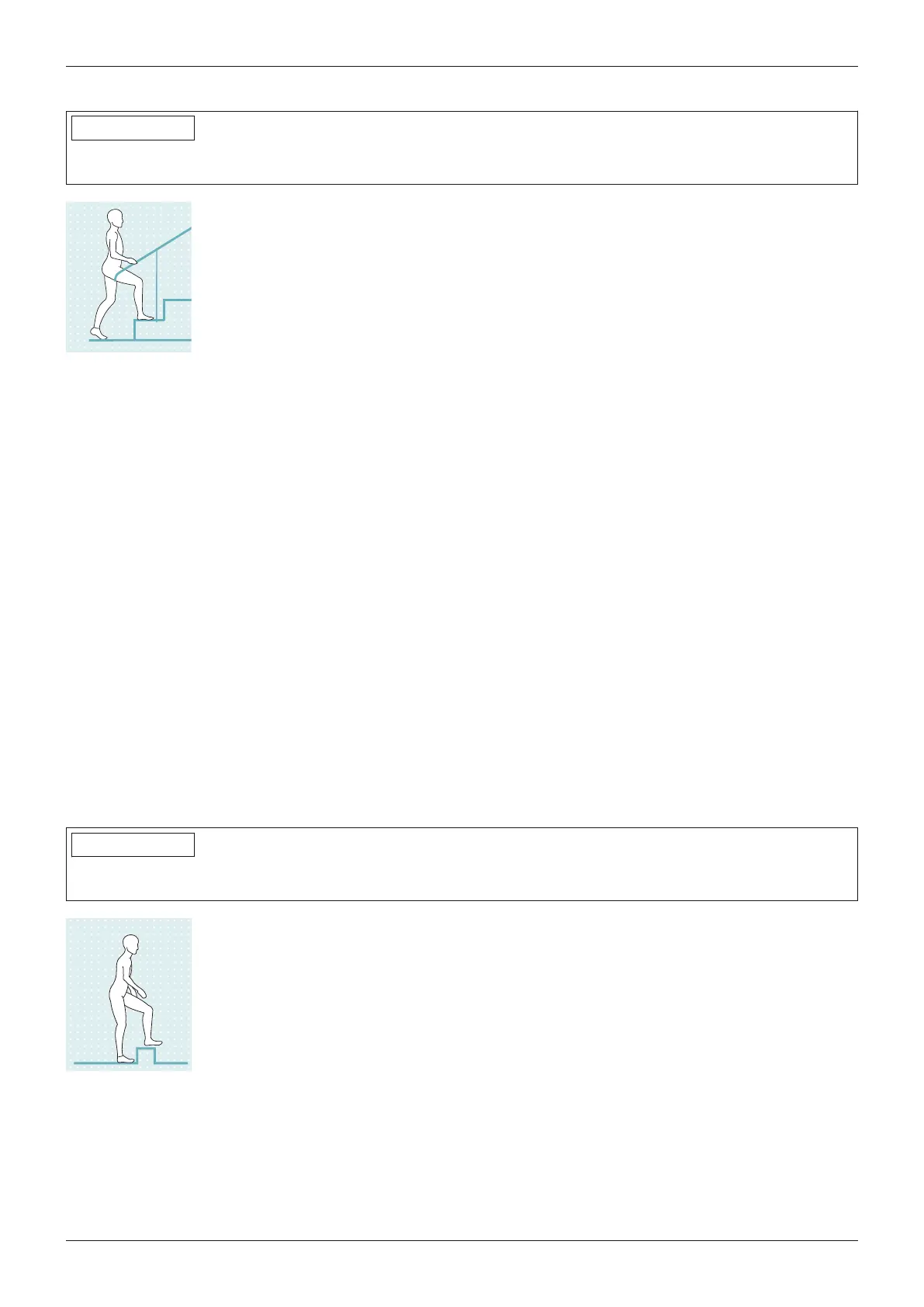
9.1.7 Walking up stairs step-over-step
INFORMATION
To use this function, it needs to be enabled in the adjustment software. It also has to be activated using the Cock
pit app (see Page86).
Although the knee joint is passive, which means it cannot actively initiate movements, negoti
ating stairs step-over-step is possible.
This function must be practised and executed consciously.
1) Lift the extended prosthesis off the floor.
2) Immediately after lifting the extended leg off the floor, extend the hip briefly and then
abruptly flex it. This requires a sufficiently secure hold in the socket and a certain level of
residual limb strength.
→ This whip motion flexes the knee, because the knee joint automatically recognises
the movement and sets the flexion resistance to minimum.
INFORMATION: Take note of people behind you before executing the whip
motion.
3) When sufficient knee flexion has been achieved, the knee joint increases extension res
istance so that there is enough time to position the foot on the next step before the knee
joint is extended again.
4) Set the foot onto the next step.
The support area for the foot on the step must be large enough that the heel does not
extend back too far over the edge. With too little support area, the lower leg would
extend too early and position the leg too far backwards. In this phase, the knee joint has
already set the flexion resistance to maximum (blocked). The knee joint can no longer be
flexed but only extended. This ensures that the leg does not buckle if the hip strength is
not sufficient for the extending motion.
5) Support yourself with your hand on the contralateral side. A smooth wall will also work.
This lateral support is intended to prevent the residual limb from twisting in the socket.
Twisting can lead to unpleasant surface tension between the skin and the socket. Lateral
support also improves balance.
6) Bring the knee into extended position. When the knee joint is fully extended, the initial
position has been reached.
7) You can climb the next step or continue walking normally.
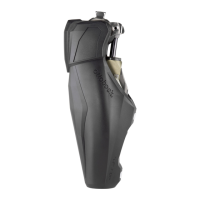
9.1.8 Overcoming obstacles
INFORMATION
To use this function, it needs to be enabled in the adjustment software. It also has to be activated using the Cock
pit app (see Page86).
The stair function can also be used to cross obstacles:
1) Lift the extended prosthesis off the floor.
2) Briefly extend the hip.
3) Quickly flex the hip. This causes the knee to flex.
4) With the knee flexed, step over the obstacle.
With sufficient knee flexion, the extension resistance is increased to allow enough time
for crossing the obstacle.
84
Use
Genium 3B1-3/3B1-3=ST






 To Next Page