EMBROIDERY BASICS
2
Needles
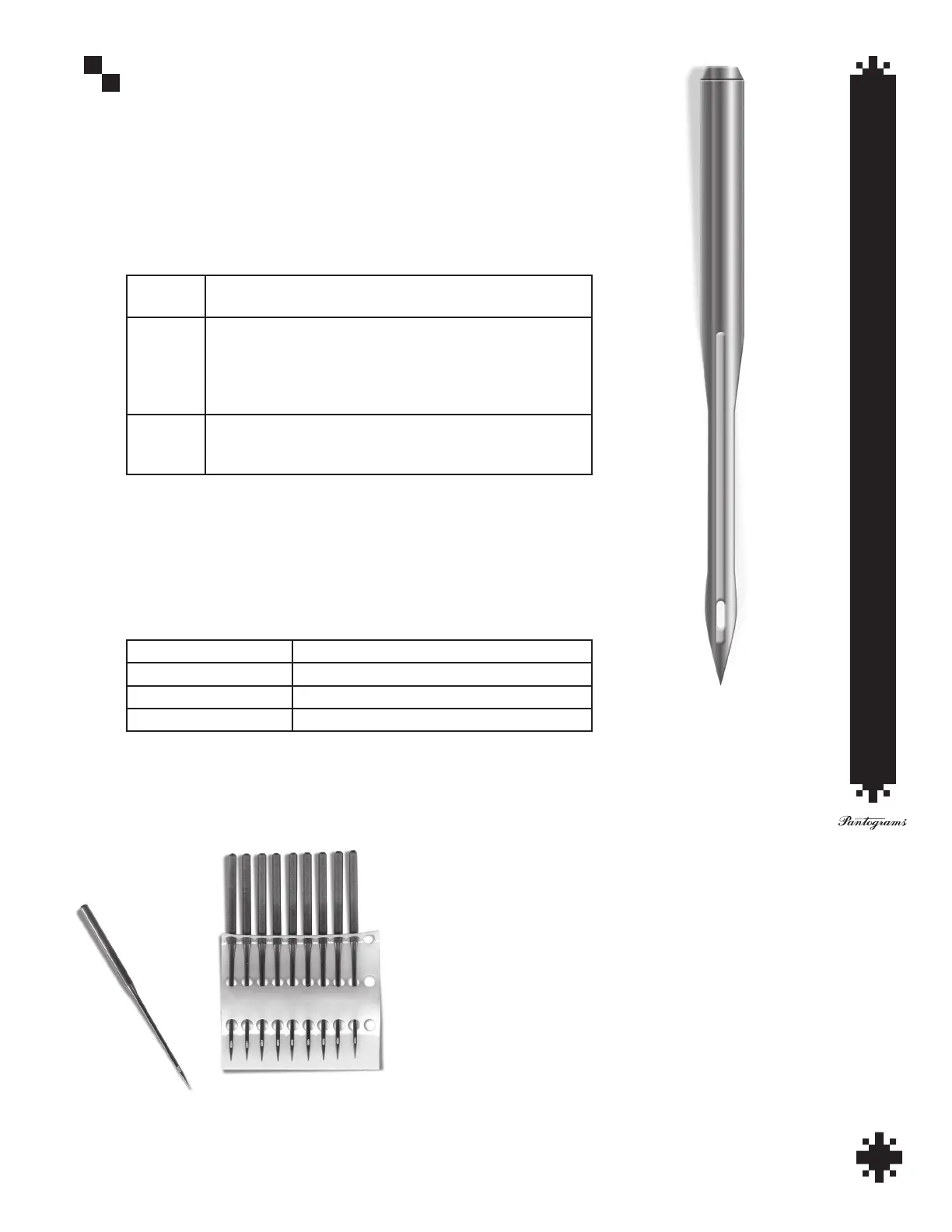
Choosing the right needle is important to ensure quality stitches. Embroidering with a
needle that is too big or too small for the thread and fabric can result in thread breaks
or even skipped stitches. Needles are typically made of chrome or titanium and there
are four things to consider when choosing the right needle for the job, and that is
style, size, point and coating.
Style
Needles have a generic number system that refers to the shaft length and eye size.
1738 standard point and standard eye for exact
penetration with low resistance for fill stitches.
DBxK5 a medium point needle with a larger eye for general
purpose embroidery and universal applications. Allows
smoother flow of thread through eye of the needle, but is
slightly less durable due to thinner eye wall. Because the
eye of the needle is larger there are less thread breaks.
DBx7ST this needle is ideal for metallic threads, with an
extremely large rectangular eye that allows easy
passage of thread.
Size
Needles have two numbers on them to designate size. For example 75/11, the first
number refers to the European size and the second refers to the American size. The
first number is the measurement of the blade’s diameter, in hundredths of a millimeter.
Sizes range from 60/8 to 110/18, the larger the number, the larger the needle. Choose
needle size by fabric weight. The most common size needle for embroidery is 75/11.
60/8 lightweight fabrics
70/10, 75/11, 80/12 medium weight fabrics
90/14, 100/16* heavy fabrics like jeans, upholstery or canvas
110/18*, 120/19* very heavy fabrics
* Remember if you use a needle over 90/14 the machine must have the timing adjusted.
Point
Sharp – the most common, has a sharp pointed tip that easily
penetrates fabrics. It is ideal for sewing on woven fabrics such as
cotton, denim, and wool.
Ballpoint – has a slightly rounded point that penetrates between
fabric threads rather than pierce them. Use on knits, fleece and
delicate fabrics like satin.
Wedge-point – this point is for leather applications.
Coating
Titanium needles (chrome with a titanium nitrate coating) are
gold in color, have a stronger hold that is more resilient, a longer
point and are required on high-speed embroidery machines such
as the GS1501. Titanium needles are sold under different names
such as “gebedur” by Groz-Beckert and “perfect durability” by
Organ.


 To Next Page