66
F. DELAYED IGNITION (HARD LIGHT-OFF)
There are several factors that may cause a delayed ignition
in the PureFire boiler due to a pressure pulse at light-off.
G. BOILER FAILS TO RESPOND TO A
CH CALL
If the display screen shows “STANDBY” and does not
respond when a thermostat call has been initiated, use the
following procedure to check operation.
1. Enter the “Installer Menu” by pressing the “Menu/Return”
key and the “Select” key simultaneously for 5 seconds.
2. Using the “
M”key move the cursor to “SYSTEM
TEST” and press “Select”.
3. Use the “M”key again to move the cursor to “Low
Power”.
4. Press the “Menu/Return” key twice to return to the status
screen.
5. If the boiler operates, return to “SYSTEM TEST” and
select “OFF”. If not, contact technical support.
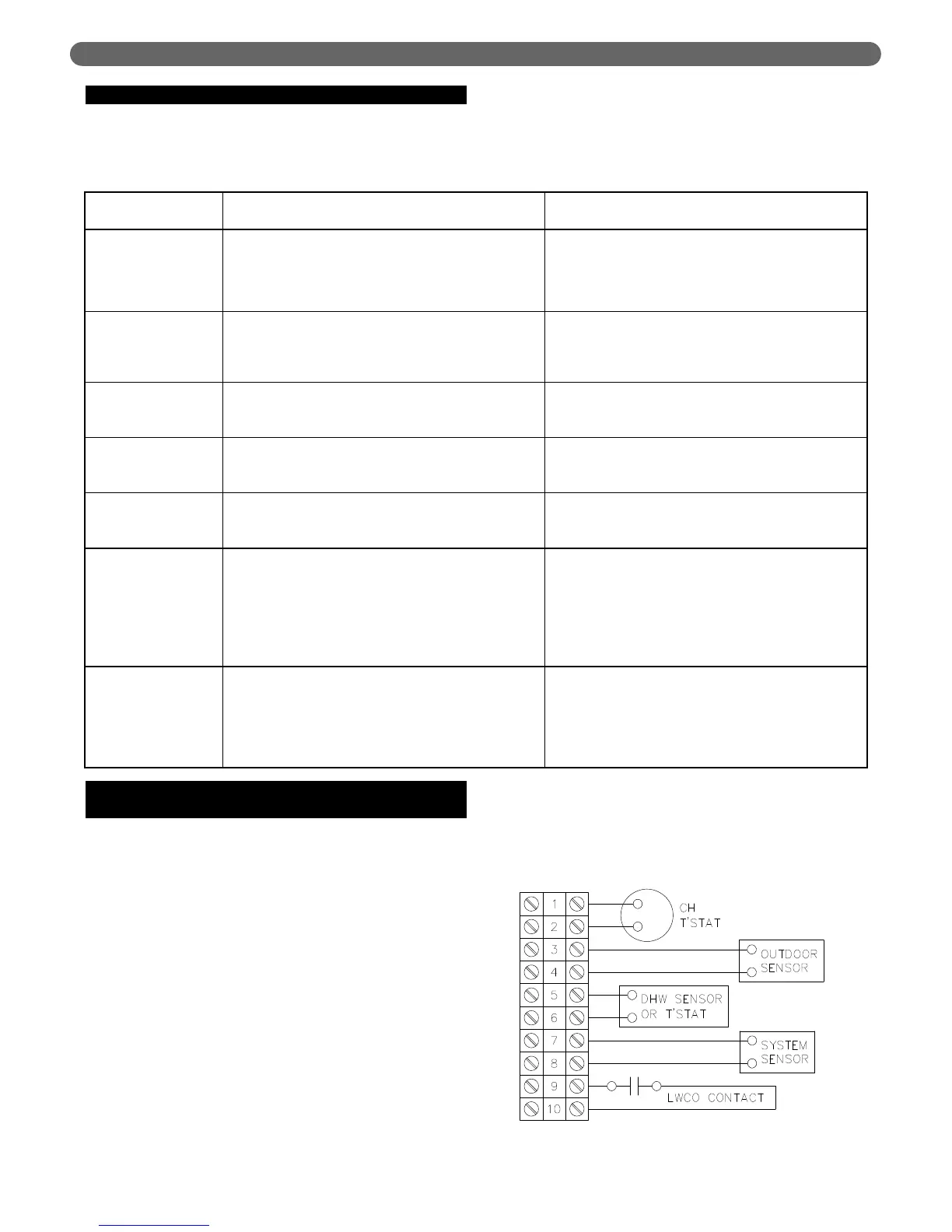
6. Next, remove any wires from terminals #1 & #2 (CH
Thermostat). See the illustration below.
7. Place a jumper in terminals #1 & #2, shown in Figure
10.2 below, to simulate a heating call.
8. If the boiler operates, there may be voltage feedback to
the thermostat terminals from the source. Check for stray
voltage or isolate the contacts.
Table 10.4: Hard Light-Off Conditions:
Condition
Condition Description Corrective Action
LOW GAS PRESSURE
If the gas inlet pressure at the inlet port on the gas valve is
below 3.5" of water for Natural Gas and 8” of water for
LP at 100% of modulation, a hard light-off may occur.
This may be due to slow introduction of the gas/air mix-
ture at light-off.
Be sure that the incoming gas pressure does not drop
below 3.5" of water for Natural Gas and 8” of water for
LP at any point in its operation. Be sure to check while
other appliances are in operation.
HIGH GAS PRESSURE
If the gas inlet pressure at the inlet port on the gas valve is
above 13.5" of water when the boiler is off, a delayed
ignition may occur. This is because the gas pressure may
inhibit the smooth opening of the gas valve at light-off.
Be sure that the incoming gas pressure is not above 13.5"
while the boiler is off or at any time during its operation.
INCORRECT
AIR/FUEL RATIO
Using a suitable combustion analyzer, check the products
of combustion to assure correct combustion air/fuel ratio
as described in Section 9.D.7 of these instructions.
If the vent CO
2
or CO is out of range in accordance with
table 5.4 in these instructions, please contact your PB
Heat representative.
SPARK GAP IS
TOO LARGE
If the spark gap between the ignition electrode and
ground rod is too large, a delayed ignition may occur.
This may be due to decreased spark energy of the larger
If the boiler is natural gas-fired, the spark gap should be
between 1/8" and 3/16". If the fuel is LP gas, the spark
gap should be between 3/16" and 1/4".
SPARK GAP IS
TOO SMALL
If the spark gap between the ignition electrode and
ground rod is too small, a delayed ignition may occur.
This may be due to a narrow ignition window from the
If the boiler is natural gas-fired, the spark gap should be
between 1/8" and 3/16". If the fuel is LP gas, the spark
gap should be between 3/16" and 1/4".
SPARK PLACEMENT
If the placement of the spark is the wrong distance from
the burner a delayed ignition may occur. The distance of
the spark from the burner surface should be approximately
3/8". If the spark gap is farther away from the burner, a
significant amount of combustible mixture may be intro-
duced into the combustion chamber before ignition. This
may result in a delayed ignition.
If the spark gap is more than 3/8" from the burner, replace
the ignitor and assure that the spark is 3/8" or less.
WEAK SPARK
A weak spark at the gap between the ignition electrode
and ground rod on the ignitor may be attributed to sever-
al problems.
1. Deterioration of the insulated spark wire
2. Dirt on the insulated portion of the spark electrode that
may provide a path for spark energy to ground
1. Check the spark wire for wear or damage. Replace if
necessary.
2. Check the porcelain insulation on the spark electrode
for evidence of dirt. Clean the insulator if dirt is evi-
dent.
TROUBLESHOOTING
Figure 10.2: CH Thermostat Terminals


 To Next Page