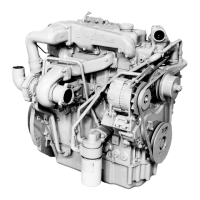
Note: The engine may be equipped with a device for
cold starting. If the engine will be operated in cold
conditions, then an extra cold starting aid may be
required. Normally, the engine will be equipped with
the correct type of starting aid for your region of
operation.
i06214259
Engine Stopping
Stop the engine according to the procedure in the
Operation and Maintenance Manual, “Engine
Stopping (Operation Section)” in order to avoid
overheating of the engine and accelerated wear of
the engine components.
Use the Emergency Stop Button (if equipped) ONLY
in an emergency situation. Do not use the
Emergency Stop Button for normal engine stopping.
After an emergency stop, DO NOT start the engine
until the problem that caused the emergency stop
has been corrected.
Stop the engine if an overspeed condition occurs
during the initial start-up of a new engine or an
engine that has been overhauled. Stopping the
engine may be accomplished by shutting off the fuel
supply to the engine and/or shutting off the air supply
to the engine.
To stop an electronically controlled engine, cut the
power to the engine.
i06214263
Electrical System
Never disconnect any charging unit circuit or battery
circuit cable from the battery when the charging unit
is operating. A spark can cause the combustible
gases that are produced by some batteries to ignite.
To help prevent sparks from igniting combustible
gases that are produced by some batteries, the
negative “−” jump-start cable should be connected
last from the external power source to the negative
“−” terminal of the starting motor. If the starting motor
is not equipped with a negative “−” terminal, connect
the jump-start cable to the engine block.
Check the electrical wires daily for wires that are
loose or frayed. Tighten all loose electrical wires
before the engine is started. Repair all frayed
electrical wires before the engine is started. Refer to
the Operation and Maintenance Manual, “Engine
Starting” for specific starting instructions.
Grounding Practices
Proper grounding for the engine electrical system is
necessary for optimum engine performance and
reliability. Improper grounding will result in
uncontrolled electrical circuit paths and in unreliable
electrical circuit paths.
Uncontrolled electrical circuit paths can result in
damage to main bearings, to crankshaft bearing
journal surfaces, and to aluminum components.
Engines that are installed without engine-to-frame
ground straps can be damaged by electrical
discharge.
To ensure that the engine and the engine electrical
systems function properly, an engine-to-frame
ground strap with a direct path to the battery must be
used. This path may be provided by way of a starting
motor ground, a starting motor ground to the frame,
or a direct engine ground to the frame.
All grounds should be tight and free of corrosion. The
engine alternator must be grounded to the negative
“-” battery terminal with a wire that is adequate to
handle the full charging current of the alternator.
i06214264
Engine Electronics
Tampering with the electronic system installation
or the OEM wiring installation can be dangerous
and could result in personal injury or death and/
or engine damage.
This engine has a comprehensive, programmable
Engine Monitoring System. The Electronic Control
Module (ECM) will monitor the engine operating
conditions. If any of the engine parameters extend
outside an allowable range, the ECM will initiate an
immediate action.
The following actions are available for engine
monitoring control: WARNING, DERATE and
SHUTDOWN. These engine monitoring modes can
limit engine speed and/or the engine power.
Many of the parameters that are monitored by the
ECM can be programmed for the engine monitoring
functions. The following parameters can be
monitored as a part of the Engine Monitoring System:
• Operating Altitude
• Engine Coolant Level
• Engine Coolant Temperature
• Engine Oil Pressure
18
SEBU9074-06
Safety Section
Engine Stopping



 To Next Page