Need help?
Do you have a question about the Pioneer SX-440 and is the answer not in the manual?
Highlights key performance and functional aspects of the stereo receiver.
Instructions for setting the correct voltage and replacing the fuse for safety.
Details on connecting various audio components to the rear panel of the receiver.
Guidance on optimal system placement and improving listening room acoustics.
Diagram identifying all buttons, knobs, and indicators on the front of the SX-440.
Detailed explanation of each knob and switch on the front panel and their functions.
Comprehensive guide to all input and output terminals on the rear panel for connectivity.
How to connect speakers, FM/AM antennas, and grounding procedures.
Guidance on connecting record players, tape decks, and cartridge players.
Step-by-step instructions for tuning into FM and AM radio broadcasts.
How to play vinyl records and cartridge tapes.
Procedures for recording audio onto tape and playing back recorded tapes.
Technical steps for aligning the AM section and stringing the dial cord.
Technical procedures for aligning the FM and multiplex stereo sections.
Detailed technical data including transistors, circuits, frequency response, and power.
Identifies common noise and operational issues and provides diagnostic steps and remedies.
Comprehensive list of all components used in the SX-440, including part numbers.
Visual layout of the tuner unit's printed circuit board with component placement.
Visual layouts of the audio and power supply unit's printed circuit boards with component placement.
Top view diagram showing the physical placement of major units and components.
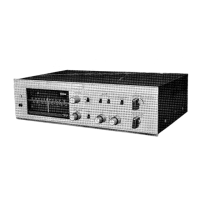
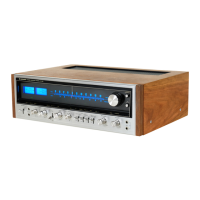
The Pioneer Model SX-440 is a solid-state FM-AM stereo receiver designed to provide high-fidelity audio reproduction and versatile connectivity for various audio components. This receiver integrates a tuner, preamplifier, and power amplifier into a single unit, offering a comprehensive solution for stereo audio systems.
The primary function of the SX-440 is to receive and amplify FM and AM radio broadcasts, as well as to process and amplify audio signals from external sources such as record players, tape recorders, and auxiliary devices. It features a sensitive FM circuit, employing a high-performance transistor in the RF amplifier to ensure excellent sensitivity without distortion or cross-modulation, even with high input power. The built-in multiplex circuit provides full-frequency response and good channel separation for a rich stereo effect. An automatic FM multiplex signal indicator illuminates when a stereo multiplex signal is detected, simplifying tuning.
For AM reception, the receiver utilizes a superheterodyne circuit and includes a built-in ferrite loopstick antenna for convenience, especially in areas with strong signals. An external AM antenna terminal is also provided for improved reception in weaker signal areas.
The audio section of the SX-440 is equipped with a dual-channel high-fidelity audio power amplifier, employing high-efficiency power transistors in a push-pull complementary circuit for full-fidelity frequency response. This design ensures robust and clear sound output to connected loudspeakers.
The SX-440 offers a range of user-friendly features for an enhanced listening experience. The front panel includes an easy-to-read tuning indicator meter, which helps users accurately tune into desired FM or AM stations by deflecting to its maximum point for optimal reception. The selector switch allows users to easily switch between different input sources: AM, FM Mono, FM Stereo, Phono (for record players with magnetic, ceramic, or crystal cartridges), and Aux (for tape recorders, TV sound, or other audio sources).
Independent bass and treble tone controls are provided, allowing users to adjust tonal qualities to suit room acoustics and individual preferences. These controls offer a flat characteristic curve when set to the middle of their rotation range. The loudness contour circuit, when activated, boosts bass and treble at low volume settings, preserving musical balance and dynamic range.
The receiver supports multiple speaker configurations, allowing connection of two or four loudspeaker systems (A and B). A loudspeaker selector switch on the front panel enables users to choose between speaker system A, B, or both. For private listening, a stereo headphone jack is conveniently located on the front panel, which automatically mutes the loudspeakers when headphones are plugged in.
The SX-440 also includes comprehensive input and output options on its rear panel. It features magnetic phono terminals for record players with magnetic cartridges, and auxiliary terminals for crystal/ceramic cartridges or other audio sources. Tape monitor and tape recording terminals (both RCA and DIN type) facilitate connection to tape recorders or tape decks, allowing for both playback and recording of program material from any selected source (AM, FM, FM stereo, or record). The recording output signals are unaffected by the volume, bass, or treble controls, ensuring a clean signal for recording.
For power management, the receiver includes switched and unswitched AC outlets on the rear panel, providing convenience for powering other audio components. The switched outlet's power is interlinked with the receiver's power switch, while the unswitched outlet provides continuous power.
The SX-440 incorporates features to ensure safe and reliable operation, as well as ease of maintenance. A line voltage selector switch on the rear panel allows the user to adapt the unit to different line voltages (110V, 117V, 130V, 220V, 240V), making it suitable for use in various regions. This selector also doubles as a fuse holder.
Protective fuses are included to safeguard the power transistors from damage due to short-circuited loudspeaker terminals or high-volume operation. Instructions are provided for checking and replacing these fuses, specifying the correct amperage for different voltage settings. The fuse cap can be easily removed by turning it with a coin in the indicated direction.
The manual provides detailed instructions for antenna connection and grounding, which are crucial for optimal reception and safety. It advises on using appropriate FM and AM antennas (indoor T-type, outdoor, ferrite loopstick) based on signal strength and location, and how to adjust them for best reception. Grounding recommendations are also given to minimize noise and enhance safety.
For troubleshooting, the manual includes a section on "Conditions Frequently Mistaken to Troubles," which helps users identify and resolve common issues such as various types of noise (continuous, hum, hiss, static) and poor tone quality. This section guides users through checking potential sources of noise (e.g., fluorescent lamps, motors, TV sets, worn styluses, poor connections) and suggests remedies. It also covers basic power-on issues, such as a blown fuse or loose line plug, and addresses howling caused by speaker-record player proximity.
The modular design, with separate tuner, audio, and power supply units, simplifies potential servicing by allowing technicians to isolate and address issues within specific sections. The inclusion of a parts list, circuit diagrams, and a mounting template further supports maintenance and repair efforts.
 General
| Input Sensitivity | 2.5mV (MM), 200mV (line) |
|---|---|
| Tuning Range | FM, MW |
| Speaker Load Impedance | 4Ω to 16Ω |
| Frequency Response | 20Hz to 20kHz |
| Signal to Noise Ratio | 80dB (line) |
| Semiconductors | 19 x transistors, 11 x diodes |
| Power Output | 12W per channel into 8Ω (stereo) |

 To Next Page