PIPER
SENECA
II
SERVICE
MANUAL
DISCHARGE
LINE
CONDENSER
SUCTION
LINE
j
PRESS.
SCHRADER
SWITCH
VALVE
1
1
~---<
...,
CAPILLARY FITTING
' ------- -= = = = = = = =
/2-E-ND-OF-:-:-:-:-RA_T_OR
__
~
REFRIGERANT
Rl2
CONTAINER
OF
WARM
WATER
(125°F)
SCALE
___
j
OPTIONAL METHOD
MUST HAVE DEVICE
TO
DEPRESS
SCHRADER
VALVE
CHARGING
STAND
PREFERRED METHOD
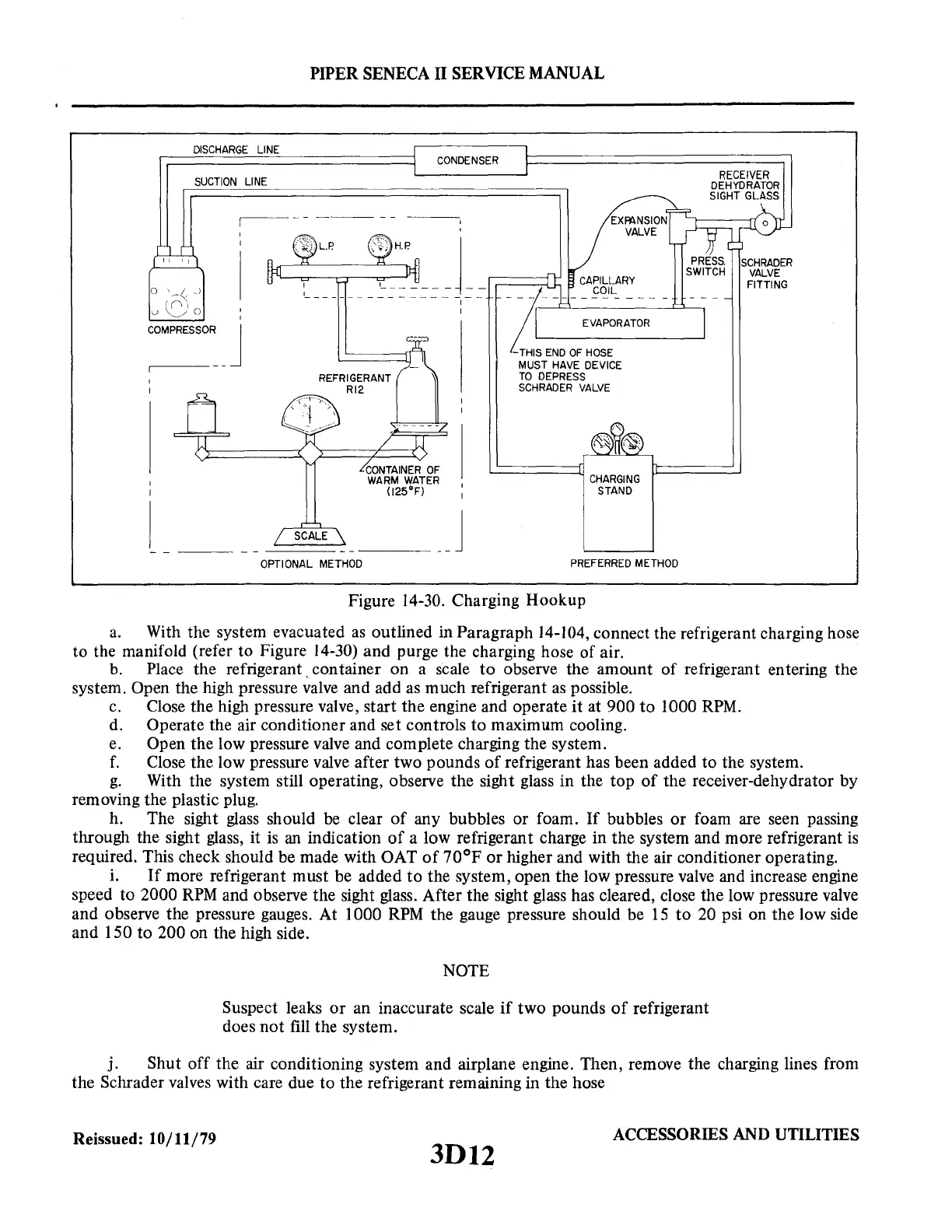
Figure 14-30. Charging
Hookup
a.
With the system evacuated
as
outlined in
Paragraph
14-I04, connect the refrigerant charging hose
to the manifold (refer to Figure 14-30)
and
purge the charging hose
of
air.
b. Place the refrigerant. container
on
a scale
to
observe the
amount
of
refrigerant entering the
system. Open the high pressure valve and add as
much
refrigerant
as
possible.
c. Close the high pressure valve, start
the
engine and operate
it
at
900
to
1000 RPM.
d. Operate the air conditioner and set controls
to
maximum cooling.
e. Open the low pressure valve and complete charging the system.
f.
Close the low pressure valve after
two
pounds
of
refrigerant has been added
to
the system.
g.
With the system still operating, observe
the
sight glass
in
the
top
of
the receiver-dehydrator
by
removing the plastic plug.
h. The sight glass should be clear
of
any bubbles
or
foam.
If
bubbles
or
foam are seen passing
through the sight glass, it
is
an indication
of
a low refrigerant charge in
the
system and more refrigerant
is
required. This check should be made with OAT
of
70°F
or
higher and with the air conditioner operating.
i.
If
more refrigerant
must
be added
to
the system, open
the
low pressure valve and increase engine
speed
to
2000
RPM
and observe the sight glass.
After
the sight glass has cleared, close
the
low pressure valve
and observe the pressure gauges.
At
1000 RPM the gauge pressure should be
15
to
20 psi on the low side
and
150
to
200 on the high side.
NOTE
Suspect leaks
or
an inaccurate scale
if
two
pounds
of
refrigerant
does
not
fill the system.
j.
Shut
off
the air conditioning system and airplane engine. Then, remove the charging lines from
the Schrader valves with care due
to
the
refrigerant remaining in the hose
Reissued:
10/11/79
ACCESSORIES
AND
UTILITIES
3D12



 To Next Page