5
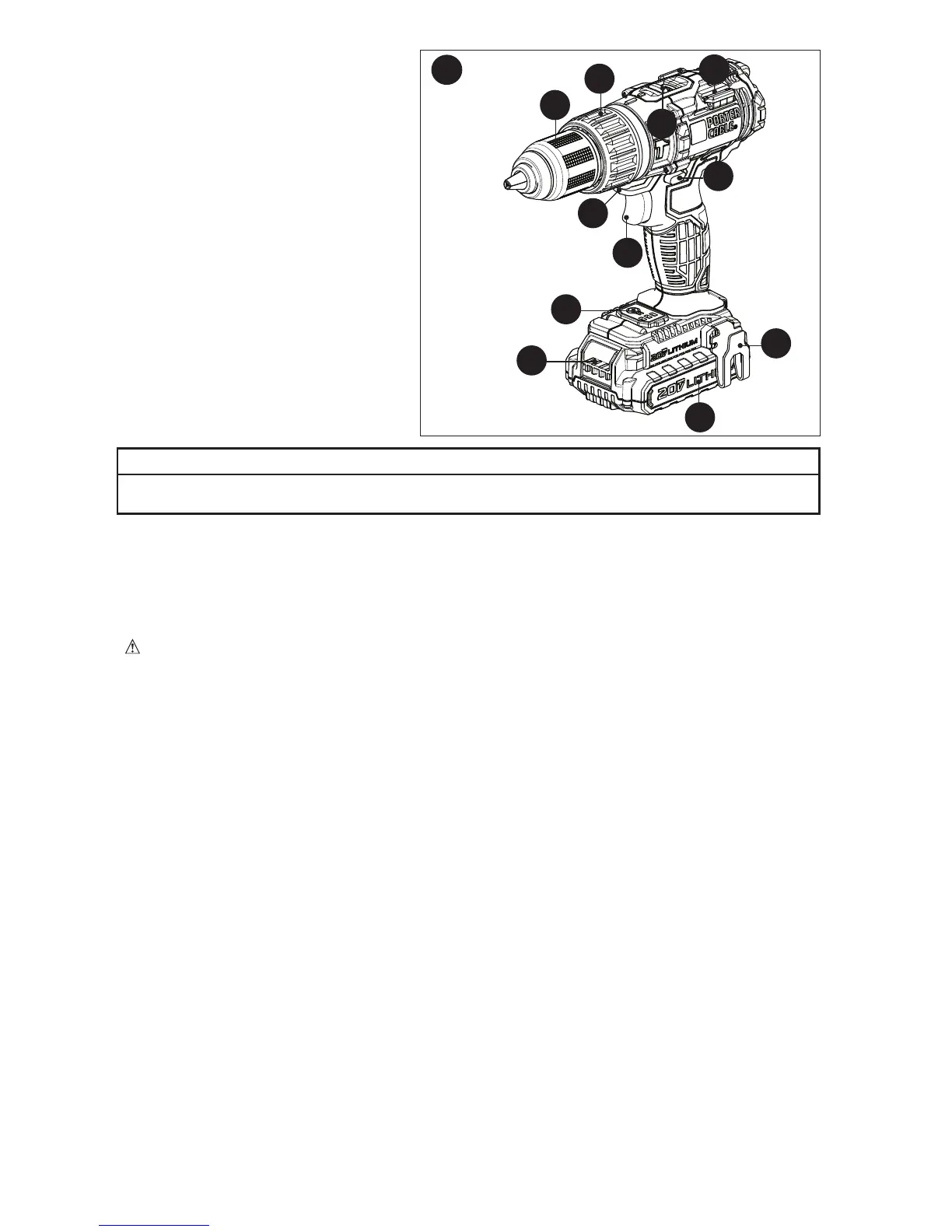
FUNCTIONAL DESCRIPTION
Figure A
1.TriggerSwitch
2.Forward/ReverseButton
3.TorqueAdjustCollar
4.DualRangeGearSelector
5.KeylessChuck
6.MagneticBitTipHolders(2)
7.Battery
8.BatteryReleaseButton
9.BatteryFuelGauge
10.LEDWorkLight
11.BeltClip
A
2
1
3
4
5
7
8
9
11
10
6
This product uses the batteries and chargers listed below.
20VMax*Lithium-IonBatteries:PCC680L,PCC681L,PCC682L,PCC685L
20VMax*Lithium-IonChargers:PCC690L,PCC691L,PCC692L,PCC695L
Important Safety Instructions for
Battery Chargers
SAVE THESE INSTRUCTIONS: This
manual contains important safety
instructions for battery chargers.
WARNING: Before using charger,
read all instructions and cautionary
markings on charger, battery pack, and
product using battery pack.
•Shock hazard.Donotallowanyliquidto
get inside charger.
• Burn hazard. To reduce the risk of
injury, charge only designated PORTER-
CABLE batteries. Other types of
batteries may burst causing personal
injury and damage.
•Under certain conditions, with the
charger plugged in to the power
supply, the charger can be shorted by
foreign material. Foreign materials of
a conductive nature such as, but not
limited to, steel wool, aluminum foil, or
any buildup of metallic particles should
be kept away from charger cavities.
Always unplug the charger from the
power supply when there is no battery
pack in the cavity. Unplug charger before
attempting to clean.
•DO NOT attempt to charge the battery
pack with any chargers other than the
ones in this manual. The charger and
battery pack are specifically designed to
work together.
•These chargers are not intended
for any uses other than charging
designated PORTER-CABLE
rechargeable batteries. Any other uses
may result in risk of fire, electric shock or
electrocution.
•Do not expose charger to rain or snow.
•Pull by plug rather than cord when
disconnecting charger. This will reduce
risk of damage to electric plug and cord.
•Make sure that cord is located so that it
will not be stepped on, tripped over, or
otherwise subjected to damage or stress.
•Do not use an extension cord unless
it is absolutely necessary. Use of
improper extension cord could result in
risk of fire, electric shock, or electrocution.
•An extension cord must have
adequate wire size (AWG or American
Wire Gauge) for safety. The smaller the
gauge number of the wire, the greater
the capacity of the cable, that is 16
gauge has more capacity than 18 gauge.
When using more than one extension to
make up the total length, be sure each
individual extension contains at least the
minimum wire size.
•Do not place any object on top of
charger or place the charger on a soft
surface that might block the ventilation
slots and result in excessive internal
heat. Place the charger in a position
away from any heat source. The
charger is ventilated through slots in the
top and the bottom of the housing.
• Do not operate charger with damaged cord
or plug — have them replaced immediately.









 To Next Page