5
ENGLISH
Adjustments and Usage Prep
Air Supply and Connections
WARNING: Do not use oxygen, combustible gases,
or bottled gases as a power source for this tool as
tool may explode, possibly causing injury.
Fittings (Fig. B)
Install a male fitting
4
on the tool which is free flowing
and which will release air pressure from the tool when
disconnected from the supply source.
Fitting Torque Specification
Torque Specification for air fitting: 60-65 in-lbs
(69-75cm-kgf).
TOOL SPECIFICATIONS
Model TS056
Length 8.67" (220 mm)
Height 6.99" (178 mm)
Width 1.81" (46 mm)
Weight 2.3 lb (1.1 kg)
SUGGESTED FASTENER
SPECIFICATIONS
Model TS056
Fastener Series Porter Cable PC700 Staples Porter Cable® PBN Brads
Fastener Range 1/4"–9/16"
(6 mm–14 mm)
12 mm–15mm
(1/2"–5/8")
Fastener Type 3/8" Crown Staple 18 Gauge Brad Nail
Tool Air Fitting (Fig. B)
This tool uses a free flow connecting plug 1/4" N.P.T.
4
The inside diameter should be .200" (5mm) or larger. The
fitting must be capable of discharging tool air pressure when
disconnected from the air supply
7
.
Operating Pressure
80 to 100p.s.i.g. (5.5 to 6.9kg/cm²). Select the operating
pressure within this range for best pin performance. DONOT
EXCEED THIS RECOMMENDED OPERATINGPRESSURE.
Air Consumption
Model CMPCS38 requires 0.41 cubic feet per min (c.f.m.) of
free air to operate at the rate of 100 fasteners per minute,
at 100 p.s.i.g. (6.9 bars). Take the actual rate at which the
tool will be run to determine the amount of air required. For
instance, if your fastener usage averages 50 fasteners per
minute, you need 50% of the tool’s c.f.m. of free air which is
required for running at 100 fasteners per minute.
ASSEMBLY AND ADJUSTMENTS
WARNING: To reduce the risk of serious personal
injury, turn unit off and remove air supply before
making any adjustments or removing/installing
attachments or accessories. An accidental actuation
can causeinjury.
The label on your tool may include the following symbols. The
symbols and their definitions are asfollows:
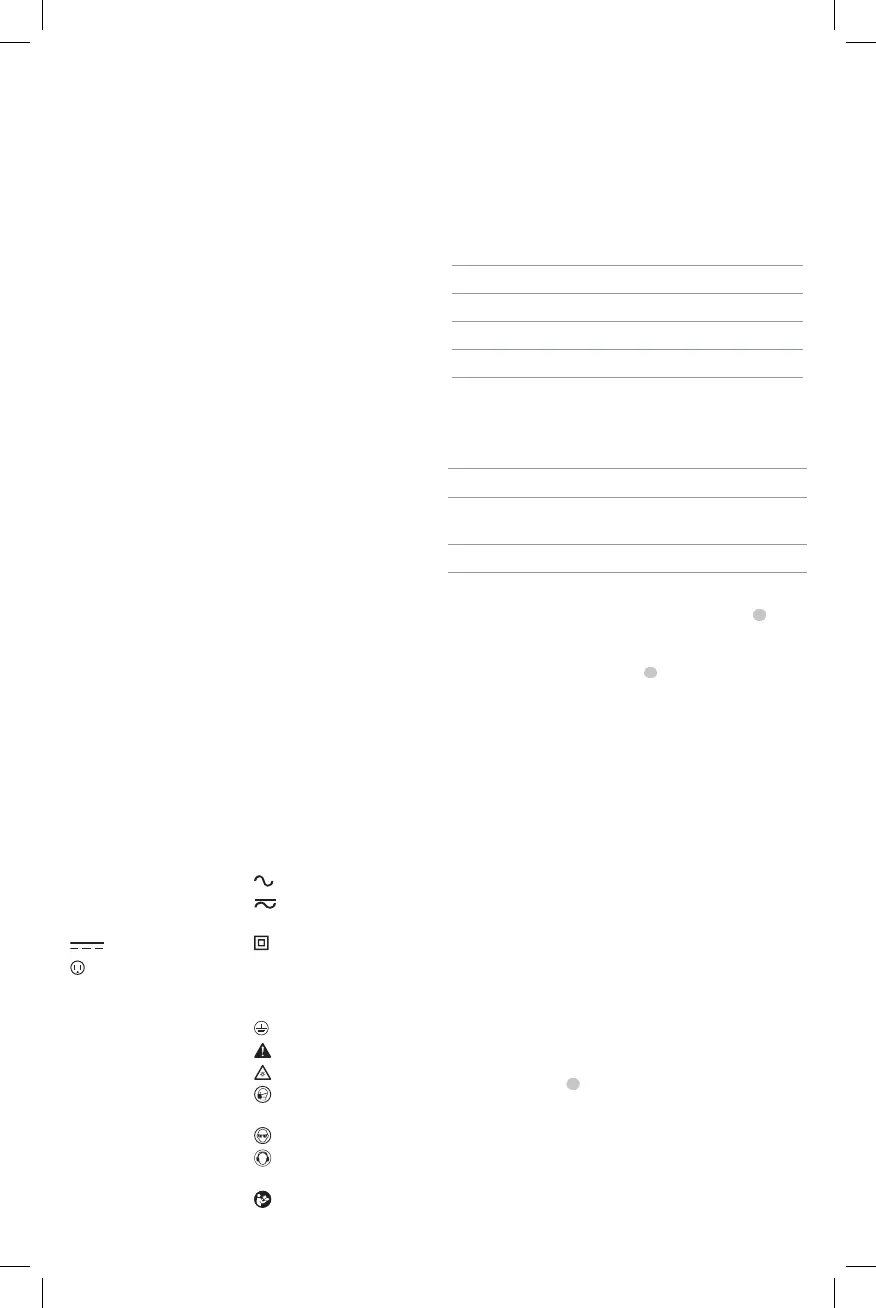
V ......................... volts
Hz .......................hertz
min ..................... minutes
or DC ......direct current
...................... Class I Construction
(grounded)
…/min ..............per minute
BPM .................... beats per minute
IPM ..................... impacts per minute
RPM .................... revolutions per
minute
sfpm ................... surface feet per
minute
SPM .................... strokes per minute
A ......................... amperes
W ........................watts
or AC ...........alternating current
or AC/DC .... alternating or direct
current
...................... Class II Construction
(double insulated)
n
o
.......................no load speed
n .........................rated speed
......................earthing terminal
.....................safety alert symbol
.....................visible radiation
..................... wear respiratory
protection
..................... wear eye protection
..................... wear hearing
protection
..................... read all
documentation
WARNING:ALWAYS use safety glasses. Everyday
eyeglasses are NOT safety glasses. Also use face or
dust mask if cutting operation is dusty. ALWAYS WEAR
CERTIFIED SAFETYEQUIPMENT:
• ANSI Z87.1 eye protection (CAN/CSA Z94.3),
• ANSI S12.6 (S3.19) hearing protection,
• NIOSH/OSHA/MSHA respiratoryprotection.
WARNING:
Some dust created by power sanding,
sawing, grinding, drilling, and other construction activities
contains chemicals known to the State of California to
cause cancer, birth defects or other reproductive harm.
Some examples of these chemicalsare:
• lead from lead‑based paints,
• crystalline silica from bricks and cement and other
masonry products, and
• arsenic and chromium from
chemically‑treatedlumber.
Your risk from these exposures varies, depending on
how often you do this type of work. To reduce your
exposure to these chemicals: work in a well ventilated
area, and work with approved safety equipment, such
as those dust masks that are specially designed to filter
out microscopicparticles.
• Wear protective clothing and wash exposed areas
with soap and water. Allowing dust to get into your
mouth, eyes, or lay on the skin may promote absorption of
harmfulchemicals. Direct particles away from face andbody.
• Use the appropriate dust extractor vacuum to remove
the vast majority of static and airborne dust. Failure
to remove static and airborne dust could contaminate the
working environment or pose an increased health risk to
the operator and those in closeproximity.
• Use clamps or other practical ways to secure and
support the workpiece to a stable platform. Holding
the work by hand or against your body is unstable and may
lead to loss ofcontrol andinjury.
• Air vents often cover moving parts and should be
avoided. Loose clothes, jewelry or long hair can be caught
in movingparts.



 To Next Page