ENGLISH
6
Air Supply-Pressure and Volume
Air volume is as important as air pressure.The air volume
supplied to the tool may be inadequate because of
undersize fittings and hoses, or from the effects of dirt and
water in the system.Restricted air flow will prevent the tool
MAINTENANCE
WARNING: To reduce the risk of serious personal
injury, turn unit off and remove air supply before
making any adjustments or removing/installing
attachments or accessories. An accidental actuation
can causeinjury.
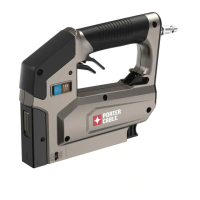
Your PORTER-CABLE power tool has been designed to
operate over a long period of time with a minimum of
maintenance. Continuous satisfactory operation depends
upon proper tool care and regularcleaning.
Tool Operation Check (Fig. A)
WARNING: remove all fasteners from tool before
performing tool operation check.
Trigger Operation with a Secondary
Trigger
WARNING: The trigger will only actuate the tool if the
secondary trigger has already been pulled.
The secondary trigger
3
is located under the handle
1
.
The secondary trigger prevents the primary trigger
2
from
actuating the tool if the secondary trigger has not been
pulled first.
Place the nose of the tool against a work piece for all of the
following operation checks.
1. With hand on rear end of the handle, further back away
from the secondary trigger, and not squeezing the
secondary trigger, use finger to pull the primary trigger.
THE TOOL MUST NOT CYCLE.
2. With hand on handle, and squeezing the secondary
trigger, use finger to pull the primary trigger. THE TOOL
MUST CYCLE.
While the secondary trigger remains squeezed, the tool will
cycle each time the primary trigger is pulled!
Trigger Operation With a Secondary
Trigger (Fig. A)
WARNING: Never inadvertently pull or grasp the
secondary trigger when moving about, changing work
location, when holstering or hanging tool, or when
preparing work surface for fastening operation.
WARNING: The operator must not hold the secondary
trigger pulled except during fastening operation as
serious injury could result if the trigger accidentally
contacts someone or something, causing the tool
tocycle.
When the secondary trigger
2
is pulled, the tool will actuate
each time the primary trigger
2
is pulled. This trigger
operated tool is operated by first pulling or grasping the
secondary trigger under the hand grip, followed by pulling
the trigger under the valve.
Loading (Fig. E–H)
WARNING: Be careful when handling fasteners,
especially when loading and unloading, as the
fasteners have sharp points.
1. Remove the air supply
7
from the 1/4" male fitting
4
.
2. Hold stapler upside down as shown and release loading
hatch
6
by pushing in the loading hatch release
button
5
.
3. Draw the loading hatch from the tool.
4. Place one stick of staples in bottom channel so legs are
pointing up. Push loading hatch closed, making sure the
loading hatch release button engages.
5. For brad nails, place only on left side (direction as shown
on the magazine liner). Be sure nail heads are pointing
down. Push loading hatch closed, making sure the
loading hatch release button engages.
Proper Hand Position (Fig. D)
WARNING: To reduce the risk of serious personal injury,
ALWAYS use proper hand position as shown.
WARNING: To reduce the risk of serious personal
injury, ALWAYS hold securely in anticipation of a
suddenreaction.
Proper hand position requires one hand on the handle
1
.
After driving a fastener, this tool may spring back (“recoil”).
OPERATION
WARNING: To reduce the risk of serious personal
injury, turn unit off and remove air supply before
making any adjustments or removing/installing
attachments or accessories. An accidental actuation
can causeinjury.
Hoses (Fig. B)
Air hoses should have a minimum of 150 p.s.i.g.(10.6kg/cm²)
working pressure rating or 150 percent of the maximum
pressure that could be produced in the air system. The supply
hose
7
should contain a fitting that will provide “quick
disconnecting” from the male fitting
4
on the tool.
Supply Source
Use only clean regulated compressed air as a power source
for this tool. NEVER USE OXYGEN, COMBUSTIBLE GASES, OR
BOTTLED GASES, AS A POWER SOURCE FOR THIS TOOL AS
TOOL MAY EXPLODE.
Regulator
A pressure regulator with an operating pressure of
0–125p.s.i.g. (0–8.79 kg/cm²) is required to control the
operat iing pressure for safe operation of this tool. Do not
connect this tool to air pressure which can potentially exceed
200 p.s.i.g. (14 kg/cm²) as tool may fracture or burst, possibly
causing injury.
Operating Pressure
Do not exceed recommended maximum operating pressure
as tool wear will be greatly increased. The air supply must be
capable of maintaining the operating pressure at the tool.
Pressure drops in the air supply can reduce the tool’s driving
power. Refer to Tool Specifications for setting the correct
operating pressure for the tool.



 To Next Page