www.powerbox-systems.com 17
The method is very simple: move the transmitter stick to the approximate point
which you wish to alter, then press the SET button. The servo now slowly moves
automatically to this exact point.
Now you can alter the servo curve at this point using buttons I and II.
You don’t need to use the transmitter to maintain the servo position; this makes
accurate settings easier.
Once you have adjusted the curve point to the desired position, press the SET
button again, and the servo slowly travels back to the position corresponding to
the actual stick position.
If you now move the stick, you will see at Input the servo position corresponding
to the transmitter stick position, and at Output the servo position now present at
this servo.
• Auto Matching
The Auto matching function is a completely new development, and this is the rst
PowerBox product to include it. Its purpose is to match the travels of up to three
mechanically interconnected servos accurately over ve points, which it accom-
plishes in just a few seconds.
How does auto matching work?
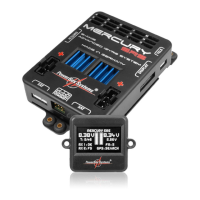
The PowerBox Mercury SR2 is tted with the latest generation of micro-control-
ler which is capable of measuring the current drawn from both batteries extre-
mely quickly and precisely. The values for measured current are used to match
two or three mechanically linked servos to each other.
This is accomplished by moving each servo to ve points in turn and recording
the lowest current values. The process is carried out in two steps: initially coar-
sely, then nely. A third stage then follows, in which ne-matching is carried out,
taking into account any stiffness in the control surface hinges.
In the initial stage the servos are strained hard against each other for very brief
periods (5 x 100ms). We have carried out hundreds of tests with this procedure,
and have found that it presents no problems to servos - even low-cost examples.
In fact, any linkage and servo must be capable of withstanding this procedure in
any case, otherwise they would not be able to cope with ight loads.
Note: This action causes all the servos which are assigned to this input chan-
nel to move to the selected position. If this were not so, mechanically linked
servos would immediately stall each other!dene Servo sofort gegeneinander
blockieren!

 To Next Page
 Loading...