
 Need help?
Do you have a question about the PreppComm DMX-40 and is the answer not in the manual?
Guide for using the DMX-40 as a low-power transceiver on 40 meters.
Guide for connecting the DMX-40 to a base station for CW decoding/encoding.
Illustrates the physical connections for the DMX-40 in QRP mode.
Instructions for powering on and a critical warning about transmitter load.
Describes the brief initial splash screen shown upon powering on the device.
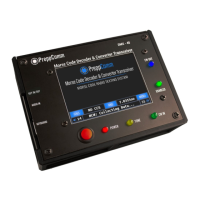
Explains the components and layout of the DMX-40's main operating screen.
How to navigate from the main screen to the main menu options.
Accessing the local station setup screen for configuration.
Procedure for entering your FCC-assigned call letters into the device.
Entering name, location, and rig type for device personalization.
Setting antenna type and selecting the appropriate FCC license level.
Understanding how the Frequency Button switches between modes.
Crucial safety advice for using the transmitter to avoid damage.
How to initiate and complete a general call sequence for broadcasting.
Steps to make a call to a specific station and its sequence.
Transmitting a short station ID to validate a response and establish communication.
How to type and send a message using the Answer button.
Lists the four primary transmit functions covered in this section.
The critical role of a good antenna and fundamental tuning principles.
Adjusting receiver frequency independently for optimal signal reception.
Detailed diagram and explanation of keyboard commands for receiving.
Highlights essential keys for controlling receiver frequency and gain.
How to adjust audio volume and signal gain for optimal listening.
Guided practice for tuning into stations and identifying signals.
Ensures accurate signal capture by restarting the decoder.
Steps to initiate a general call to find other stations.
Essential rule for correctly tuning to another station's frequency.
Step-by-step guide on how to apply the tuning rule when answering a call.
Identifies operating the DMX-40 and tuning/QSOs as primary practice areas.
Lists the necessary cables and adapter plugs for external mode connection.
Important warning about careful connection to prevent PCB damage.
Steps for connecting power supply and USB keyboard to the DMX-40.
Instructions for connecting audio output and manual key input.
How to use an external mixer to combine DMX-40 tone with transceiver audio.
Explains the specific tone frequency and filter requirements for external mode.
Guide for using the DMX-40's decoder function without other features.
Operating in HCW mode and tuning the band to find signals.
Using manual keying and automatic keying functions in external mode.
How to operate the DMX-40 as the primary controller for an external rig.
 General
| Brand | PreppComm |
|---|---|
| Model | DMX-40 |
| Category | Transceiver |
| Language | English |

 To Next Page
