
 Need help?
Do you have a question about the QTS Level-Trac LT-310 and is the answer not in the manual?
Each channel is individually assigned an alarm/trip state, wet or dry. Cable monitoring for probe states.
Seven 8A DPDT relays for alarms/trips. Configurable delays and states for RL1-RL6; RL7 for system fault.
Details how RL1-RL6 operate on single channels or channel pairs, including voting logic options.
Sets probe channel sensitivity to one of three conductivity ranges (1, 2, or 4 mS/cm²).
Two switches simulate Wet/Dry states, activating Red/Green test and indicating System Fault in simulation.
Indicates faults from power supply failure, test switch 'On', or out-of-sequence probe logic.
Indicates a fault when any channel is not in its normal wet or dry state, signaled by a yellow LED.
Describes the LT-310 enclosure's NEMA 4X rating, dimensions, and mounting instructions.
Details power requirements (100-240 VAC) and connection to the unit's switching power supplies.
Recommends high-temperature cable for probes, specifying conductor counts and maximum run length.
Shows terminal connections for probes, including common ground and solder jumps for normal probe states.
Details connection points for relays and remote indicators, including status LEDs and relay ratings.
Describes the panel-mountable display unit, its cut-out size, and required conductors for connection.
Details programming options on the discriminator PCB: time delay, relay assignment, alarm state, sensitivity, and sequence check.
Illustrates the power supply and relay PCB, showing connections for power input and relay outputs.
Provides step-by-step instructions for installing/removing covers, changing latches, and adding mounting feet.
Specifies technical details for the 16-conductor unshielded cable, including construction, materials, and ratings.
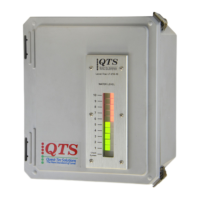
The Level-Trac Model LT-310 Control Unit is a remote level indication system, also capable of functioning as an alarm or trip device, designed to meet ASME Section I, PG-60 standards. It discriminates between water and steam based on the significant difference in resistivity between the two states over the saturation range.
The system utilizes probes with insulated tips inserted into a probe manifold. When a voltage is applied to the probe tip, conduction occurs between the tip and the inside wall of the column if water is present, indicating water. Probe and manifold dimensions are engineered to provide a resistance typically less than 100 KΩ when immersed in water, and greater than 5 MΩ when in contact with steam. An electronic discrimination circuit senses this resistance to determine the presence of water or steam. Probes are vertically spaced in a manifold attached to the boiler, with each probe connected to its own sensing and water/steam indication circuit. A vertical display of Green/Red indicators simulates the water level in the steam drum. The spacing between probes is customizable to cover the visible range and alarm or trip points.
The LT-310 control unit is designed to manage up to six probes from various locations with discrete settings. It incorporates two printed circuit boards within a NEMA 4X (IP65) wall-mounted enclosure. These boards provide up to 6 discrete water/steam discrimination circuits, an LED display, relay alarm/trip outputs, fault detection, and terminals for a remote display unit. To prevent galvanic interaction and sensing voltage variations, an alternating voltage source is applied to the probes. Two low-frequency oscillators drive the odd and even numbered channels, respectively. The voltage applied to the probe is less than 6 volts, current-limited to 50 µA, ensuring safety. The system is designed for use with two discrete power sources, maintaining full functionality even if one power source fails.
 General
| Brand | QTS |
|---|---|
| Model | Level-Trac LT-310 |
| Category | Control Unit |
| Language | English |

 To Next Page