EasyManua.ls Logo

Ramsa WR-DA7 - User Manual

Ramsa WR-DA7
83 pages
Print Icon
To Next Page IconTo Next Page
Loading...
SPECIFICATIONS
General
Power requirement : AC 220 – 240 V 50 Hz
Power consumption : 105 W (with options)
Frequency response : 20 Hz - 20 kHz, +1 dB - –2 dB
T.H.D. (total harmonic distortion) : Less than 0.1 % (input = +10 dB/1 kHz, output = +4 dB/RL 600 )
Equivalent input noise : –128 dB (Rs = 150 Input sensitivity = –60 dB typical)
Residual noise : –93 dB typical
Maximum voltage gain : 84 dB: MIC/LINE(1-16) in to BUS out
84 dB: MIC/LINE(1-16) in to MASTER out
84 dB: MIC/LINE(1-16) in to AUX out
Common Mode Rejection Ratio : More than 80 dB (1kHz)
Crosstalk : 90 dB typical (1kHz)
Dynamic Range (Fs = 48kHz, DIN audio filter) :
113 dB typical : DA converter (digital in to analog out)
112 dB typical : AD converter (analog in to digital out)
110 dB typical : AD + DA (analog in to analog out)
AD Converter : 24 bit, 64 times oversampling (input 1 to 16)
20 bit, 64 times oversampling (aux returns 3 to 6)
DA Converter : 24 bit, 64 times oversampling (MASTER, MONITOR A)
24 bit, 128 times oversampling (MONITOR B)
20 bit, 128 times oversampling (aux returns 3 to 6)
Internal signal processing : 32 bit (Dynamic range 192 dB)
Sampling Frequency (Fs) : Internal: 44.1 kHz and 48 kHz
External: 44.1 kHz ± 6 % and 48 kHz ± 6 %
Signal delay : Less than 2.5 ms, MIC/LINE input to MASTER out
Audio Mixer
WR-DA7
ORDER NO. AVS9807114C8
C 1998 Matsushita Communication Industrial Co., Ltd.
All rights reserved. Unauthorized copying and
distribution is a violation of law.
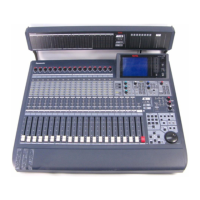
The Meter Bridge shown in photo is one of the optional accessories.
Question and Answer IconNeed help?

Do you have a question about the Ramsa WR-DA7 and is the answer not in the manual?

Summary

Mixer Specifications

General Specifications

General technical specifications of the audio mixer.

Mixer Operation and Controls

Top Panel Control Sections

Overview of major control groups on the mixer's top panel.

Channel, Fader Layer, and Bus Controls

Controls for individual channels, fader layers, bus outputs, and input gain.

EQ, Dynamics, Delay, and Aux;Monitor Sections

Signal processing, routing, and monitoring controls.

Setup, Scene Memory, and Library Functions

Controls for mixer configuration, scene management, and parameter libraries.

Display Bridge and Navigation Controls

LCD screen, meters, keypad, cursor, and headset connection.

System Architecture and Connectivity

Rear Panel I;O Connectors

Details on all input and output connectors on the rear panel.

Optional Interface Cards

Information about the slots for optional audio interface cards.

Block Diagrams Overview

Visual representation of the mixer's internal circuit board connections.

Overall Block Diagram

A high-level overview of the mixer's internal component interconnections.

Main Board Block Diagrams

Detailed diagrams for Main Board CPU, Panel Control, DSP, and Audio Interface.

Board-Level Block Diagrams

Block diagrams for AD/DA, Fader Drive, HA, INS, Monitor, EFX, and Meter boards.

Maintenance and Troubleshooting

Test Equipment and Disassembly

Required test equipment and procedure for disassembling the unit.

Self-Check Function Tests

Procedures for executing and interpreting various self-check tests.

Version, CPU, and Interface Tests

Checks for system version, CPU function, and serial interface integrity.

IC, DSP, and Meter Signal Tests

Tests for integrated circuits, DSPs, and meter signal paths.

Switch, Knob, LCD, and Memory Tests

Procedures to test switches, potentiometers, LCD, and memory functions.

Fader Calibration and Upgrade Procedures

Calibrating faders and upgrading system software.

Quitting Self Check

Procedure to exit diagnostics and return to normal operation.

Ramsa WR-DA7 Specifications

General IconGeneral
BrandRamsa
ModelWR-DA7
CategoryMusic Mixer
LanguageEnglish