5
1.2 kW 1.8 kW
1.8 kW 1.2 kW
ArtNo.312-0003 Moving pans
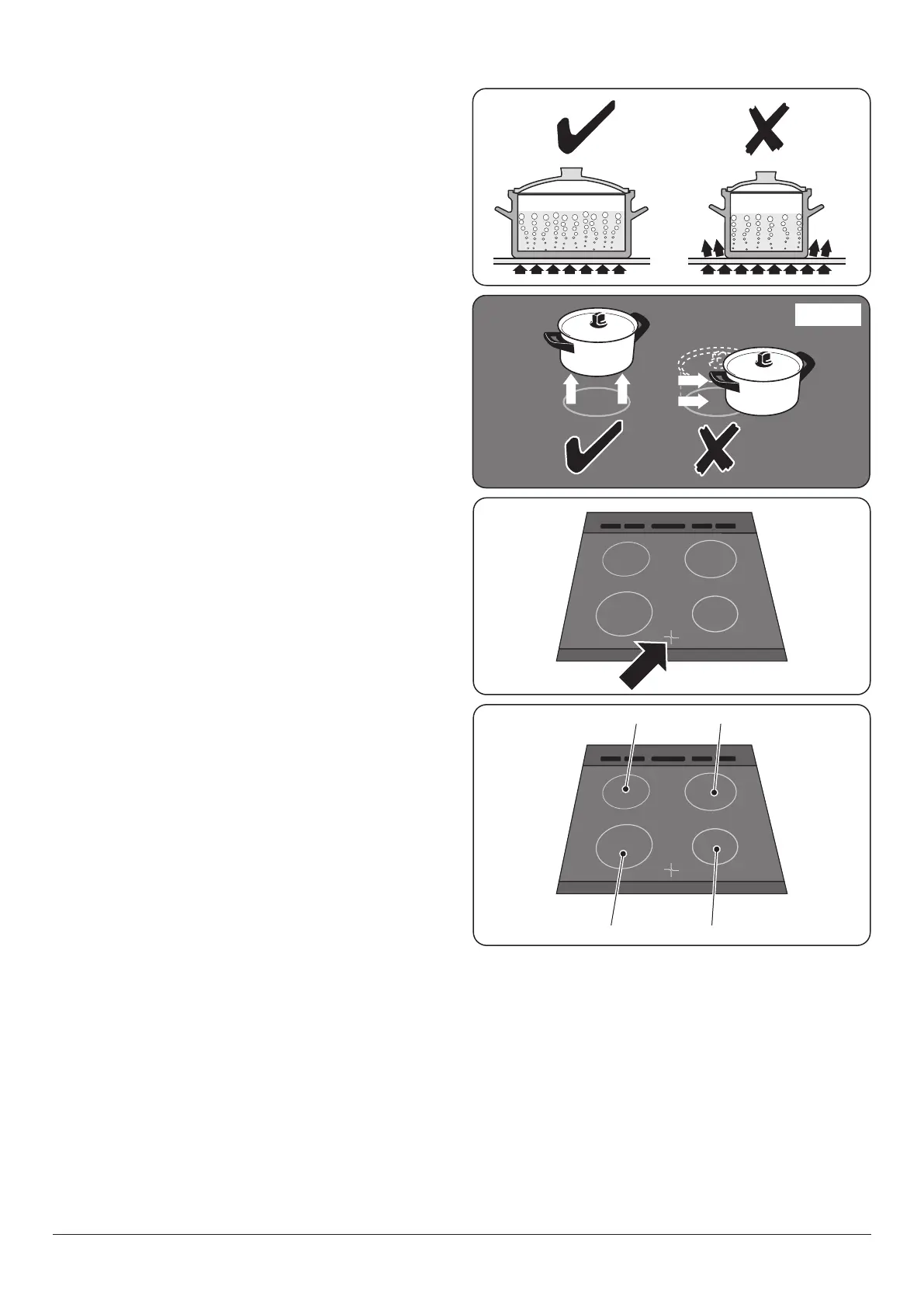
Pots and pans should have thick, smooth, at bottoms
(Fig. 2.2). This allows the maximum heat transfer from the
hob to the pan, making cooking quick and energy ecient.
Never use a round-bottomed wok, even with a stand.
The very best pans have bases that are very slightly curved up
when cold. If you hold a ruler across the bottom you will see
a small gap in the middle (Fig. 2.3). When they heat up the
metal expands and lies at on the cooking surface.
Make sure that the base of the pan is clean and dry to prevent
any residue burning onto the hob panel. This also helps
prevent scratches and deposits.
Always use pans that are the same size as (or slightly larger
than) the areas marked on the hob top (Fig. 2.4). Using
smaller pans wastes heat, and any spillage will be burnt on.
Using a lid will help the contents boil more quickly.
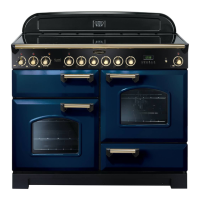
Always lift pans o the hob (Fig. 2.5). Sliding pans may cause
marks and scratches. Always turn the control to the ‘OFF’
position before removing a pan.
n
Take care when placing hot lids onto the hob
surface. Lids that have been covering boiling or
steaming foods can ‘stick’ to the ceramic glass.
Should this occur, DO NOT attempt to lift the lid
o the hotplate: this may damage the hob surface.
Instead, slide the lid to the edge of the hob surface
and remove.
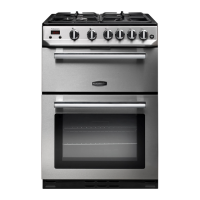
There are indicator lights for each of the cooking areas
(Fig. 2.6). The lights come on when a hob control is turned on
and stays lit while the surface cools.
n
Always take care before touching the surface, even
when the hob is turned o – it may be hotter than
you think.
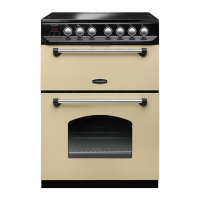
The ratings of the dierent cooking areas are shown in
Fig. 2.7.
When cooking on the hob, you may see the hob area you
are using switch o and on: this is caused by a safety device
that limits the temperature of the hob. This is quite normal,
especially when cooking at high temperatures. If it happens
a lot with a particular pan, however, it may mean the pan is
not suitable – perhaps too small or too uneven – for a ceramic
hob.
For best results, preheat a covered serving dish for 10 minutes
before adding food to it.
Use only heat-resistant dishes.
n
Important: When ceramic heaters are operated in
higher heat settings, the heated areas may be seen
switching on and o. This is due to a safety device
which prevents the glass from overheating. This is
normal at high temperatures, causing no damage to
the hob and little delay in cooking times.
ArtNo.312-0006 Correct pan sizes
Fig. 2.4
Fig. 2.5
Fig. 2.6
Fig. 2.7


 To Next Page