10 Transducers for Fishfinders
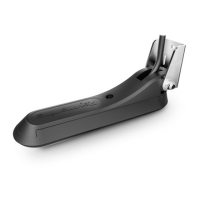
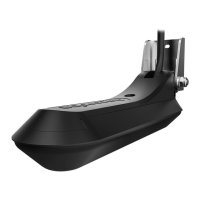
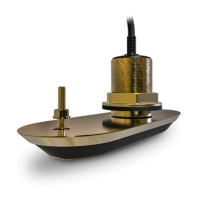
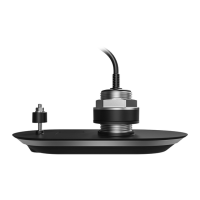
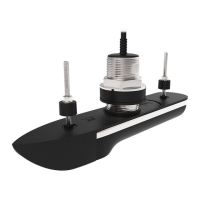
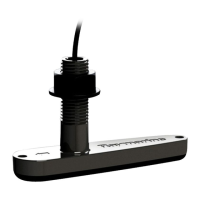
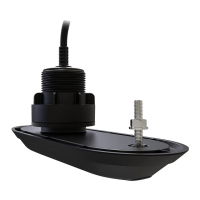
Thru-hull Transducer and In-hull Transducer
Similarconsiderationshouldbe givento the locationof thru-hulland
in-hulltransducers.Figure1-4 showsthebesttransducerlocationfor
different hull types.
• Displacement hull powerboat –Locate at 1/3 aft load waterline
length(LWL) and 6 - 12" (150-300 mm) off the centerline on the
side of the hull where the propeller is moving downward.
• Planing hull powerboat – Mount well aft,on or near the center-
line, and well inboard of the first set of lifting strakes to ensure
that it is in contact with the water athigh speeds.Mount on the
side of the hull where the propeller is moving downward.
Outboardand I/O – Mount just forward of the engine(s).
Inboard – mount well forward of thepropeller(s) and shaft(s).
Step-hull –Mount justahead of the first step.
Boats capableof speeds above 25 kn (29 m.p.h.) – Review
transducer location and operating results of similar boats before
proceeding.
• Fin keel sailboats – Mount to the side of thecenterline and for-
ward of the fin keel 1 - 2 ft (300-600 mm).
• Fullkeelsailboats– Locateamidshipsand away fromthekeel at
the point of minimum deadrise angle.
• Fiberglass Hulls – Since the hull absorbs acoustic energy, trans-
mitting throughthe hull reducesthe sensor’s performance. Fiber-
glasshullsareoftenreinforcedinplacesforaddedstrength.These
coredareascontainbalsawoodorstructuralfoam,whicharepoor
sound conductors.If you cannot avoid locating the sensor over
coring, follow the instructionsfor Installation in a Cored Fiber-
glass Hull on page 29.
• Thru-hull Transducer Headroom– Allow adequate headroom
insidethevesselfortheheightofthethru-hullhousing,tightening
the nuts and removing the insert. The minimum headrooms are:
With fairing: 10" (254mm)
Without fairing: 12" (305 mm)
• In-hull Transducer – Find a location where the fiberglass is
solid:
There are no air bubbles trapped in the fiberglass resin.
There is no coring, flotation material, or dead air space sand-
wiched between the insideskin and the outer skinof the hull.



 To Next Page
 Loading...