5
WARNINGS AND SAFETY NOTES
• Have you checked the battery voltage? Lithium battery packs can be wired in parallel
and in series, i.e. a 2-cell pack can be 3.7V (in parallel) or 7.4V (in series).
• Have you checked that all connections are firm and secure? Make sure there are no
intermittent contacts at any point in the circuit.
Standard Battery Parameters
Be very careful to choose the correct voltage for different types of battery otherwise you
may cause damage to the batteries. Incorrect settings could cause the cells to fire or
explode.
Charging
During charge process, a specific quantity of electrical energy is fed into the battery.
The charge quantity is calculated by multiplying charge current by charge time. The
maximum permissible charge current varies depending on the battery type or its perfor-
mance, and can be found in the information by the battery manufacturer. Only batteries
that are expressly stated to be capable of quick-charge are allowed to be charged at
rates higher than the standard charge current.
Connect the battery to the terminal of the charger: red is positive and black is negative.
Due to the difference between resistance of cable and connector, the charger can not
detect resistance of the battery pack. The essential requirement for the charger to work
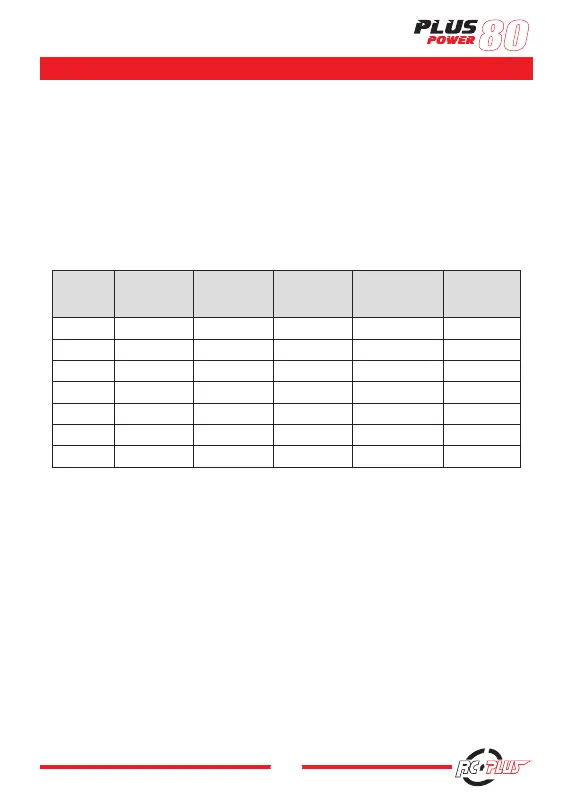
Battery
Type
Fast Charge
Rate
Nominal Cell
Voltage
Max. Charge
Voltage Cell
Min. discharge
Voltage Cell
Storage
Voltage Cell
Ni-Cd 1 - 2C 1.2V 1.5V 0.85V
Ni-MH 1 - 2C 1.2V 1.5V 0.85V
Li-Ion <= 1C 3.6V 4.1V 2.5V 3.7V
Li-Po <= 1C 3.7V 4.2V 3.0V 3.8V
Li-Po HV <= 1C 3.8V 4.35V 3.3V 3.9V
Li-Fe <= 4C 3.3V 3.6V 2.0V 3.3V
PB <= 0.4C 2V 2.46V 1.75V


 To Next Page