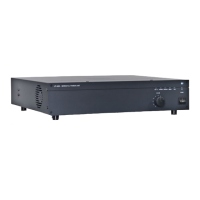
A BRIDGED PAIR AND TWO INDIPENDENT CHANNELS
Make sure the amplier is switched off before setting:
- the BRIDGE A+B switch
10
to ON
- the BRIDGE C+D switch
11
to OFF
- the switch
15
to FOUR INDEPENDENT CHANNELS.
CHANNELS A AND B: these are bridged and work with the same input signal (channel
A input). The result is a doubling of the output voltage in order to get a double power (on
a double impedance load).
The output level is adjusted only by the channel A front panel control (turn fully
counterclockwise the channel B control).
Do NOT connect the channel B speaker output.
Minimum load impedance is 4 Ω (on channel A speaker output).
Pay attention to the SPEAKON wiring: pin 1+ positive, pin 2– negative.
CHANNELS C AND D: these two channels are completely independent and a front
panel level control affects its respective speaker output.
Minimum load impedance is 2 Ω per speaker output.
TWO BRIDGED PAIRS
Make sure the amplier is switched off before setting:
- the BRIDGE A+B switch
10
to ON
- the BRIDGE C+D switch
11
to ON
- the switch
15
to FOUR INDEPENDENT CHANNELS.
All channels are bridged (two pairs): the result is a doubling of the output voltage in
order to get a double power (on a double impedance load).
Each pair works with the same input signal: channel A input for A-B channels, channel C
input for C-D channels.
The output levels are adjusted by the channel A and C front panel controls (turn fully
counterclockwise the channel B and D controls).
Do NOT connect the channel B and D speaker outputs.
Minimum load impedance is 4 Ω per speaker output (channel A and C).
Pay attention to the SPEAKON wiring: pin 1+ positive, pin 2– negative.
1+
2+
1–
2–
1+ 1– 1+ 1– 1+ 2–
ACDAC
BRIDGE C+D
BRIDGE A+B
FOUR INDIPENDENT
CHANNEL


 To Next Page