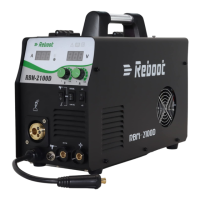
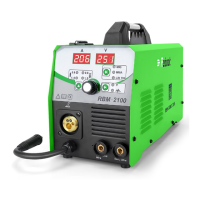
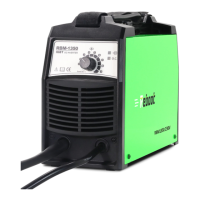
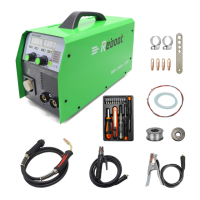
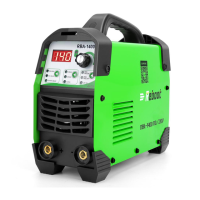
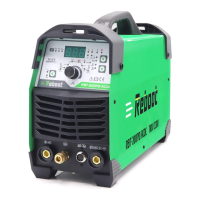
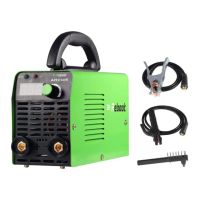
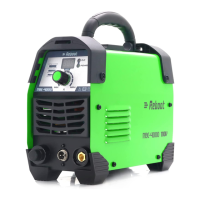
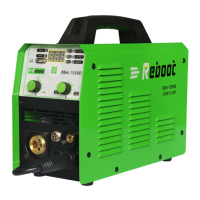
The Reboot RBM-1550 welding machine is a versatile and intelligent multi-function tool designed for both professional and amateur welding enthusiasts. Utilizing the latest pulse width modulation (PWM) technology and an insulated gate bipolar transistor (IGBT) power module, it converts work frequency to a medium frequency, replacing traditional transistor transformers with a more efficient medium-frequency transformer. This design results in a portable, small-sized, lightweight, and low-consumption device, making it highly convenient for various applications.
Function Description
The RBM-1550 supports four primary welding processes: MMA (Manual Metal Arc), MIG GAS (Gas Metal Arc Welding with gas shielding), MIG GASLESS (Gas Metal Arc Welding without gas shielding, using flux-cored wire), and LIFT TIG (Tungsten Inert Gas welding with lift arc ignition). This broad functionality allows users to tackle a wide range of welding tasks and materials.
For MMA welding, the machine supports welding rods up to 4.0mm (5/32in), with common sizes being 2.5mm (3/32in) and 3.2mm (1/8in). It is compatible with European style E6013 and American style E7018 electrodes, as well as stainless steel ER308. It can weld carbon steel from 1-8mm (1/64-5/64in) and stainless steel from 1-5mm (1/64-7/32in). Aluminum cannot be welded in MMA mode. The machine automatically matches welding parameters, but the current can be adjusted via a dedicated knob.
In MIG mode, the RBM-1550 offers both gas-shielded and self-shielded (flux-cored) welding. Gas-shielded welding is recommended for better results, especially in a home or studio setting, using pure carbon dioxide or a mixture of argon and carbon dioxide. The machine intelligently matches optimal welding parameters for 0.8mm and 1.0mm diameter solid welding wires. For self-shielded welding, it supports 1.0mm diameter flux-cored wires and automatically adjusts parameters. The spool gun mode also supports both solid and flux-cored wires, with polarity conversion settings to match the wire type.
LIFT TIG mode is ideal for thin plates and applications requiring higher precision, particularly for stainless steel welding. This mode requires pure argon gas and the use of tungsten needles, which must be purchased separately and matched in size to the collet and collet body of the welding gun. It uses a contact arc starting method, meaning the tungsten electrode must touch the workpiece to initiate the arc, differentiating it from high-frequency TIG welding.
The machine features a clear digital display for current and voltage, input indicator lights for 220V and 110V, and a fault light for overheating or overcurrent protection. A switch allows selection between spool gun and MIG gun. While the machine generally provides automatic parameter matching, a small range voltage adjustment knob is available for fine-tuning if significant deviations occur.
Usage Features
The RBM-1550 is designed for ease of use, even for beginners. Its intelligent parameter matching simplifies setup, allowing users to quickly get started. The control panel includes intuitive selectors for welding processes (MIG/MMA/LIFT TIG), wire diameter, and gas type (for MIG).
For MMA welding, users simply select the MMA process, connect the welding holder and ground clamp, and adjust the current. Proper connection of the ground clamp to clean, bare metal is crucial for good electrical conductivity. Maintaining an ideal distance of 1-2mm between the welding rod and workpiece helps ensure a stable arc.
For MIG welding, the setup involves selecting the MIG process, connecting the MIG gun and ground clamp, installing the wire spool, and setting the drive roll. The wire feed wheel has two grooves (0.030”/0.8mm and 0.040”/1.0mm) to accommodate different wire diameters. The pressure knob for the drive roll should be set to 2-3 marks to ensure stable wire feeding without slipping or deformation. Gas-shielded MIG requires connecting a CO2 gas bottle with a hose and regulator. The welding torch is installed by extending the wire through the European central socket and matching the wire guide tube and contact tip to the welding wire. A quick wire feeding function is activated by pressing and holding the torch switch for more than 3 seconds without welding.
For flux-cored welding, the polarity needs to be set correctly (connected to the negative terminal 13), and a gear wire feed wheel is used, which comes pre-installed with the machine. The process for installing the wire spool, setting the drive roll, and connecting the MIG gun is similar to gas-shielded MIG.
LIFT TIG welding involves selecting the LIFT TIG process, connecting the appropriate TIG torch (not included), and adjusting the current. The ground clamp connection is similar to MMA.
The machine supports dual-voltage input (110V or 220V, depending on the model and region), making it adaptable to different power supplies. When using a generator, it should have a minimum output of 5000W.
Maintenance Features
The RBM-1550 incorporates several features to ensure durability and ease of maintenance. It undergoes strict factory testing to guarantee quality upon delivery. Users are advised to inspect the machine for external damage upon receipt and test its power-on functionality.
The machine includes a fault light that indicates overheating or overcurrent protection. During high-strength continuous welding, the machine may enter a protection state. It will automatically recover after a cooling period, typically a few minutes. If it doesn't recover after 10 minutes, a shutdown and restart may be necessary. The fan may continue to rotate for a few seconds after power-off to aid cooling.
Regular checks are recommended for optimal performance. For MMA, ensuring the ground wire connection is free of rust, paint, or oil is important. For MIG, checking the wire drive motor, drive rolls, cable liner, and contact tip for clogs or incorrect sizing is crucial for stable wire feeding. Consumables such as nozzles, conductive tips, and flux-cored wire need frequent replacement and should be kept in inventory. The guide wire tube is also a wear part that may require replacement.
When replacing welding wire, cutting off the front section of the contact tip and loosening the wire feed mechanism pinch wheel prevents wire bounce. The wire feed wheel grooves and contact tip aperture must always match the diameter of the welding wire being used.
The manual provides troubleshooting steps for common issues such as no arc, unstable wire feeding, or no power response, guiding users to check connections, settings, and internal components. For unresolved issues, customer support is available.
Safety is paramount, and the manual emphasizes wearing appropriate personal protective equipment, including a welding helmet with a proper filter shade, safety glasses with side shields, protective clothing, foot protection, and ear plugs if noise levels are high. Contact lenses should not be worn while welding.


 To Next Page
 General