Beveling
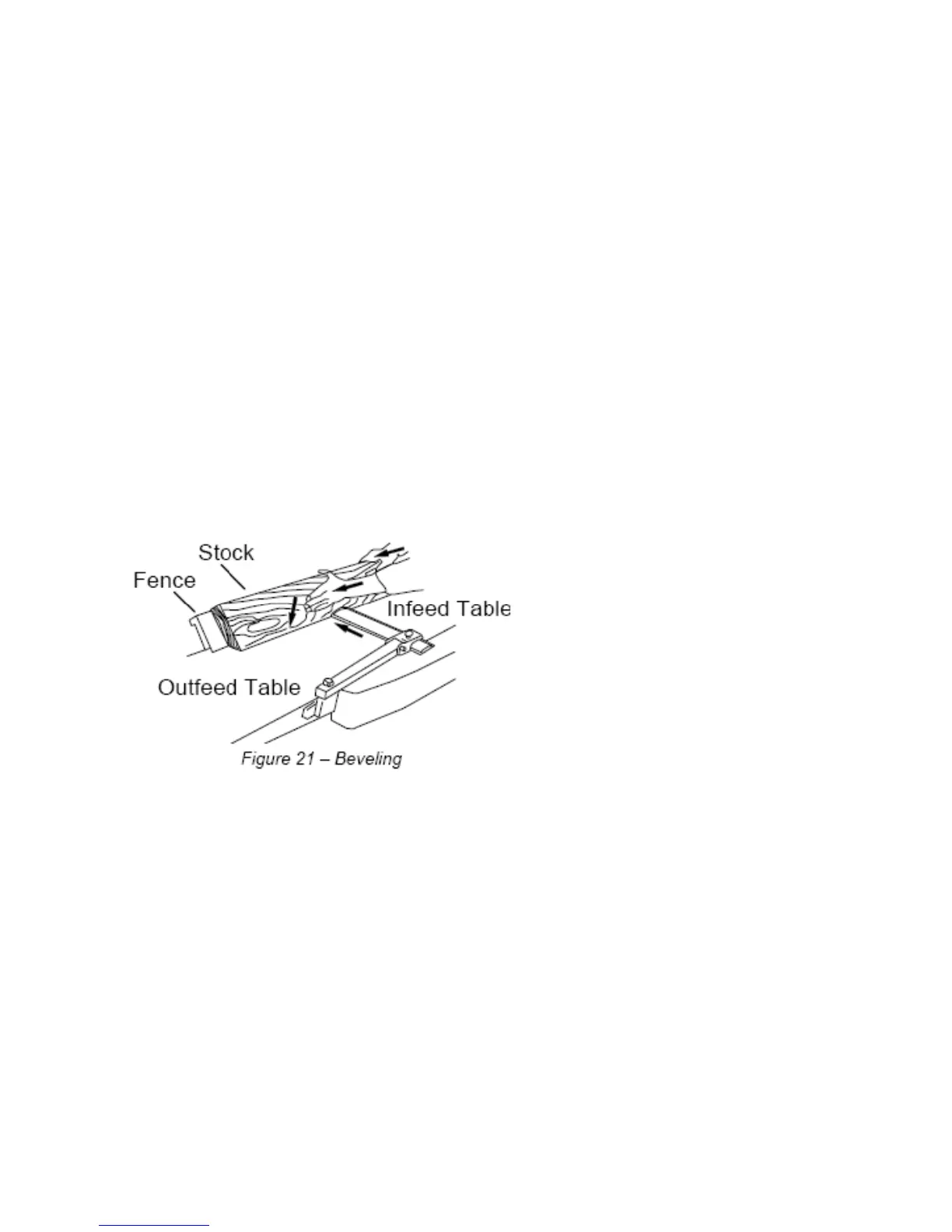
Beveling an edge is the same operation as edge jointing, except that the fence is tilted to a
specified angle.
Make certain material being beveled is over 12 inches long, more than 1/4 inch thick and 1 inch
wide.
To bevel:
1. Use a bevel gauge to determine the desired angle. Then set the fence to the same angle.
2. Inspect stock for soundness and grain direction (refer to Direction of Grain on
previous page).
3. Set the infeed table for a cut of approximately1.5mm.
4. If the board is bowed (curved), place the concave edge down on the infeed table.
5. Feed the stock through the cutterhead, making sure the face of the stock is
completely flat against the fence and the edge is making solid contact on the infeed
and outfeed tables (Figure 21).
For wood wider than 3 inches – hold with fingers close together near the top of the
stock, lapping over the board and extending over the fence. For wood less than 3 inches wide –
use beveled push blocks and apply pressure toward the fence. Keep fingers near top of push block.
Several passes may be required to achieve the
full bevel will probably take several passes.
Planer Operations
Depth of Cut
Thickness planing refers to the sizing of lumber to a desired thickness while creating a level
surface parallel to the opposite side of the board. Board thickness that the planer will produce is
indicated by the scale and the depthof- cut gauge . Preset the planer to the desired thickness of
the finished workpiece using the gauge. The depth-of-cut is adjusted by raising or lowering the
planer table (C, Fig. 5) using the
handwheel (F, Fig. 5).
The quality of thickness planning depends on the operator's judgment about the depth of cut.
The depth of cut depends on the width, hardness, dampness, grain direction and
grain structure of the wood.
The maximum thickness of wood that can be removed in one pass is 1/8” for planning
operations on workpieces up to 5-1/2” wide.
The workpiece must be positioned away from the center tab on the rollercase to cut


 To Next Page