50
Setting options:
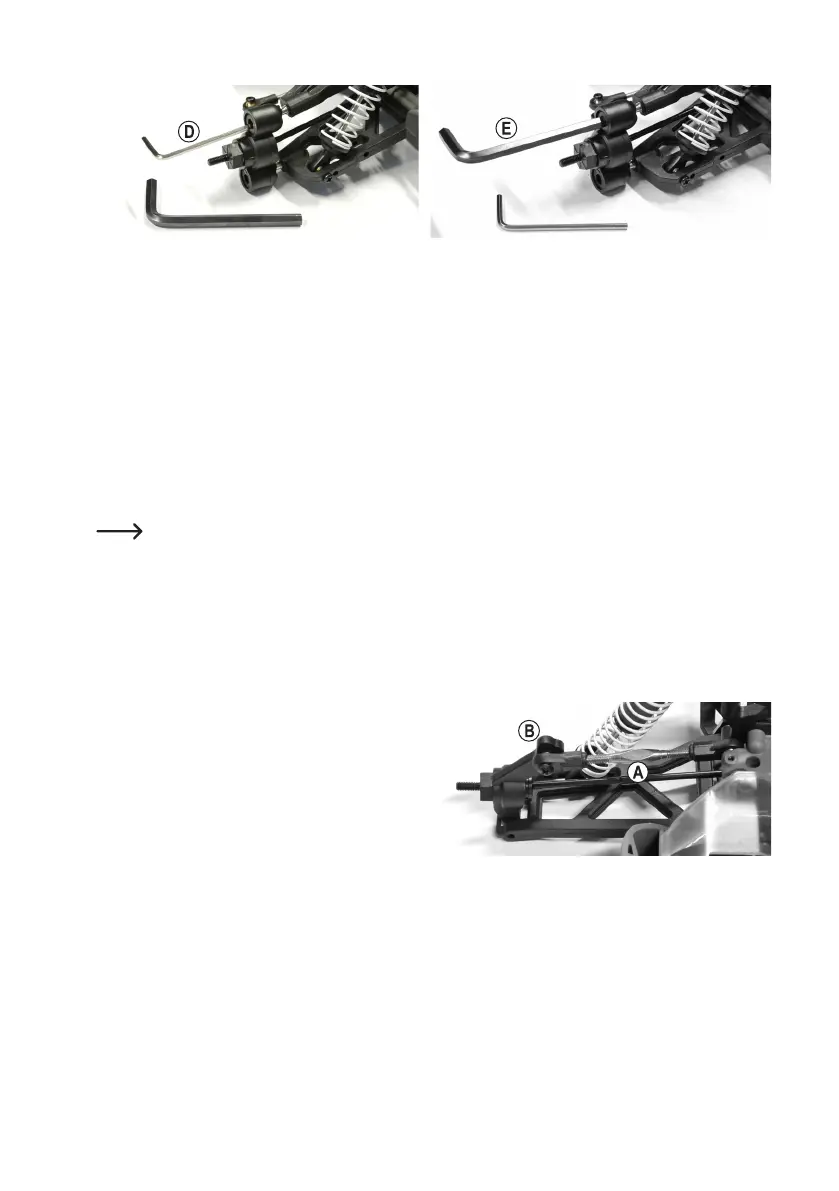
• To adjust the wheel camber, twist the metal ball-head screws with a small 2.5 mm hexagon wrench (D).
• In order to tighten the plastic grub screws (or to release them), twist them with a larger 5 mm hexagon wrench (E).
As described already, they must be adjusted so that the metal ball-head screws in the axis stub can move easily
without wobbling.
Set camber more negatively:
Turn the upper ball-head screw (A) to the right clockwise, and the lower ball-head screw (B) to the left counter-
clockwise at the same angle.
Set camber more positively:
Turn the upper ball-head screw (A) to the left counter-clockwise, and the lower ball-head screw (B) to the right clock-
wise at the same angle.
Twist the ball-head screws (A) and (B) via the small hexagon wrench (D) only by one quarter and then
check the changed driving conduct.
The small hexagon hole of the ball-head screws (A) and (B) is only visible when looking right through the
large hexagon hole of the plastic grub screws (C).
Do not turn out the ball-head screws too far. Else, the drive axis may fall out (or the thread of the ball-head
screws will no longer stick in the transverse links).
Setting Rear Axle Camber:
For setting the camber, turn the screw (A) of the upper
transverse link.
Because this screw has a left and right hand thread at
either end, the transverse link does not need to be dis-
mantled for the camber to be adjusted.
Furthermore, the rear axle stub (B) has several different
suspension points for the upper transverse link.
Ifthetransverselinkwasattachedinadifferentlocation,thiswouldchangethecamberwhenthewheeldeectsand
extends.
The manufacturer already selected the best setting for the vehicle. Therefore, you should not change the attachment
point (B).




 To Next Page