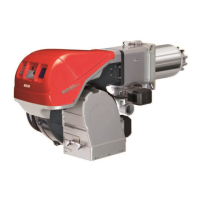
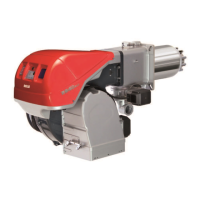
This document describes the Riello RS 45/E BLU forced draught gas burner, designed for progressive two-stage or modulating operation. It is intended for installation, use, and maintenance according to the provided instructions.
Function Description
The Riello RS 45/E BLU is a forced draught gas burner that operates in either a progressive two-stage or modulating mode. This allows for flexible control over the combustion process, adapting to varying heat demands. The burner is designed to be integrated with a combustion chamber and a boiler, ensuring efficient and safe operation. It utilizes a control box for managing the air/fuel ratio, servomotors for precise adjustments, and various sensors for monitoring and safety. The burner is suitable for use with natural gas (G20, G21, G22, G23, G25) and can be configured for different electrical supply systems (230/50-60Hz, 3N/400V-230V/50Hz, 3/400V/50Hz). The control box, such as the RWF40, manages the burner's operation, including start-up, calibration, and shutdown sequences. It also handles error detection and displays operational parameters.
Important Technical Specifications
- Model: RS 45/E BLU
- Type: 827 T3
- Output (maximum): 190 - 550 kW (163 - 474 Mcal/h)
- Output (minimum): 90 kW (78 Mcal/h)
- Fuel: Natural gas: G20 (methane gas), G21, G22, G23, G25
- Operation: Intermittent (min. 1 stop in 24 hours), two progressive or modulating stages with kit (see accessories).
- Room temperature: 0 - 40 °C
- Combustion air temperature: -10 - 50 °C
- Electrical supply: AC 230V - 15% / +10%, 50/60 Hz +/- 6%
- Internal fuse: 6.3 A T
- Fan motor: 2820 rpm, 220/240 V, 420 W, 3.0 A
- Ignition transformer: 220/240 V, 45 VA, 15 kV, 25 mA
- Absorbed electrical power: 700 W max
- Protection level: IP 44
- Noise level: 70 dB(A)
- Servomotor type: Stepping motor, AC/DC 24V, IP40
- Servomotor firing rate: 0 - 90°
- Servomotor torque: 0.7 Nm (fuel), 0.7 Nm (air)
- Servomotor input power: 7.5 W (fuel), 7.5 W (air)
- Blast tube length: Short (229 mm) and Long (354 mm) options available with specific kits.
- Gas train connections: Various sizes from 3/4" to 2" depending on the model (e.g., Multibloc MB DLE 120, 407 S52, 410 S52, 412 S52, 415 S52, 420 S52).
- Compliance: EN 676, EN 12100, EN 676, 2006/42/EC (Machine Directive), 2006/95/EC (Low Voltage Directive), 2004/108/EC (Electromagnetic Compatibility).
Usage Features
The burner is designed for ease of installation and operation, with clear instructions provided in the manual.
- Progressive Two-Stage or Modulating Operation: Allows the burner to adapt to varying heat demands, optimizing fuel consumption and efficiency.
- Control Box with LCD Display: The operator panel features an LCD display for monitoring parameters, viewing error codes, and performing adjustments. This includes information mode (Info), service mode (Ser), and parameter mode (ParA).
- Simple Start-up and Calibration: The manual outlines a step-by-step procedure for initial start-up, including checking gas supply pressure, adjusting minimum gas pressure, and performing final calibration of the pressure switches.
- Air/Fuel Ratio Control: The control box manages the air/fuel ratio, ensuring optimal combustion. Servomotors precisely adjust the air damper and gas valve.
- Error Diagnostics: The system includes comprehensive error detection and display, with specific error codes and recommended measures for troubleshooting.
- Remote Control Compatibility: The burner can be integrated into remote control and supervision systems for enhanced management.
- Safety Features: Includes various safety measures such as pressure switches, flame detection, and lock-out functions to prevent unsafe operation.
- Adjustable Combustion Head: The combustion head can be adjusted to optimize the air/gas mixture for specific boiler and installation conditions.
Maintenance Features
Regular maintenance is crucial for the safe and efficient operation of the burner.
- Maintenance Frequency: The gas combustion system should be checked at least once a year by a qualified technician.
- Combustion Head Cleaning: The combustion head should be inspected for deposits and cleaned as necessary.
- Gas Leaks Check: Regular checks for gas leaks on the conduit between the gas meter and the burner are required.
- Gas Filter Replacement: The gas filter should be replaced when it is dirty.
- Flame Inspection Window Cleaning: The flame inspection window should be cleaned to ensure clear visibility.
- Electrical Disconnection: Before any maintenance, the electrical supply to the burner must be disconnected.
- Fuel Interception: The fuel interception tap must be closed before maintenance.
- Burner Opening and Closing: Detailed instructions are provided for safely opening and closing the burner for internal inspection and component replacement. This involves loosening screws, disconnecting plugs, and carefully removing and reinserting components like the probe and electrode cables.
- Component Replacement: The manual provides guidance on replacing various components, including the blast tube, servomotors, and electrical parts.
- Parameter Adjustment: The control box allows for adjustment of various operating parameters, which can be accessed through a password-protected menu.
- Troubleshooting Guide: A comprehensive list of error codes and recommended solutions is provided to assist technicians in diagnosing and resolving issues.
- Documentation: The manual emphasizes the importance of keeping records of maintenance operations and any adjustments made to the burner.

 Need help?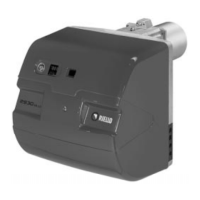



 To Next Page
 General