ARBOTOM
®
- Manual 47
Mechanic Graph
Please note: The Mechanic Graph is only available if this module is
unlocked. An instruction how to unlock the module can be
found on page 39 in this handbook.
Concept
Stability of trees, and especially their strength, is not only affected by wood
quality, but also by its geometrical form. Compared to a circular cross-section
form, an elliptical cross-section can bear different loads, depending on the
direction of force. You can compare this to a board which can bear a higher load
on its narrow side than on its broad side.
In civil engineering, this effect is described as the ‘moment of resistance’. It
varies depending on the sample form and the direction of load:
M
=
σ
A large moment of resistance is therefore an indicator of the tree’s great ability
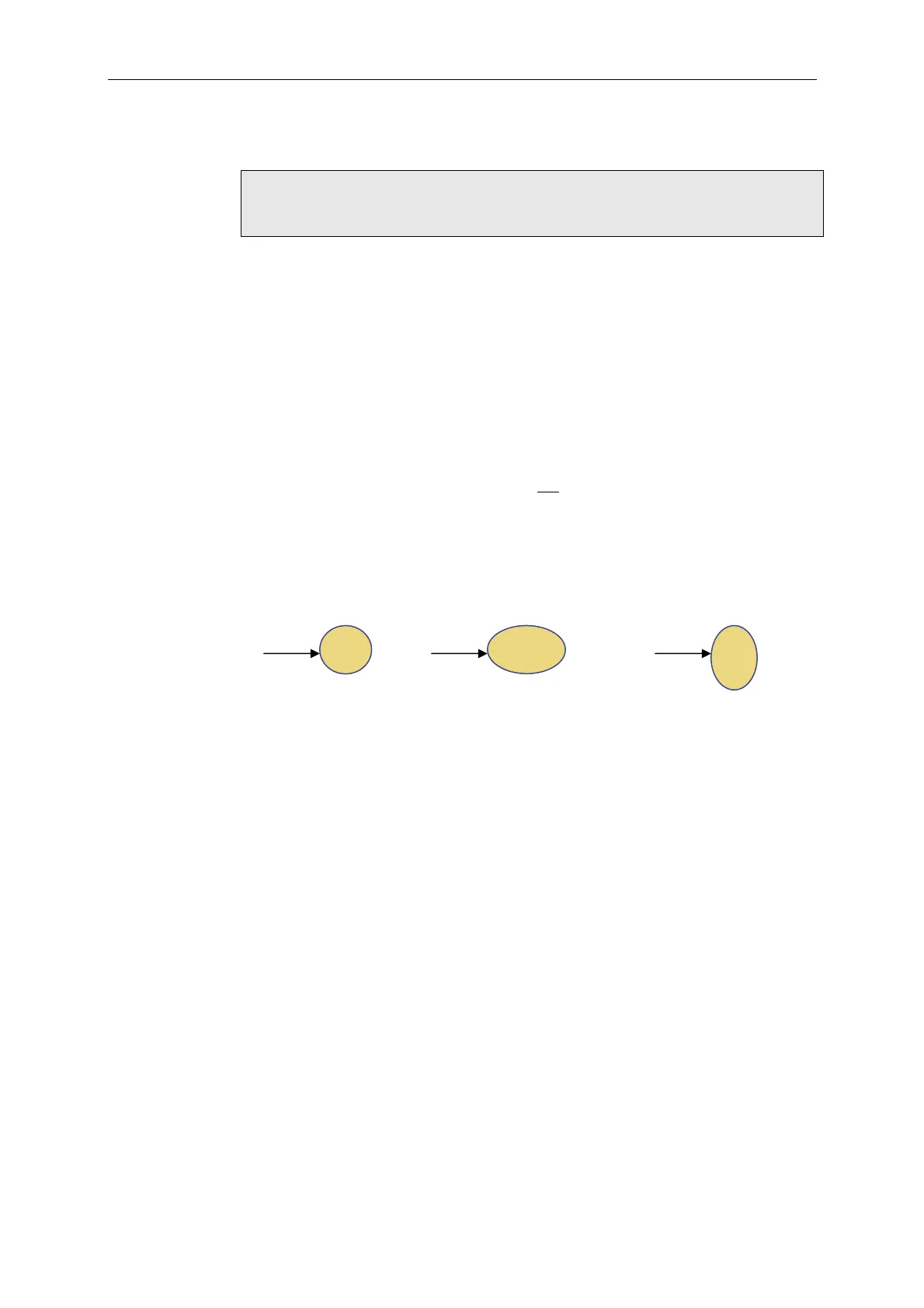
to resist heavy wind loads. The following image shows the effect of stem
geometry on resulting bending stress σ at constant wind load F:
Internal decay reduces the cross-sectional area of the trunk or branch, and
therefore reduces the moment of resistance. If the decay reaches 50% of the
radius, the resulting bending stress is hardly affected. At 30% residual wall
thickness, the stress of the outer fibers will be raised by almost one third. At 10%
residual wall thickness, the stress reaches 3 times the amount appearing in the
sound trunk at the same load. In trees with non-circular cross-sections, the
calculation becomes even more complex. It must be mentioned that we are
talking here about relative changes only. The absolute bending stress can only be
calculated if the bending moment, thus the amount and height of wind load is
known.
In the practice of tree assessment, this means that trunk form, as well as the
precise form and location of decay must be known to evaluate the hazard safety .
The ARBOTOM
®
Mechanic Graph is based on this concept. It enables the
assessment and visual presentation of the relative moment of resistance for trees
with any cross-sectional geometry. Decayed areas are taken into consideration as
well as the different tension and compression strength of wood (the compression
strength is half the tension strength of wood in average).



 To Next Page