Need help?
Do you have a question about the Roland FC-300 and is the answer not in the manual?
Explains the meaning of warning and caution labels used in the manual for safety.
Explains the meaning of symbols used for instructions, warnings, and prohibitions.
Provides crucial safety precautions for operating the unit to prevent hazards.
Further cautions regarding electrical safety, handling, environmental factors, and battery use.
Guidelines for using AC adaptors and batteries for power supply, including recommendations.
Recommendations for positioning the unit to ensure proper operation and prevent damage.
Instructions for cleaning and general maintenance of the unit to ensure longevity.
Information regarding data loss during repairs and recommendations for backing up important data.
Further safety advice, handling tips for pedals, cables, and general operational guidelines.
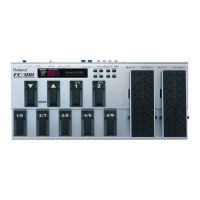
Overview of the FC-300's key capabilities, modes, and connectivity options.
Explanation of the unit's liquid crystal display (LCD) and mode indicators.
Details of the FC-300's top panel button layout and their respective functions.
Description of the FC-300's expression and control pedals, including their indicators.
Explanation of the various connectors and ports found on the FC-300's rear panel.
Details on connecting the FC-300 as a MIDI foot controller to external devices.
Step-by-step guide for installing batteries into the FC-300 for portable operation.
Instructions on how to properly connect the AC adaptor for continuous power supply.
Connecting the FC-300 as a dedicated controller for RRC2 IN devices like the VG-99.
Procedure for turning the FC-300 on and off when used as a MIDI foot controller.
Procedure for turning the FC-300 on and off when connected to RRC2 IN devices.
Mode for sending Program Change and Control Change messages with pedal assignments.
Mode for sending Control Change messages and managing pedal settings.
Mode for transmitting and receiving System Exclusive messages for device control.
Mode for storing and transmitting groups of MIDI messages as patches.
Explains the different methods to switch between the FC-300's operating modes.
Describes the indicators that show the currently selected operating mode on the display.
How to send Program Change messages using pedals in Standard Mode.
Configuring how pedal operations trigger tone changes based on settings.
How to send Control Change messages using expression and control pedals.
Connecting and using external pedals for transmitting MIDI messages.
Factory default Controller Number assignments for the FC-300's pedals.
How to customize pedal assignments, ranges, and modes for various functions.
Overview of the mode for sending Control Change messages and managing pedal settings.
How to send Control Change messages using various pedals in this mode.
Using number pedals to transmit Control Change messages.
How the up/down pedals affect number pedal functions and selection.
How expression pedals transmit Control Change messages based on their movement.
How control pedals and switches transmit Control Change messages.
Connecting and using external footswitches and expression pedals for control.
Factory default Controller Number assignments for the FC-300's pedals.
How to customize pedal assignments, MIDI messages, and ranges.
How to save customized pedal configurations as pedal settings for later recall.
How to quickly switch between stored pedal settings.
How to remove stored pedal settings from the FC-300's memory.
Explains the mode for transmitting and receiving System Exclusive messages for device control.
Overview of the mode for storing and transmitting groups of MIDI messages as patches.
Defines a patch as a configurable unit of MIDI messages and settings.
How to transmit Control Change messages using pedals in Patch Mode.
Connecting and using external pedals for transmitting MIDI messages in Patch Mode.
Factory default MIDI controller assignments for pedals in Patch Mode.
How to transmit the MIDI messages saved within a selected patch.
How to set parameters like ON/OFF streams, amp control, and patch names.
How to add, delete, or modify MIDI messages within a patch stream.
How to copy or move MIDI messages within a stream for programming.
How to copy an edited stream to a different patch or stream.
How to remove MIDI streams from patches.
Configuring when OFF MIDI streams are transmitted relative to patch changes.
Configuring AMP CONTROL jack behavior when patches are selected.
Customizing ON/OFF streams, assign numbers, MIDI channels, and messages for pedals.
How to assign a descriptive name to a patch for easy identification.
How to save created patches to the FC-300's internal memory.
How to remove entire patches from the FC-300's memory.
General procedure for setting system parameters like LCD contrast and economy mode.
How to adjust the brightness and readability of the LCD display.
Enabling economy mode to extend battery life when using battery power.
Configuring Program Change transmission methods in Standard Mode (PC Mode).
Using up/down pedals to adjust settings like bank change mode.
Setting an upper limit on switchable banks for patch selection.
Adjusting the increment/decrement step size for bank and number pedals.
Selecting how numbers are displayed in Standard Mode (LINEAR, BANK&NUM, FC-200).
Configuring polarity for AMP CONTROL jacks to match amp indicators.
Specifying if EXP PEDAL/CTL jacks function as expression or control pedals.
Customizing which modes can be selected via the MODE pedal.
Configuring pedal indicators to flash or remain off for better visibility.
Configuring the MIDI channel for outgoing messages.
Configuring the Device ID for System Exclusive messages.
Determining whether Bank Select messages are transmitted with Program Changes.
Adjusting Bank Select message values for connected devices.
Sending FC-300 settings to external devices using System Exclusive messages.
Loading settings from external devices into the FC-300.
Procedure to reset all FC-300 settings to their original factory defaults.
Calibrating expression pedals for optimal performance and sensitivity.
Explains common error messages and their potential causes and solutions.
Provides solutions for common operational problems and issues.
Details on Roland's System Exclusive message format, structure, and commands.
Information on MIDI messages the FC-300 receives and transmits.
How to transfer data between FC-300 and other devices using System Exclusive.
Mapping of FC-300 parameters and detailed status information for System Exclusive messages.
Lists the various connectors and controls available on the FC-300.
Details on the LCD display, mode indicators, and pedal indicators.
Specifications for power supply options and expected battery life.
Physical characteristics, weight, and included accessories.
 Materials
| front cloth material | Nylon |
|---|---|
| inside core material | polyurethane |
 Weight and Dimensions
| dimensions | 585 (W) x 210 (D) x 280 (H) mm 23-1/16 (W) x 8-5/16 (D) x 11-1/16 (H) inches |
|---|---|
| weight | 1240 g / 2 lbs 12 oz |

 To Next Page