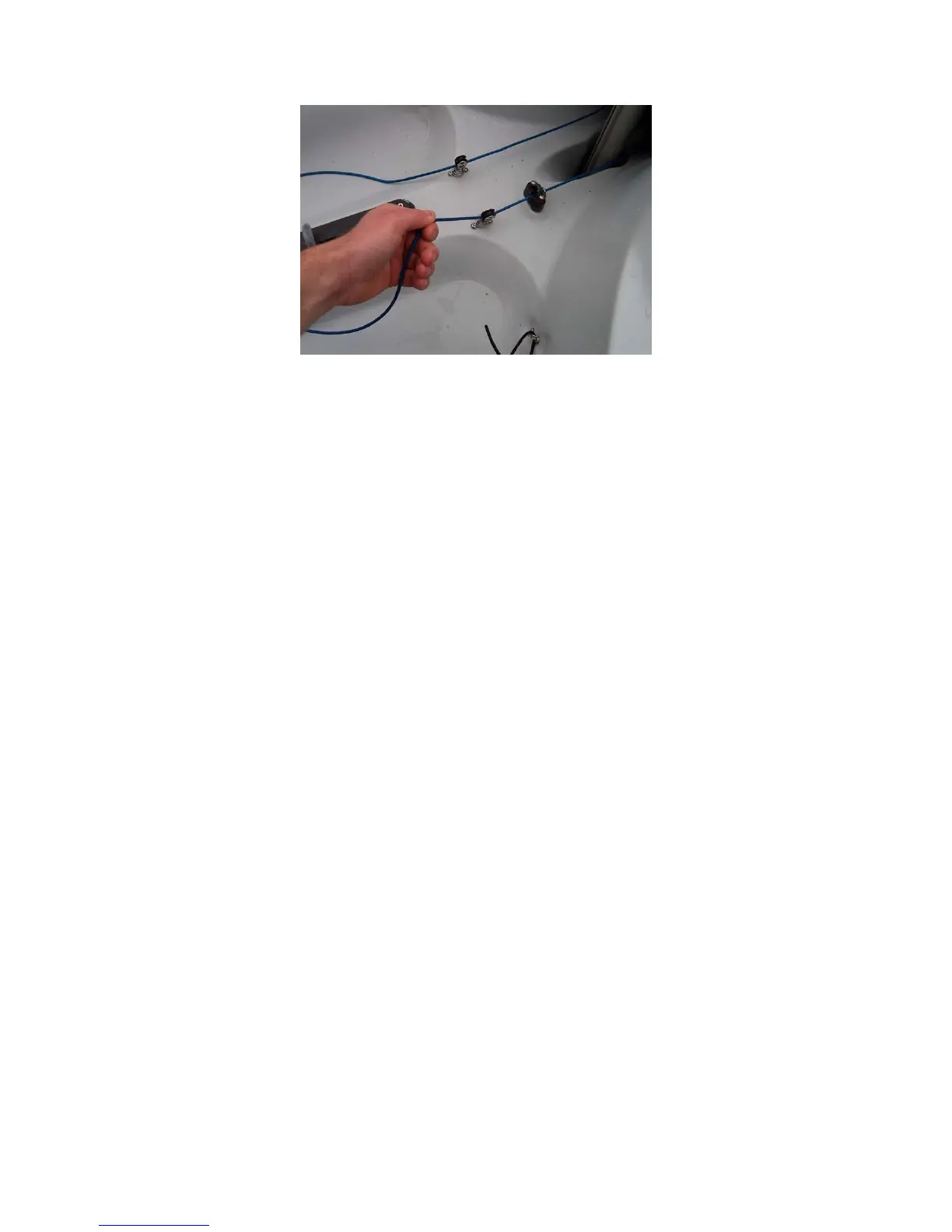
Picture 5.1 Hoisting the Gennaker
The gennaker halyard pulls the bowsprit out at the same time – when the gennaker
is hoisted, you are ready to go. The crew, or the helm if sailing
singlehanded, should now pull gently on the leeward gennaker sheet until the
gennaker has filled.
Gennakers may be effectively used from a close reach to a broad reach so, to get
downwind, one should become adept at gybing. It is not possible to tack with the
gennaker hoisted. For the best effect, the gennaker sheet should always be eased
as far as possible, so that the luff is just on the point of curling.
Gybing with the gennaker is fairly straightforward. Like the jib, it should be pulled
across at the same time as the mainsail comes across. As soon as it has been
pulled in and filled with wind, it should again be immediately eased for maximum
efficiency and speed. If sailing singlehanded, the mainsail should be cleated, and
the helm should hold the gennaker sheet at all times.
To drop the gennaker, reverse the procedure used to hoist. The boat should be
sailing on a broad reach, and the slack in the gennaker downhaul is pulled in from
the left hand halyard block (see picture 5.2). As the gennaker downhaul goes tight,
the gennaker halyard should be popped out of the cleat. Then, pull the remainder of
the gennaker downhaul through until the gennaker is pulled sharply into the chute.
Dropping the gennaker on tighter reaches
is harder, and requires more effort on the
gennaker downhaul. If possible, this should be avoided when sailing singlehanded.


 To Next Page