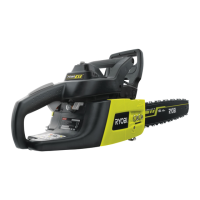
1. Place the chainsaw on level ground and ensure that
no objects or obstructions are in the immediate vicinity
that could come in contact with the bar and chain.
2. Hold the front handle rmly with your left hand and put
your right foot onto the base of the rear handle. Do not
drop start the chainsaw as injury may result.
1. Turn on the ignition switch.
2. Make sure the chain brake is in the run position by
pulling back on the lever/hand guard.
3. Fully press and release the primer bulb at least 7
times.
4. Pull choke lever all the way out to START position.
5. When the temperature is above 10°C, pull the starter
grip until the engine attempts to start, but no more than
3 times. When the temperature is below 10°C, pull the
starter grip until the engine attempts to start, but no
more than 5 times.
6. Push choke lever to RUN position. Pull starter grip until
engine runs.
Note: Allow the saw to run in this position 15-30
seconds, depending upon the temperature.
7. Depress the trigger release and squeeze and release
the throttle trigger to return the engine to idle after a
total run time of at least 30 seconds.
1. Turn on the ignition switch.
2. Make sure the chain brake is in the run position by
pulling back on the lever/hand guard.
3. Pull choke lever all the way out and then return to the
run position. This will engage the fast idle.
4. Pull starter grip until engine runs, but no more than 5
times. If engine does not start after 5 pulls, use cold
engine starting procedure.
5. When the engine starts, squeeze and release the
throttle trigger to disengage the fast idle and return the
engine to its normal idle.
See Figures 7 and 14.
See Figure 15.
n If the engine starts, runs, and accelerates, but will
not idle, turn the idle speed screw “T” clockwise to
increase idle speed.
n If the chain turns at idle, turn the idle speed screw “T”
counterclockwise to reduce the idle RPM and stop
the chain movement. If the saw chain still moves at
idle speed, contact an authorised service centre for
adjustment and discontinue use until the repair is
made.
See Figure 16.
See Figures 17 - 18.
See Figure 19.
General Safety Rules
n
n



 To Next Page