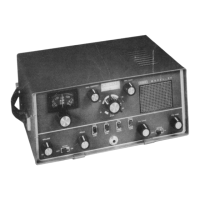
SBE SB-36 OPERATION MANUAL
5. 3 RECEIVER CIRCUITRY
5.3.1 Receiver Signal Path
RF signals from the antenna connector pass through the antenna relay
and trap coil L-24 to the grid of 1st, the first RF amplifier. Trap Coil L-24
minimizes spurious receiver response caused by signals which fall
within the 9 MHz IF frequency range. The amplified signal from V-4 is
coupled to the grid of V-3, the receiver mixer tube. Signals present in V-
3 consist of the incoming RF signal and the VFO/HFO mixture from TR-
11.
The output of V-3 is a 9 MHz IF signal which is coupled to either the
upper or lower crystal filter through transformer T-9A. Output of the
crystal filter is then coupled to TR-7, TR-28, TR-27 and TR-i6 which are
all 9 MHz IF amplifiers. The output of TR-26 is coupled to both the
receiver balance protector circuit and the receiver AGG circuit.
The 9 MHz output of the TR-26 is also coupled to Diodes D-18 through
D-21, the receiver balanced detector. The audio output of the balanced
detector is then applied to VR-509, the AF gain control. The audio
signal front the wiper of VR-9 is routed to the audio printed circuit board
where it is coupled to the base of TR-25. The output cf TR-25 drives
TR-22 and TR-23 the AF power amplifier transistors.
The resultant audio output from TR-22 and TR-23 is applied to the
earphone jack, speaker jack and telephone patch out jack.
5.3.2 Noise Blanker
The noise blanker circuit utilized in the SB-36 Transceiver receives
noise information directly from the antenna connector. The incoming
noise signal is amplified by integrated circuit TR-8 detected by Diodes
D-205 and D-206 and coupled to the gate of TR-7 to inhibit the received
signal from passing through
TR-7 during the presence of strong RF noise pulses.
5.3.3 Automatic Gain Control
Automatic Gain Control (AGC) is employed in the SB-36 Transceiver to
maintain a constant receive signal level passing through the front end
and IF Amplifier Board. The AGC circuitry can be completely disabled
by switching the front panel "AGC" control to the "OFF" position.
NoobowSystems Lab. Tomioka, Japan 2003 http://www.noobowsystems.com/ Page 23 / 56



 To Next Page