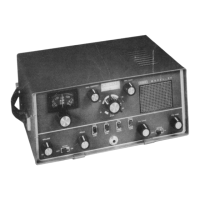
SBE SB-36 OPERATION MANUAL
speaker (which is also heard by the microphone) from keying the
transceiver. The output of transistor TR-13A, a DC potential derived
from Diodes D-14 and D-15, is applied to the base of the Darlington pair
transistors TR-14 and TR-15.
When the VOX SENSE and ANTI- TRIP controls are properly set, audio
from the transceiver speaker, which is also picked up by the
transceivers microphone, will produce opposite voltages at the base of
transistor TR-14 which will cancel each other so that the stage remains
cut off. Any speech then applied to the microphone will cause the stage
to conduct.
5.3.5 Frequency Mixing Network
The basic concept of the frequency mixing employed in the SB-36
Transceivers is show in Table 5.1.
Table 5.1 shows the relationship of the 9 MHz carrier oscillator, VFO
and HFO outputs for the various bands used in the SB-36 Transceiver.
TABLE 5.1 SB-36 FREQUENCY CHART
Band Mode Output Frequency BFO
Freq.
VFO Freq. HFO
Freq.
(MHz) (kHz) (kHz) (kHz) (kHz)
3.5 CW 3500 - 4000 9000 5000 - 5500 ---
7.0 CW 7000 - 7500 9000 5000 - 5500 21500
14.0 CW 14000 - 14500 9000 5000 - 5500 28500
21.0 CW 21000 - 21500 9000 5000 - 5500 35500
28.0 CW 28000 - 28500 9000 5000 - 5500 42500
28.5 CW 28500 - 29000 9000 5000 - 5500 43000
29.0 CW 29000 - 29500 9000 5000 - 5500 43500
29.5 CW 29500 - 30000 9000 5000 - 5500 44000
5.3.5.1 Carrier Oscillator
The Carrier Oscillator is a crystal controlled oscillator operating at 9.000
MHz. The output of the 9 MHz oscillator transistor TR-17 is coupled to
transmitter buffer transistor TR-19 and receiver buffer transistor TR-20.
The output of the transmitter buffer transistor TR-19 is applied via the
mode switch to the wiper arm of BR-5 located in the transmit balanced
modulator circuitry.
NoobowSystems Lab. Tomioka, Japan 2003 http://www.noobowsystems.com/ Page 25 / 56



 To Next Page