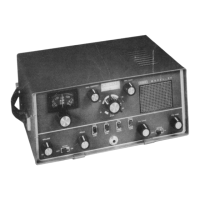
SBE SB-36 OPERATION MANUAL
and various modes. Perform a visual check for damaged wires,
electrical and mechanical parts, and printed circuit boards. Check for
loose interconnection between printed circuit boards.
D. Check individual parts.
The following procedure describes the method of checking individual
parts. Parts which are soldered in place are best checked by
disconnecting one end. This isolates the measurements from the effects
of surrounding circuitry.
(1) Transistors and Integrated circuits.
The best check of operation is actual performance under operating
conditions. If a part is suspected of being defective, it can best be
checked by substituting a new part or one which has been checked
previously. However, be sure that circuit conditions are not such that a
replacement might also be damaged.
(2) Diodes.
A Diode can be checked for open or shorted conditions by measuring
the resistance between terminals. With an ohm meter scale having an
internal source of between 800 millivolts and 3 volts, the resistance
should be very high in one direction and very low when the leads are
reversed.
(3) Resistors.
Check the resistors with an ohm meter. check the electrical parts list for
the tolerance of the resistor used in the instrument. Resistors do not
nominally need to be replaced unless the measured value varies widely
from the specified value.
(4) Inductors.
Check for open inductors by checking continuity with an ohm meter.
Shorted or partially shorted inductors can easily be found by checking
the wave form response when high frequency signals are passed
through the circuit. Partially shorting often reduces high frequency
response (roll-off).
(5) Capacitors.
A leaky or shorted capacitor can best be detected by checking
resistance with an ohm meter on high scale. Do not exceed the voltage
reading of the capacitor. The resistance reading should be high after
initial charge of the capacitor. An open capacitor' can best be detected
NoobowSystems Lab. Tomioka, Japan 2003 http://www.noobowsystems.com/ Page 32 / 56



 To Next Page