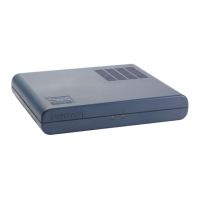
Watson SHDSL Router
Operating Manual
Watson-SHDSL-Router-Manual.doc
Version 1.0-03
There are numerous services that should be considered blocking, such as online games and file
sharing servers. For example, the firewall can be configured to block certain P2P and file sharing
applications not to put business at risk from illegally traded copyright files.
3.2.2 Port Forwarding
In its default state, Watson SHDSL router blocks all external users from connecting to or communi-
cating with the local network. Therefore the system is safe from hackers who may try to intrude on
the network and damage it. However, you may want to expose your local network to the Internet in
certain limited and controlled ways in order to enable some applications to work from the LAN and
to enable Internet-access to servers in the LAN. The Port Forwarding feature supports both of these
functionalities.
For example, if you want to use a File Transfer Protocol (FTP) application on one of your PCs, you
would simply select 'FTP' from the list and enter the local IP address or host name of the desig-
nated computer. All FTP-related data arriving at Watson SHDSL router from the Internet will hence-
forth be forwarded to the specified computer.
Similarly, you can grant Internet users access to servers inside your local network, by identifying
each service and the PC that will provide it. This is useful, for example, if you want to host a Web
server inside your local network. When an Internet user points his/her browser to Watson SHDSL
router external IP address, the router will forward the incoming HTTP request to your Web server.
With one external IP address (Watson SHDSL router main IP address), different applications can
be assigned to the LAN computers, however each type of application is limited to use one com-
puter. For example, you can define that FTP will use address X to reach computer A and Telnet will
also use address X to reach computer A, but attempting to define FTP to use address X to reach
both computer A and B will fail. Watson SHDSL router therefore provides the ability to add addi-
tional public IP addresses to port forwarding rules, and enter into the 'NAT IP Addresses Pool'. You
will then be able to define FTP to use address X to reach computer A and address Y to reach com-
puter B.
Additionally, port forwarding enables you to redirect traffic to a different port instead of the one to
which it was designated. Lets say, that you have a Web server running on your PC on port 8080
and you want to grant access to this server to anyone who accesses Watson SHDSL router via
HTTP. To accomplish this, do the following:
Define a port forwarding rule for the HTTP service, with the PC's IP or host name.
Specify 8080 in the 'Forward to Port' field.
All incoming HTTP traffic will now be forwarded to the PC running the Web server on port
8080.
When setting a port forwarding service, you must ensure that the port is not already in use by an-
other application, which may stop functioning.
Note: Some applications, such as FTP, TFTP, PPTP and H323, require the support of special spe-
cific Application Level Gateway (ALG) modules in order to work inside the local network. Data
packets associated with these applications contain information that allows them to be routed cor-
rectly. An ALG is needed to handle these packets and ensure that they reach their intended desti-
nations. Watson SHDSL router is equipped with a robust list of ALG modules in order to enable
maximum functionality in the local network.
The ALG is automatically assigned based on the destination port.
3-4 Revision: 2007-05-24


 To Next Page